How to Design Effective AI Agent Patterns
TL;DR
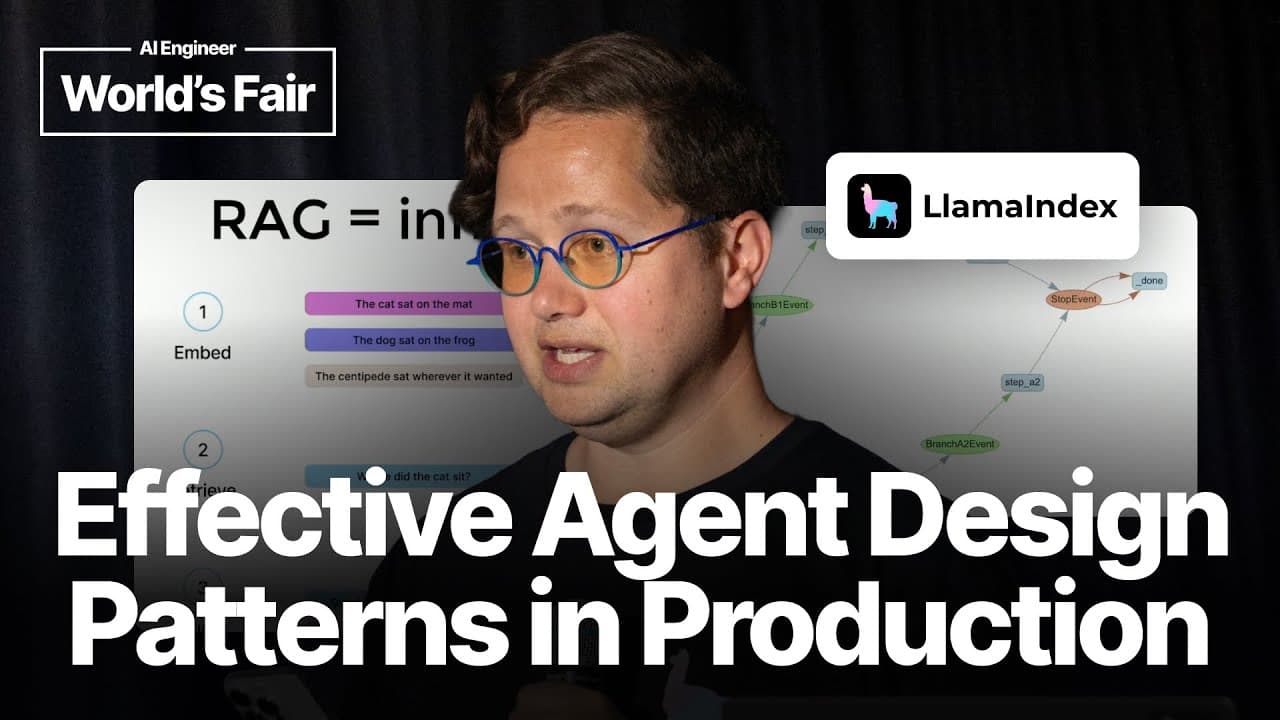
Effective AI agents require structured design patterns to enhance performance and accuracy. LlamaIndex offers a framework for building generative AI applications, focusing on agents and retrieval-augmented generation. Key patterns such as chaining, routing, and parallelization improve agent functionality, making them suitable for handling unstructured data efficiently.
Transcript
uh hi everybody uh you probably met me this morning uh when I greeted you all to the conference my name is Lori i'm VP of developer relations at Llama Index uh today I'm going to be talking about Llama Index and what it is uh very briefly because I've only got 15 minutes uh and then we're going to talk about agents and how they are built plus a ver... Read More
Key Insights
- LlamaIndex is a framework in Python and Typescript for building generative AI applications, particularly effective for agents.
- Llama Parse is a service that improves agent quality by parsing complex document formats like PDFs and Word documents.
- Llama Cloud is an enterprise service for document retrieval, available as SaaS or private cloud deployment.
- Agents are semi-autonomous software capable of using tools to achieve goals without explicit step-by-step instructions.
- Retrieval-augmented generation (RAG) is crucial for agents, enabling efficient data handling and context-specific responses.
- Key design patterns for agents include chaining, routing, parallelization, and orchestrator-worker models.
- Parallelization reduces hallucination by using multiple LLMs to process queries and aggregate results.
- Evaluator-optimizer patterns enable self-reflection, allowing agents to assess and improve their own outputs.
Install to Summarize YouTube Videos and Get Transcripts
Explore YouTube Video Summarizer or Get YouTube Transcript Extractor
Questions & Answers
Q: How does LlamaIndex improve AI agent design?
LlamaIndex enhances AI agent design by providing a framework that facilitates the development of generative AI applications. It offers tools like Llama Parse for parsing complex documents and Llama Cloud for document retrieval. The framework supports various design patterns, such as chaining and parallelization, which improve agent performance by enabling efficient data handling and context-specific responses.
Q: What is the role of retrieval-augmented generation in AI agents?
Retrieval-augmented generation (RAG) plays a critical role in AI agents by enabling efficient data handling and context-specific responses. RAG involves embedding data into vectors, allowing agents to retrieve relevant context from a large corpus of data. This process ensures that agents can provide accurate answers without the need to process all data every time, reducing computational costs and improving response speed.
Q: What are the key design patterns for effective AI agents?
Key design patterns for effective AI agents include chaining, routing, parallelization, and orchestrator-worker models. Chaining involves passing outputs from one LLM to another, while routing allows decision-making between different tools. Parallelization reduces hallucination by processing queries through multiple LLMs. Orchestrator-worker models break complex tasks into simpler questions, enabling efficient parallel processing and aggregation of results.
Q: How does parallelization enhance AI agent performance?
Parallelization enhances AI agent performance by allowing multiple LLMs to process the same query concurrently. This approach reduces hallucination by comparing results from different LLMs, ensuring more accurate outputs. Parallelization can involve sectioning, where different aspects of a query are processed simultaneously, or voting, where results from multiple LLMs are aggregated to reach a consensus, thus improving reliability and accuracy.
Q: Why is the evaluator-optimizer pattern important for AI agents?
The evaluator-optimizer pattern is important for AI agents because it enables self-reflection, allowing agents to assess and improve their own outputs. This pattern involves using an LLM to evaluate whether the generated response meets the original goal. If not, feedback is generated, and the agent revisits the initial steps to refine its output. This iterative process enhances the accuracy and reliability of the agent's responses.
Q: What is the purpose of Llama Parse in AI agent development?
Llama Parse serves a crucial purpose in AI agent development by improving the quality of agents through effective data parsing. It processes complex document formats like PDFs and Word documents, making unstructured data more accessible to LLMs. By enhancing data readability, Llama Parse ensures that agents can understand and utilize information more effectively, leading to better performance and more accurate outputs.
Q: How do agents differ from traditional programming?
Agents differ from traditional programming by being semi-autonomous and capable of using tools to achieve goals without explicit step-by-step instructions. Unlike traditional software, which follows predefined logic, agents have decision-making power, allowing them to handle unexpected scenarios and unstructured data flexibly. This adaptability makes agents particularly useful in applications where the ability to process and summarize large volumes of text is required.
Q: What is the significance of unstructured data in AI agent applications?
Unstructured data is significant in AI agent applications because it represents a vast amount of information that needs to be processed efficiently. Agents excel at handling unstructured data, using LLMs to transform it into structured, actionable insights. This capability is crucial for applications like document summarization, contract interpretation, and report generation, where large volumes of text must be condensed into meaningful outputs.
Summary & Key Takeaways
-
LlamaIndex provides a robust framework for building AI agents, emphasizing the importance of structured design patterns. These patterns, such as chaining and parallelization, enhance agent capabilities, making them suitable for processing unstructured data efficiently. The use of RAG further optimizes data handling, enabling agents to deliver accurate, context-specific responses.
-
The presentation highlights the necessity of using design patterns like routing and orchestrator-worker models to improve agent performance. These patterns allow agents to handle complex tasks by breaking them into simpler questions and processing them in parallel, ultimately leading to more accurate and reliable outputs.
-
Laurie Voss discusses the benefits of using LlamaIndex for developing AI agents, focusing on the framework's ability to integrate various tools and services. The talk emphasizes the flexibility and power of agents in handling unexpected scenarios, particularly when dealing with large volumes of unstructured data.
Read in Other Languages (beta)
Share This Summary 📚
Summarize YouTube Videos and Get Video Transcripts with 1-Click
Try YouTube Summary with ChatGPT & Claude or YouTube Transcript Generator
Explore More Summaries from AI Engineer 📚




Summarize YouTube Videos and Get Video Transcripts with 1-Click
Try YouTube Summary with ChatGPT & Claude or YouTube Transcript Generator