How Does Barry Zhang of Anthropic Build Effective AI Agents?
TL;DR
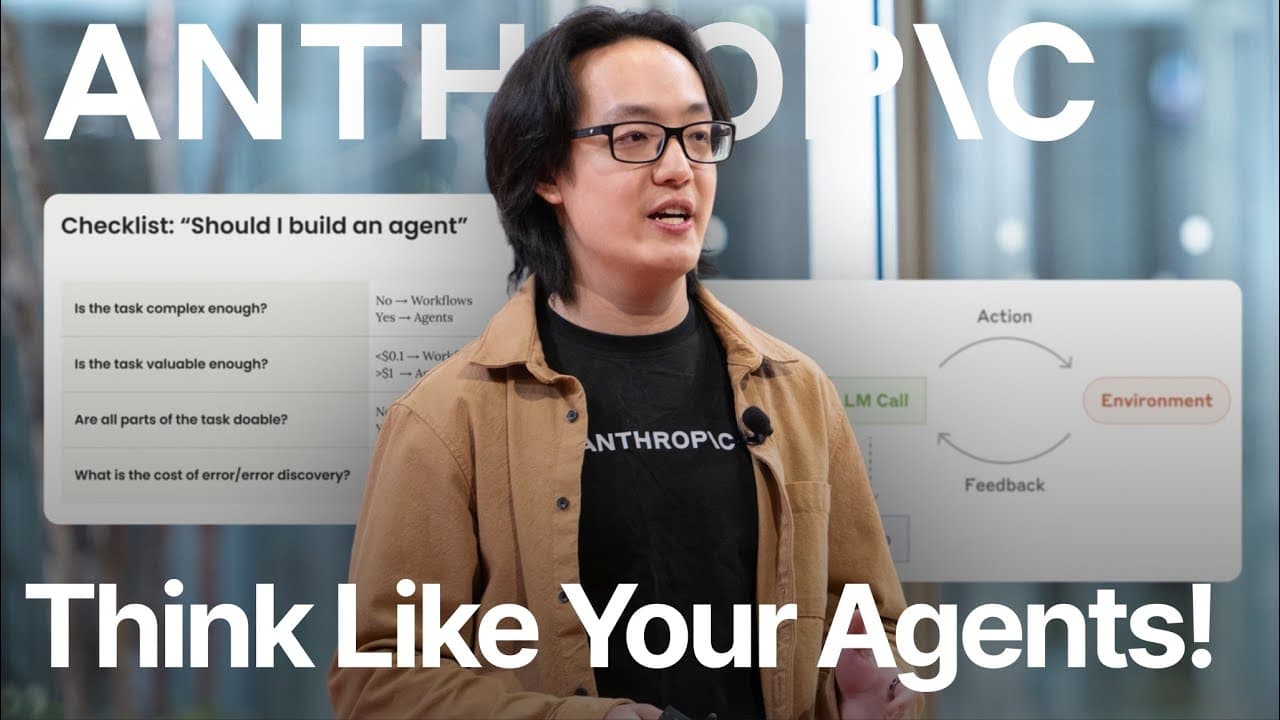
Effective AI agents are built by choosing complex, valuable tasks with manageable errors, then keeping the design simple enough to iterate quickly. Barry Zhang describes an agent as a model using tools in a loop, shaped by its environment, tools, and system prompt. Workflows are often better when decisions can be mapped explicitly or costs must stay controlled. Read on for the complete use-case checklist and practical design principles.
Transcript
Wow, it's uh incredible to be on the same stage as uh so many people I've learned so much from. Let's get into it. My name is Barry and today we're going to be talking about how we build effective agents. About two months ago, Eric and I wrote a blog post called Building Effective Agents. In there, we shared some opinionated take on what an agent i... Read More
Key Insights
- Agents should be built for complex and valuable tasks, not as a default solution for every problem.
- Workflows are a practical and cost-effective way to handle common scenarios without the need for agents.
- Simplicity in agent design is crucial for fast iteration and optimization.
- Understanding the agent's perspective helps in bridging the gap between human expectations and agent behavior.
- Budget awareness is essential for managing the cost and latency of agent operations.
- Self-evolving tools can make agents more adaptable and general-purpose.
- Multi-agent collaboration may enhance efficiency and protect the main agent's context window.
- Effective communication between agents is necessary for successful multi-agent systems.
Install to Summarize YouTube Videos and Get Transcripts
Explore YouTube Video Summarizer or Get YouTube Transcript Extractor
Questions & Answers
Q: When should you build an AI agent instead of a workflow?
Build an agent when the task is ambiguous, complex, and valuable enough to justify higher token costs and latency. If you can easily map the full decision tree, Barry Zhang recommends implementing it explicitly as a workflow for greater control and cost-effectiveness.
Q: What checklist does Barry Zhang use to evaluate an AI agent use case?
Consider the task’s complexity and value, then test whether the agent has any critical capability bottlenecks. Also assess the cost of errors and how easily those errors can be discovered before giving the agent more autonomy.
Q: Why shouldn’t developers build agents for every use case?
Agents can choose their own trajectory from environmental feedback, which makes them useful for ambiguous work but also raises costs, latency, and the consequences of errors. They should therefore scale complex, valuable tasks rather than serve as a drop-in upgrade for every application.
Q: Why are workflows sometimes better than AI agents?
Workflows orchestrate model calls through predefined control flows, providing more control over predictable tasks. For common scenarios or tasks with tight budgets, they can deliver much of the value more cost-effectively than an agent that explores its own path.
Q: What makes coding a strong use case for AI agents?
Moving from a design document to a pull request is an ambiguous, complex task with valuable output. Coding agents can also be evaluated through unit tests and continuous integration, making their results easier to verify.
Q: What are the core components of a simple AI agent?
Barry Zhang describes an agent as a model using tools in a loop. Its behavior is defined by the environment where it operates, the tools through which it acts and receives feedback, and the system prompt specifying its goals, constraints, and ideal behavior.
Q: Why should an AI agent’s design remain simple at first?
Upfront complexity slows iteration and makes agent behavior harder to refine. Starting with the environment, tools, and system prompt lets developers improve the basic loop before introducing additional complexity.
Q: How should developers handle capability bottlenecks and risky errors?
Test critical capabilities to ensure the agent can complete essential parts of its trajectory, such as writing, debugging, and recovering from errors in a coding task. If bottlenecks remain, reduce the scope or simplify the task; for risky or hard-to-detect errors, limit access or add human oversight.
Summary & Key Takeaways
-
Effective agents should be developed for tasks that are complex and valuable, not as a universal solution. Simplicity in design allows for better iteration and optimization. Understanding the agent's perspective is crucial for improving decision-making and performance.
-
Budget control, self-evolving tools, and multi-agent collaboration are key areas for future development in agentic systems. These factors will enable more efficient and adaptable agent operations.
-
Communication between agents is an important aspect to consider for successful multi-agent systems. Developing asynchronous communication methods could expand the capabilities of these systems.
Read in Other Languages (beta)
Share This Summary 📚
Summarize YouTube Videos and Get Video Transcripts with 1-Click
Try YouTube Summary with ChatGPT & Claude or YouTube Transcript Generator
Explore More Summaries from AI Engineer 📚



Summarize YouTube Videos and Get Video Transcripts with 1-Click
Try YouTube Summary with ChatGPT & Claude or YouTube Transcript Generator