How to Validate and Ship an App in 12 Hours
TL;DR
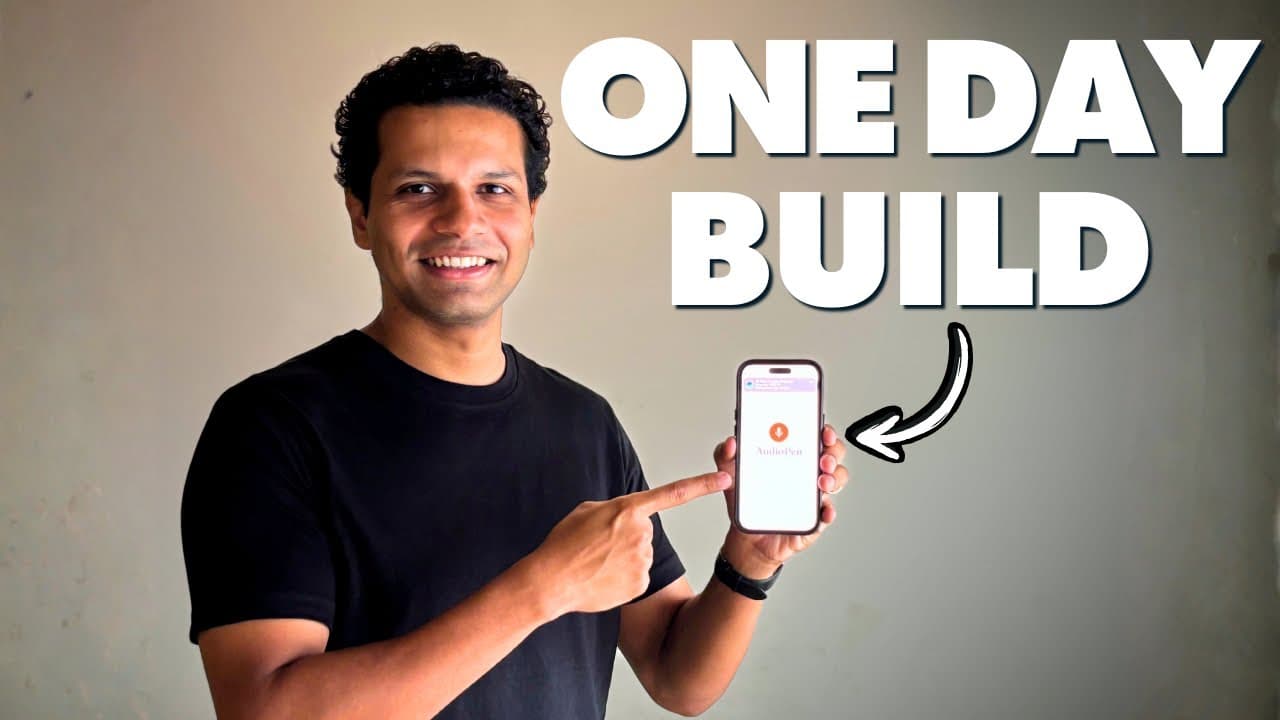
Build the smallest useful product quickly, share it publicly, and treat audience response as a signal for where to invest further effort. Louis Pereira turned AudioPen from a 12-hour MVP into a B2C SaaS product making about $15,000 per month by testing many ideas, talking to interested users, designing before building, launching early, and refining the product after validation.
Transcript
I'm a part-time indie hacker and I built the MVP of my app in just 12 hours. Meet Lewis, a dude from India who spent his nights and weekends building projects. But after failing with 15 of them, he decided he would try something different. I started building at noon and I wanted to know if I could take an idea all the way to revenue before midnight... Read More
Key Insights
- AudioPen is a B2C SaaS tool that records speech, transcribes it, and transforms the transcription into a chosen writing style. It works across languages and devices, helping users capture ideas, document meetings, and overcome writer's block.
- AudioPen's core MVP was built in about 12 hours during a Halfday Build hackathon. Participants began at noon and tried to move independently from an idea to an MVP and at least one dollar in revenue before midnight.
- Repeated experimentation increased the chance of finding a promising idea. Pereira built approximately 15 to 20 unsuccessful tools before AudioPen and created four or five small tools during the week when its MVP emerged as the one receiving exceptional interest.
- Early audience response served as the product's initial validation. Pereira shared his small tools on Twitter, noticed stronger enthusiasm for AudioPen, contacted interested people about their use cases, and designed a fuller product around the needs they described.
- Design is an important step before implementation because deciding how a product should look can take longer than expected. Pereira gathered visual inspiration from Pinterest, worked through the interface in Figma, and recommends sharing designs publicly to gather reactions before building.
- A waitlist can test demand before a product is complete. Pereira launched one roughly 10 hours into the hackathon, attracted advance signups, and then received unexpected Stripe payments from early beta testers who already had access and had not been asked to pay.
- Public credibility and community support can influence early purchasing decisions. Pereira attributed part of AudioPen's launch to his history of building publicly on Twitter, the anticipation created before release, and visible encouragement from members of the Halfday Build community.
- AudioPen's paid plans are sold for $99 for one year or $159 for two years. Both are non-recurring subscriptions, allowing customers to decide whether to renew, while a free version lets prospective users experience the product before purchasing.
Install to Summarize YouTube Videos and Get Transcripts
Explore YouTube Video Summarizer or Get YouTube Transcript Extractor
Questions & Answers
Q: How did Louis Pereira build and validate an app in 12 hours?
Pereira joined his own Halfday Build format, starting at noon with the goal of reaching an MVP and revenue by midnight. He had already noticed interest after sharing a tiny AudioPen prototype on Twitter. He gathered visual inspiration, designed the interface in Figma, built the core product, launched a waitlist around 10 hours in, and received unexpected payments from early testers before the 12-hour period ended.
Q: What is AudioPen and how does it work?
AudioPen is a B2C SaaS product that turns spoken thoughts into clearer written text. A user records speech, the app transcribes the recording, and then it transforms that transcription into a writing style selected by the user. It works across languages and is available on mobile and desktop. People use it for capturing ideas, recording meeting notes, and working through writer's block.
Q: Why did AudioPen succeed after Louis Pereira's earlier projects failed?
AudioPen addressed a need that Pereira did not initially know people had, and its early prototype received noticeably stronger interest than his other tools. His previous projects also gave him practice running small experiments and recognizing useful feedback. Additional factors included credibility from building publicly on Twitter, anticipation created before launch, and support from a community whose visible trust helped potential customers feel comfortable purchasing.
Q: How should indie hackers validate a product idea quickly?
Indie hackers can test several small ideas that are easy to discontinue without harming users, then share those experiments publicly and watch for unusually strong interest. When people respond positively, the builder should ask why they value the tool and what use cases matter to them. Designs can then be shared for further feedback, while a simple email list or Google form measures interest before the complete product launches.
Q: Why should founders design an app before building it?
Pereira recommends designing first because visual and interaction decisions can take longer than expected, even when AI tools make implementation fast. A founder should determine what the product should look like and why that presentation fits its purpose. Pereira used Pinterest for inspiration and Figma for design. Sharing those designs publicly can reveal what resonates with potential users before significant building work begins.
Q: What is the best first version of a product to launch?
The first release should be the simplest version that performs its expected job very well. Pereira argues that it does not need to look amazing at launch, but its core function must be useful. Founders can release early, observe whether people care, and refine the experience afterward. As the product improves and delivers more value, they can continue raising its price rather than delaying launch for polish.
Q: How did building in public help AudioPen gain customers?
Building in public gave Pereira an audience that could see his experiments, designs, and progress before AudioPen was complete. He had spent months or possibly years establishing credibility on Twitter, so potential customers already understood his work. Public anticipation created interest around the launch, while encouragement from the Halfday Build community provided visible social trust. Some users later said that following his journey was one reason they liked AudioPen.
Q: How much does AudioPen cost and how large is its user base?
AudioPen offers a free version that gives prospective customers a taste of the product. Its paid version costs $99 for one year or $159 for two years. These are non-recurring subscriptions, so customers control whether they renew when their term ends. According to Pereira, AudioPen has about 200,000 users, more than 5,000 paying customers, and currently generates about $15,000 per month.
Summary & Key Takeaways
-
Louis Pereira built AudioPen's core MVP during a 12-hour online hackathon after approximately 15 to 20 earlier projects had failed. He created several tiny tools, shared them on Twitter, and noticed that AudioPen received unusually strong interest. That response persuaded him to develop a complete version and add a price.
-
AudioPen converts spoken, unstructured thoughts into clearer text in a selected writing style. It works across languages and on mobile and desktop, supporting idea capture, meeting notes, and writer's block. The product has about 200,000 users, more than 5,000 paying customers, and generates about $15,000 monthly.
-
Pereira's playbook is to run inexpensive experiments, design before building, share designs and progress publicly, collect interested users through a simple email list, and launch the simplest version that performs its core job well. He recommends raising the price as the product improves and communicating honestly as an independent builder.
Read in Other Languages (beta)
Share This Summary 📚
Summarize YouTube Videos and Get Video Transcripts with 1-Click
Try YouTube Summary with ChatGPT & Claude or YouTube Transcript Generator
Explore More Summaries from Starter Story 📚

Summarize YouTube Videos and Get Video Transcripts with 1-Click
Try YouTube Summary with ChatGPT & Claude or YouTube Transcript Generator