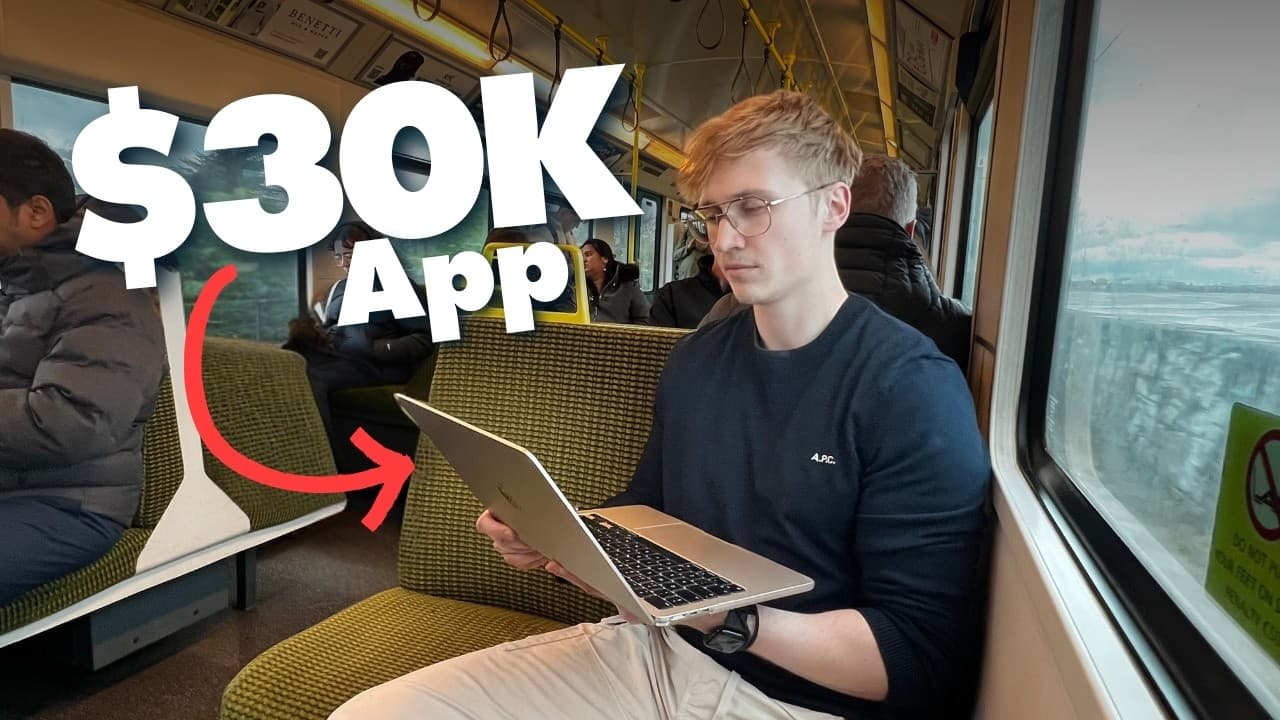
How Paulius Built a $30K AI App in 30 Days
TL;DR
Paulius used AI tools to build and launch a matching startups with influencers app, earning $30K with it and doing it solo. He explains using Bolt, Cursor, and Framer to create an MVP quickly, validating the idea before launch, and marketing by sharing progress publicly. The process emphasizes starting small with AI and shipping fast.
Transcript
i prompted my way to $30,000 without writing a single line of code this guy made $30,000 from an app he built on his morning commute how two tools Cursor and Bolt i think a lot of people make cool stuff with Bolt and Cursor nowadays but they don't monetize it because they need In this video we'll go over the wild story of how Polus just built launc... Read More
Key Insights
- AI enables rapid MVP construction with tools like Bolt and Cursor.
- Validation before launch is critical; early sales provide proof of demand.
- A clean, focused landing page and above the fold messaging accelerate conversions.
- Design quality comes from simple templates and fast iteration using Framer.
- Building in public can amplify reach by aligning with existing conversations.
- User onboarding and authentication are simplified with tooling like Clerk and Supabase.
- Marketing momentum can be driven by tweets that tap into current trends and debates.
- Idea validation and customer discovery should guide feature development and positioning.
- More videos from this channel:
- More from this channel: Starter Story
Install to Summarize YouTube Videos and Get Transcripts
Explore YouTube Video Summarizer or Get YouTube Transcript Extractor
Questions & Answers
Q: How did Paulius validate the app idea before launching
Paulius used an experimental mindset and built a database for creators and services with AI to create a fully fledged SaaS concept. He watched for early sign ups and sales after launch, noting that the initial validated payments helped confirm demand. Validation guided further refinements and marketing focus.
Q: What role did AI play in building the MVP
AI served as the core engine to accelerate development. Paulius used Perplexity for guided steps, Bolt to structure the MVP, Cursor to flesh out UI and back end, and Framer for design. This stack reduced manual coding, allowed rapid iteration, and helped reach a working product quickly.
Q: How did the marketing strategy contribute to traction
The marketing strategy leaned into building in public and timely tweets that align with industry discussions. A single post reached around 500k impressions, illustrating how joining trending conversations can amplify reach. Consistent, transparent updates helped potential customers understand the product and its value.
Q: What is the recommended workflow for beginners to build MVPs with AI
Begin with a guided AI resource like Perplexity to get step by step instructions, then apply Bolt to establish the MVP framework and Cursor to finalize details. Use Framer for design and Clerk or similar tools for authentication. Iterate quickly, address errors with AI, and keep the MVP minimal but functional.
Q: What design principles did Paulius emphasize for landing pages
Paulius emphasized focusing 80 percent of effort on the hero area above the fold. The headline and subheading should clearly state the value proposition, followed by a strong call to action. The page should communicate the problem being solved and the benefits succinctly to reduce user friction.
Q: How did Paulius handle UI UX design using AI
Paulius kept UI/UX clean, functional, and modern by asking AI to generate clean layouts and components. He used templates in Framer and refined with feedback. When needed, he drafted ideas in Figma and integrated them into Cursor, ensuring cohesive design and a smooth onboarding flow.
Q: What tech stack did Paulius use and what were costs like
The stack included Bolt for MVP building, Cursor for fine tuning, Framer for design, and back end integrations such as authentication. The talk highlights that this combination allowed him to build quickly and launch with a lean setup, though exact ongoing costs are not specified in the transcript.
Q: What lessons did Paulius share about entrepreneurship and AI
Key lessons include shipping often and building in public, validating with real user feedback, and focusing on solving a real problem. He stresses the importance of understanding customer needs, using AI to reduce manual work, and iterating based on market response rather than chasing fads.
Summary & Key Takeaways
-
Paulius built an app that connects startups with influencers using AI tools and launched it within months, achieving $30K in revenue with hundreds of paid users.
-
The build relied on a multi-tool stack including Bolt, Cursor, Framer, and Supabase style backends, showing a rapid MVP path from idea to product.
-
Marketing and product validation were essential, using public updates and a data driven approach via SEO and product discourse to gain traction.
Read in Other Languages (beta)
Share This Summary 📚
Summarize YouTube Videos and Get Video Transcripts with 1-Click
Try YouTube Summary with ChatGPT & Claude or YouTube Transcript Generator
Explore More Summaries from Starter Story 📚




Summarize YouTube Videos and Get Video Transcripts with 1-Click
Try YouTube Summary with ChatGPT & Claude or YouTube Transcript Generator