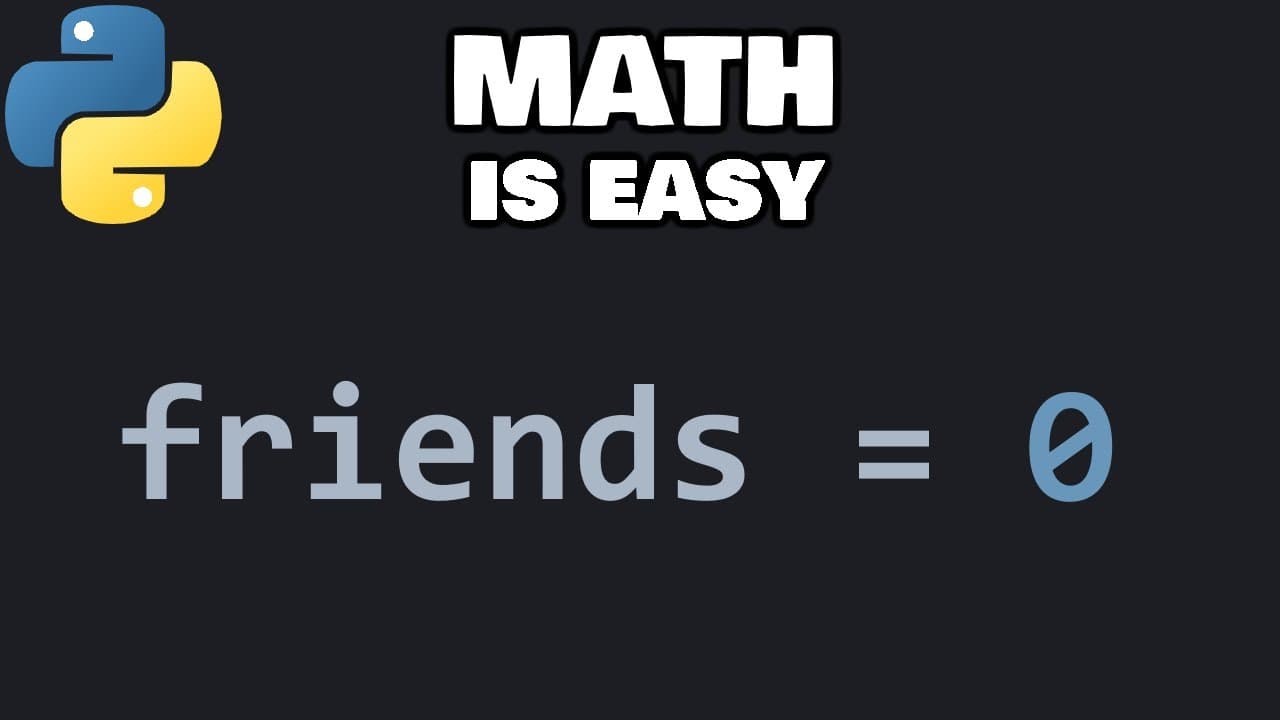
How to use Python math operators and the math module?
TL;DR
You can perform basic and advanced math in Python using operators, augmented forms, and functions from the math module. The video shows examples for addition, subtraction, multiplication, division, exponent, modulus, and functions like round, abs, pow, max, min, and math constants pi and e, plus practical exercises for circumference, circle area, and triangle hypotenuse.
Transcript
hey everybody in this video I'm going to show you all of the different math that we'll need throughout the rest of the series I have a lot to cover and I'll split this video into different sections we'll cover some basic arithmetic operators built-in math functions a few functions from the math module and then a few exercises be sure to look at the... Read More
Key Insights
- X is used to store a numeric value that can be updated with augmented assignment operators like +=, -=, *=, and /=, which shorten code and improve readability.
- The plus operator adds numbers, and its augmented form adds and reassigns in one step, making code concise.
- The modulus operator returns the remainder of a division, which helps determine odd or even numbers and groupings.
- Exponentiation computes powers by raising a base to a given exponent, with the augmented form combining multiplication and assignment.
- The built in abs function returns the absolute value, converting negative numbers to positive while leaving positives unchanged.
- The round function converts a number to an integer or to a specified number of decimal places, useful for controlling precision.
- The max and min functions compare multiple values and return the largest or smallest, respectively, guiding simple statistical checks.
- The math module provides constants like pi and e, and functions such as sqrt, ceil, and floor for more advanced mathematics.
Install to Summarize YouTube Videos and Get Transcripts
Explore YouTube Video Summarizer or Get YouTube Transcript Extractor
Questions & Answers
Q: What is augmented assignment in Python and why use it?
Augmented assignment in Python combines an operation with assignment in a single expression, such as +=, -=, *=, or /=, which updates a variable in place. This makes code shorter and often easier to read while clearly conveying that a value is being updated based on its prior value. It is especially useful in loops and when tallying counts or accumulators.
Q: How do you compute the circumference of a circle using Python?
To compute the circumference, you multiply 2 by pi and by the radius, using values from the math module for accuracy. The formula is 2 times pi times radius, and you typically cast user input to float to ensure decimal multiplication works. The result is then printed as a value with units if desired.
Q: How is the area of a circle calculated in Python shown in the video?
The area is calculated as pi times the radius squared. You can either square the radius with the power operator or use exponentiation, then multiply by pi from the math module. The value is printed, optionally formatted to a fixed number of decimal places for readability.
Q: What do the round and floor functions do in Python math usage?
The round function rounds a number to the nearest integer or to a specified number of decimal places, improving numerical presentation. The floor function always rounds down to the nearest integer, which is useful for truncating values below a threshold. Both are shown in context of circle calculations.
Q: What is the relation between sqrt and the Pythagorean theorem demonstration in the video?
The sqrt function computes the square root of the sum of squares, which is the core of calculating the hypotenuse in a right triangle. By squaring the two legs and adding them, then taking the square root, you obtain the length of the hypotenuse, illustrating a practical geometry application of Python math.
Q: Which constants from the math module are introduced and what are their uses?
Pi is introduced to represent the ratio of a circle’s circumference to its diameter, used in circumference and area calculations. E is presented as the exponential constant, though not used in depth in this video. These constants allow precise mathematical expressions beyond simple arithmetic.
Q: What practical exercises are used to demonstrate the math skills?
The exercises include calculating the circumference of a circle, computing the circle area, and finding the hypotenuse of a right triangle. Each exercise relies on user input, type casting to float, and applying functions from the math module or basic arithmetic operators to reach a final result.
Q: Why are built in functions like max and min useful in basic Python math?
Built in functions like max and min quickly compare multiple numeric values to identify the largest or smallest. This is useful in determining ranges, making quick statistical checks, and guiding control flow decisions where you need to select extreme values without writing manual comparisons.
Summary & Key Takeaways
-
This summary explains how to use Python arithmetic operators and augmented assignment to modify variables efficiently, with examples of addition, subtraction, multiplication, division, and exponentiation. It also covers modulus for remainders and how to test evenness, providing a foundation for more complex operations.
-
The second summary highlights built in functions for math like round, abs, pow, max, and min, and introduces the math module with constants pi and e, plus functions such as sqrt, ceil, and floor. It sets up practical circle and triangle exercises.
-
The third summary reviews three exercises: calculating circumference of a circle using pi from the math module, computing the circle area, and finding the hypotenuse of a right triangle using square roots and squares.
Read in Other Languages (beta)
Share This Summary 📚
Summarize YouTube Videos and Get Video Transcripts with 1-Click
Try YouTube Summary with ChatGPT & Claude or YouTube Transcript Generator
Explore More Summaries from Bro Code 📚
Summarize YouTube Videos and Get Video Transcripts with 1-Click
Try YouTube Summary with ChatGPT & Claude or YouTube Transcript Generator