How to Build Tic-Tac-Toe in C++ for Beginners
TL;DR
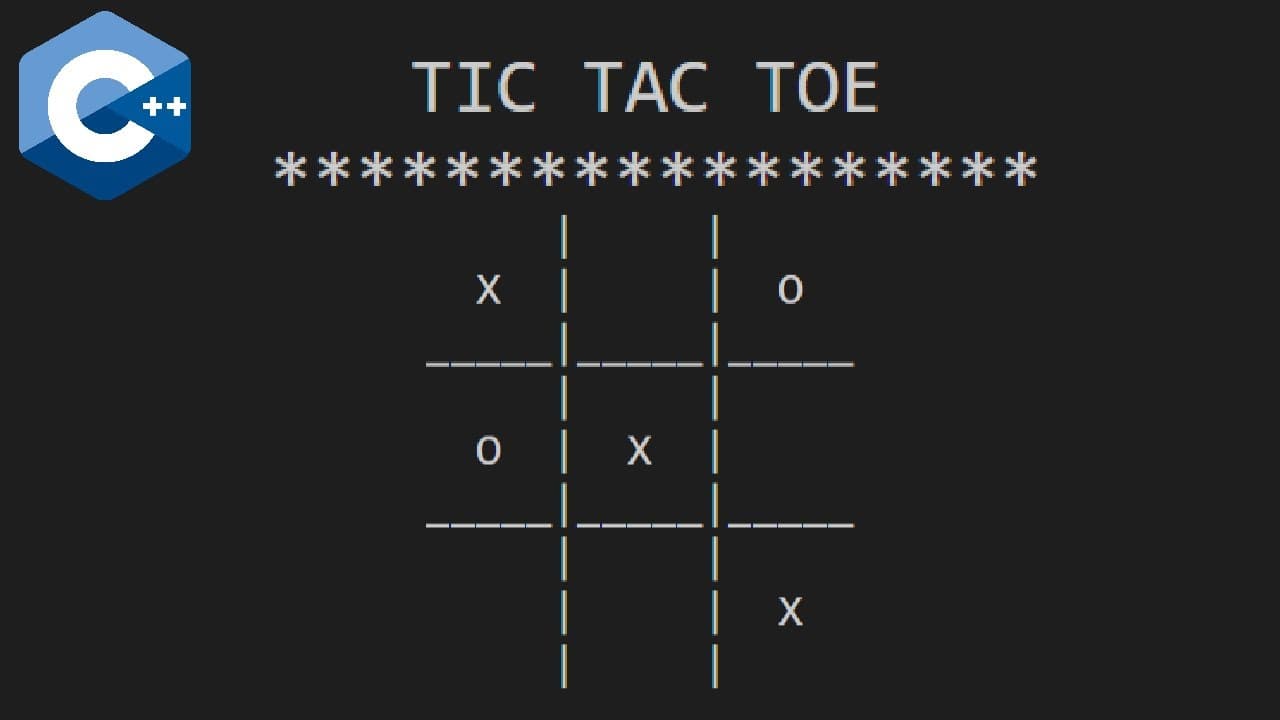
Build the game around a nine-element character array that records empty, player, and computer spaces. Separate functions draw the board, validate the player’s selection, generate the computer’s random move, and test every row, column, and diagonal for a winner, while a running boolean controls the main loop and ends play when a winning condition is found.
Transcript
hey guys in this topic we're going to create a game of tic-tac-toe we'll be working with random numbers you may or may not need to include this header file include c time we'll add some function declarations then some definitions void draw board there will be one parameter a pointer to an array named spaces spaces will be a one-dimensional array th... Read More
Key Insights
- The board is represented by a one-dimensional character array containing nine elements, with each element initially holding an empty space. These elements track which positions remain available and which contain the player’s or computer’s marker throughout the game.
- The program is divided into functions for drawing the board, processing the player’s move, generating the computer’s move, checking for a winner, and checking for a tie. Arrays passed into these functions decay into pointers, so the function parameters use pointers to the spaces array.
- The player’s input is converted from positions one through nine into array indices zero through eight by decrementing the entered number. A do-while loop keeps requesting input until the chosen index is within the required range and refers to an empty position.
- The computer’s move is selected by seeding random-number generation with the time function and calculating rand() modulus nine. Because the resulting index can already be occupied, a while loop rerolls until an empty array element is found, assigns the computer marker, and breaks.
- The main game loop is controlled by a boolean variable named running, which starts as true. After each player or computer move, the board is redrawn and checkWinner is called. When that function reports a winner, running becomes false and the loop is exited.
- The winner check covers eight arrangements: three rows, three columns, and two diagonals. Each condition compares three array elements for equality, then uses the marker in the first checked position to determine whether the player won or the computer won.
- The winner conditions must verify that the compared positions are not empty. Without this guard, three matching empty-space characters can be mistaken for a completed row, causing the program to announce a loss before a genuine winning sequence has been created.
- The checkWinner function returns false when no winning arrangement matches and returns true after a row, column, or diagonal is completed. Its boolean result allows the main loop to place the function call directly inside an if statement after each move.
Install to Summarize YouTube Videos and Get Transcripts
Explore YouTube Video Summarizer or Get YouTube Transcript Extractor
Questions & Answers
Q: How do you represent a tic-tac-toe board in C++?
Represent the board with a one-dimensional character array named spaces containing nine elements. Initialize every element with an empty-space character, then replace an element with the player’s or computer’s marker when that position is selected. Indices zero through eight correspond to the nine visible board positions, and the array can be passed to game functions as a pointer.
Q: How does the player choose a board position?
Ask the player to enter a position from one through nine, store that input in a local number variable, and decrement it by one so it corresponds to an array index from zero through eight. Confirm that the indexed element contains an empty space before assigning the player marker. A do-while loop repeats the prompt when the selection is invalid or occupied.
Q: How does the computer make a random move?
Seed random-number generation by calling srand with the time function, then generate an index using rand() modulus nine. This produces a value corresponding to one of the board’s array elements. If that position is occupied, the computer repeats the random selection inside a while loop. When an empty position is found, the computer marker is assigned and the loop breaks.
Q: How do you draw the tic-tac-toe board?
Create a drawBoard function that accepts a pointer to the spaces array and prints a grid with vertical bars and horizontal separators. Insert array elements zero, one, and two into the first row, elements three, four, and five into the second row, and elements six, seven, and eight into the final row. Redraw after each move to display changes.
Q: How do you check for a winner in tic-tac-toe?
Compare the three elements in every possible winning arrangement. The checks cover the three horizontal rows, the three vertical columns, and the two diagonals. Each condition confirms that the first position is not empty and that all three characters match. The marker in the first position then identifies whether the player won or the computer won.
Q: Why must winner detection ignore empty spaces?
Every unused board element initially contains the same empty-space character. If winner detection only checks whether three positions are equal, an untouched row can satisfy that comparison because all three empty characters match. Adding a condition that the first checked position does not equal an empty space prevents the program from treating an unused row, column, or diagonal as a win.
Q: How is the main tic-tac-toe game loop structured?
Initialize a running boolean to true, draw the empty board, and enter a while loop controlled by that boolean. Call playerMove, redraw the board, and check for a winner. If nobody has won, call computerMove, redraw again, and repeat the winner check. When checkWinner returns true, set running to false and break out of the loop.
Q: What functions are used in the C++ tic-tac-toe program?
The declared functions are drawBoard, playerMove, computerMove, checkWinner, and checkTie. The board-drawing and move functions receive a pointer to the spaces array, while move functions also receive the relevant marker. checkWinner receives the array plus both markers and returns a boolean. checkTie receives the array pointer and is also declared to return a boolean.
Summary & Key Takeaways
-
The program stores the board in a character array named spaces with nine elements, each initially containing an empty space. Separate character variables represent the player and computer markers, while a running boolean begins as true. The drawBoard function receives the array as a pointer and prints its contents inside a grid.
-
The main loop calls playerMove, redraws the board, and checks for a winner. It then calls computerMove, redraws again, and repeats the winner check. The player selects a position from one through nine, which the program decrements to match array indices zero through eight before confirming that the selected space is empty.
-
The computer repeatedly generates a random index with rand() modulus nine until it finds an empty position. Winner detection compares the three positions in every row, column, and diagonal, while also ensuring the first checked position is not empty. Matching markers produce either a win or loss message and return true.
Read in Other Languages (beta)
Share This Summary 📚
Summarize YouTube Videos and Get Video Transcripts with 1-Click
Try YouTube Summary with ChatGPT & Claude or YouTube Transcript Generator
Explore More Summaries from Bro Code 📚


Summarize YouTube Videos and Get Video Transcripts with 1-Click
Try YouTube Summary with ChatGPT & Claude or YouTube Transcript Generator