How Does DevOps Improve the SDLC Process?
TL;DR
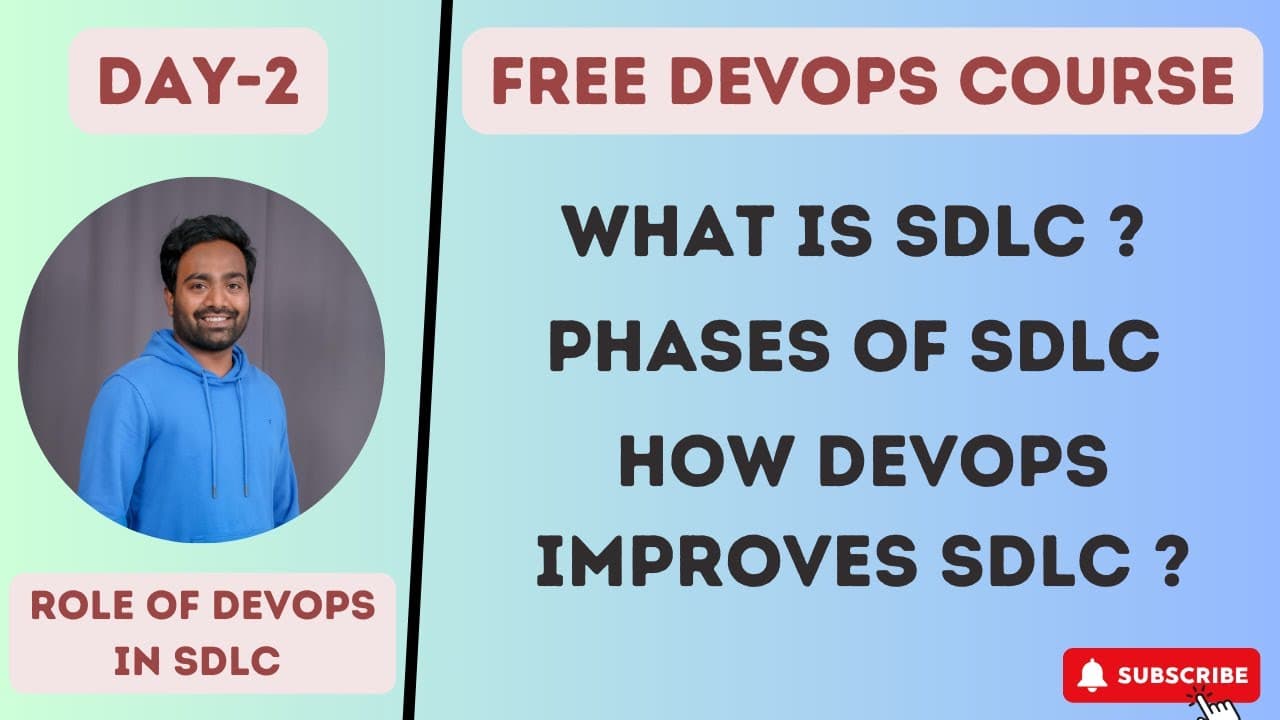
SDLC is a repeatable process for planning, designing, building, testing, and deploying software that meets customer expectations. DevOps engineers should evaluate how tools and practices can improve organizational efficiency, selecting technology according to the organization’s actual needs instead of adopting a tool merely because it is popular in the community.
Transcript
hello everyone my name is Abhishek and welcome back to my channel so first of all thank you so much for watching my previous video on devops that is Introduction of devops so today is day two if you haven't watched the day one video on devops I would highly recommend you to go back and watch the day one so there is a devops Zero to Hero playlist wh... Read More
Key Insights
- SDLC is a software-industry process for designing, developing, testing, and delivering high-quality products. It establishes a standard workflow that software professionals must understand when working in an organization, regardless of whether they specialize in development, testing, software engineering, or DevOps.
- The main goal of SDLC is to deliver a high-quality product that meets customer expectations. Design guides development, while testing checks the developed product before delivery. Omitting these stages can result in an application that has not been properly validated for the customer.
- The SDLC described here is a circular process containing planning, design, building, testing, and deployment. The cycle repeats whenever an organization wants to introduce another feature, making software delivery an ongoing process rather than an activity that ends after the first release.
- Planning and requirement gathering are fundamental because they begin the development life cycle. Product owners, business analysts, and senior members can collect customer feedback, evaluate interest in a proposed feature, and determine whether the idea should move into design and development.
- Customer feedback is evidence for deciding whether a feature is worth pursuing. If current and potential customers show no interest in a proposed children’s catalog, the organization can suspend the idea during planning instead of sending unnecessary work through every later SDLC phase.
- Requirement gathering is the process of identifying the specific form a requested feature should take. For a children’s clothing catalog, the organization should determine which age ranges interest customers and measure interest in each option before proceeding with implementation.
- DevOps engineers are expected to consider how their work can improve organizational efficiency. When learning tools such as Terraform or Ansible, they should connect each tool to a practical organizational need and evaluate how it could improve the existing software delivery process.
- Tool selection is an organizational decision rather than a popularity contest. A tool such as Terraform may be widely promoted within the DevOps community but still be unsuitable for a particular organization, so the DevOps engineer should assess its fit and advise colleagues accordingly.
Install to Summarize YouTube Videos and Get Transcripts
Explore YouTube Video Summarizer or Get YouTube Transcript Extractor
Questions & Answers
Q: What is the software development life cycle?
The software development life cycle, commonly called SDLC, is the standard process used by the software industry to design, develop, test, and deliver high-quality products. It provides an organized sequence of work that helps an organization move from an initial idea to a tested application that can be deployed for customers and their requirements.
Q: Why should every software engineer understand SDLC?
Every software engineer should understand SDLC because organizations use standard processes to create and deliver software. The concept applies to developers, testers, DevOps engineers, and other professionals working in the software or IT industry. Understanding the stages helps each participant recognize how their responsibilities contribute to designing, developing, testing, and delivering a quality product.
Q: What are the main phases of the SDLC process?
The SDLC phases presented are planning, design, building, testing, and deployment. Planning includes collecting and evaluating requirements. Design prepares the proposed solution, building creates the software, testing evaluates the developed product, and deployment delivers it. These phases form a circle because the organization repeats them whenever it develops another feature.
Q: Why is SDLC represented as a repeating cycle?
SDLC is represented as a cycle because an organization follows the same broad process for each new feature it develops. After planning, designing, building, testing, and deploying one feature, another requirement can begin the sequence again. The circular model therefore reflects continuous feature development and repeated application of the organization’s software delivery standards.
Q: What happens during SDLC planning and requirement gathering?
During planning and requirement gathering, product owners, business analysts, senior members, and other core participants collect input about the proposed feature. They study customer feedback, evaluate whether enough people want the feature, and document specific requirements. This stage determines whether the idea should proceed and what the later design and development work should address.
Q: How can customer feedback prevent unnecessary development work?
Customer feedback allows an organization to test the value of an idea during the planning stage. If current and potential customers are not interested in a proposed feature, the organization can suspend it before design, building, testing, and deployment begin. This prevents an unsupported idea from consuming effort throughout all the remaining SDLC stages.
Q: How does the children’s catalog example explain requirements?
The example considers an e-commerce clothing application that already serves men and women but does not offer a children’s section. Before creating that catalog, the organization gathers customer interest and identifies desired age ranges, such as 6–12 years or 1–4 years. That collected information becomes the basis for planning the feature and its requirements.
Q: How should a DevOps engineer choose tools for an organization?
A DevOps engineer should evaluate a tool according to the organization’s needs and its potential effect on efficiency. Community popularity alone does not make a tool appropriate. For example, Terraform may be considered a strong tool within the DevOps community while remaining a poor fit for one organization, so the engineer should assess suitability and communicate that conclusion.
Summary & Key Takeaways
-
The software development life cycle defines the standard process organizations use to design, develop, test, and deliver high-quality software. Developers, testers, DevOps engineers, and other software professionals need to understand it because startups, multinational companies, and other organizations use consistent stages to organize product development and meet customer expectations.
-
The demonstrated SDLC forms a repeating cycle of planning, design, building, testing, and deployment. Every new feature passes through this process. An e-commerce company adding a children’s clothing catalog, for example, must first validate the idea, define customer requirements, design and build the feature, test its quality, and deploy it.
-
Planning and requirement gathering form the starting stage of the SDLC. Product owners, business analysts, and senior members collect customer input to determine whether a proposed feature is useful and what customers specifically need. An unsupported idea can be suspended during planning, preventing unnecessary work in all subsequent development stages.
Read in Other Languages (beta)
Share This Summary 📚
Summarize YouTube Videos and Get Video Transcripts with 1-Click
Try YouTube Summary with ChatGPT & Claude or YouTube Transcript Generator
Explore More Summaries from Abhishek.Veeramalla 📚

Summarize YouTube Videos and Get Video Transcripts with 1-Click
Try YouTube Summary with ChatGPT & Claude or YouTube Transcript Generator