How to Master Facebook Ads in 14 Minutes: Lessons From 1,000+ Hours
TL;DR
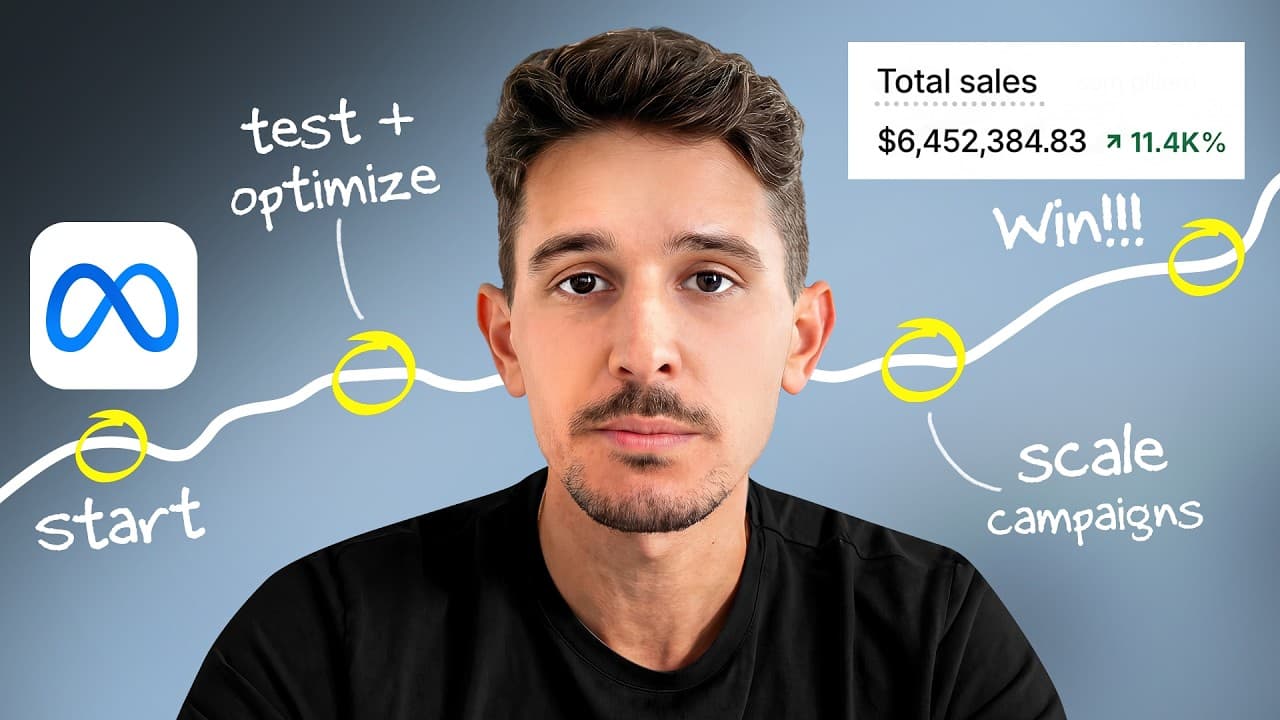
Master Facebook ads by choosing one profit-focused “king goal,” calculating your break-even point, and using the M3 method to structure campaigns, test creative, and graduate top performers. The approach also favors Meta’s default 7-day click and 1-day view attribution, which the speaker says gets advertisers 90-plus percent of the way there at no cost. Read on for the practical framework and scaling principles.
Transcript
If you're feeling completely stuck running Facebook ads, I'm going to show you how to break through and get real results. The truth is, if you're struggling to make your ads profitable, it's probably not because you made some catastrophic mistake. It's most likely because you're missing the big picture on how Facebook ads works. So, by the end of t... Read More
Key Insights
- Setting a 'king goal' is crucial for Facebook ad success. It should be the primary focus, overriding other metrics.
- The M3 method includes campaign structure, creative testing, and a graduation system to optimize ad performance.
- Profit should be prioritized over other metrics like return on ad spend (ROAS) to maximize business growth.
- Word-of-mouth is an unmeasurable but powerful factor in growing a brand through Facebook ads.
- Day of the week analysis can reveal optimal times for ad spending, often showing better performance on weekends.
- Creative testing should follow the 80/20 rule, focusing on new variations of existing successful ads.
- A graduation system dedicates ad spend to top-performing ads, ensuring consistent performance.
- Understanding audience segments, such as age and gender, helps in targeting the right demographics effectively.
Install to Summarize YouTube Videos and Get Transcripts
Explore YouTube Video Summarizer or Get YouTube Transcript Extractor
Questions & Answers
Q: How do you master Facebook ads and make them profitable?
Start by setting one “king goal” that overrides secondary metrics and keeps the campaign focused on profit. Calculate the business’s break-even point, then use the M3 method of campaign structure, creative testing, and a graduation system to improve performance.
Q: What is a “king goal” for Facebook ads?
A king goal is the single most important objective that overrides every other campaign goal. Metrics such as cost per acquisition, return on ad spend, cost per click, CPM, and cohort analysis can still be reviewed, but the speaker advises against measuring success against all of them at once.
Q: How do you calculate a break-even model for Facebook ads?
Consider cost of goods, fixed brand costs, average order value, current order volume, and the economies of scale gained as spending and customer acquisition increase. In the speaker’s example, $1 million in revenue and $1 million in costs produces $0 profit, while $900,000 in costs produces $100,000, or 10% profit.
Q: What is the M3 method in Facebook advertising?
The M3 method combines a structured campaign framework, creative testing, and a graduation system. It organizes campaigns, develops creative variations, and directs dedicated ad spend toward top-performing ads.
Q: What attribution settings does the speaker recommend for Facebook ads?
The speaker recommends starting with Meta’s standard default 7-day click and 1-day view attribution while reviewing and optimizing for incremental attribution in Facebook. He says this gets advertisers 90-plus percent of the way there with a $0 price tag, reducing the need to begin with third-party tools such as Triple Whale or Hyros.
Q: Why should profit take priority over ROAS in Facebook ad campaigns?
The speaker says the most important result is how much money the business makes and what its bank account shows. ROAS and CPA remain useful indicators, but they should not replace profit when profit is the campaign’s king goal.
Q: How does the 80/20 rule guide Facebook ad creative testing?
The 80/20 rule calls for spending 80% of creative-testing time on new variations of ads that are already successful. This preserves the core elements of proven ads while introducing fresh variations intended to maintain performance.
Q: How can Facebook ads support word-of-mouth growth?
Spending more to acquire customers can expand the brand’s community, giving more people opportunities to tell their friends. The speaker describes word of mouth as an unmeasurable, exponential factor that growing brands use to grow.
Summary & Key Takeaways
-
Achieving success with Facebook ads requires setting a 'king goal' that prioritizes profit over other metrics. The M3 method, which includes structured campaign frameworks and creative testing, is essential for optimizing ad performance. Additionally, leveraging word-of-mouth can significantly enhance brand growth.
-
The 80/20 rule in creative testing focuses on creating new variations of successful ads to maintain performance. A graduation system ensures ad spend is dedicated to top-performing ads, while analyzing days of the week can optimize ad spending for better results.
-
Understanding audience segments, such as age and gender, is crucial for effective targeting. Prioritizing profit and leveraging word-of-mouth are key strategies for maximizing the impact of Facebook ads and growing a brand effectively.
Read in Other Languages (beta)
Share This Summary 📚
Summarize YouTube Videos and Get Video Transcripts with 1-Click
Try YouTube Summary with ChatGPT & Claude or YouTube Transcript Generator
Explore More Summaries from Sam Piliero 📚


Summarize YouTube Videos and Get Video Transcripts with 1-Click
Try YouTube Summary with ChatGPT & Claude or YouTube Transcript Generator