How RPC Fixes Data Representation and Binding Issues
TL;DR
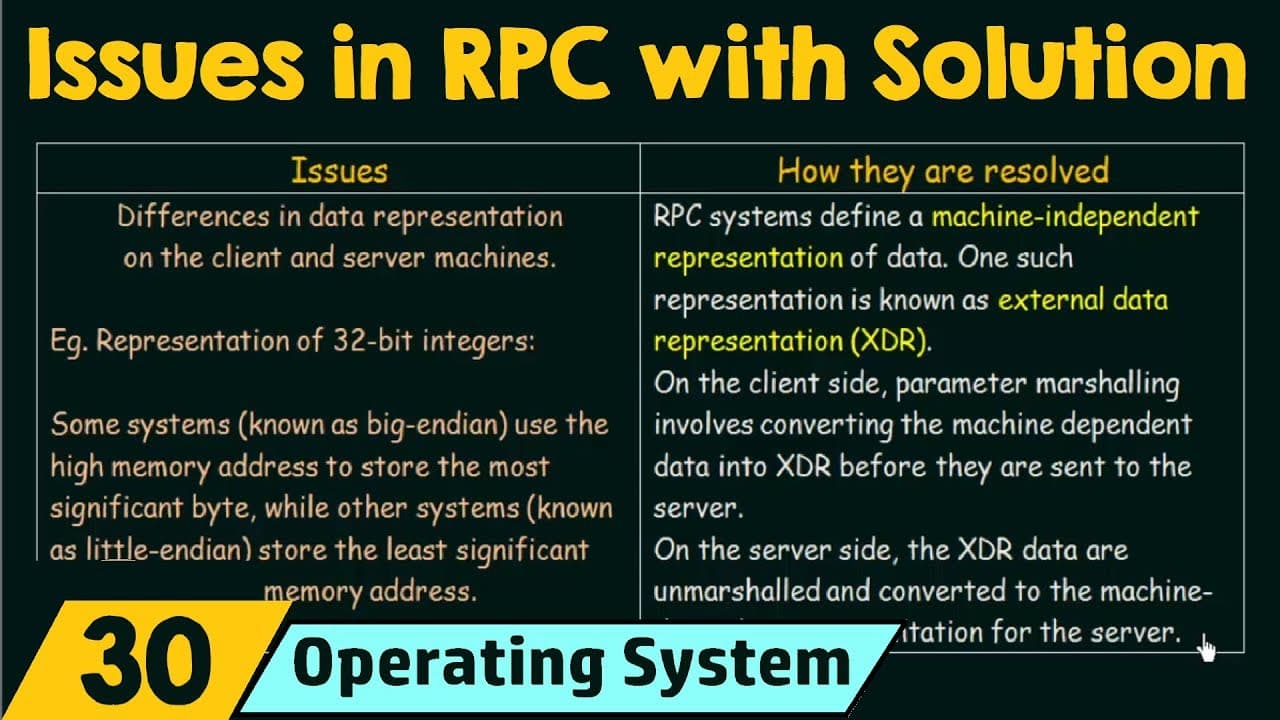
XDR provides a machine independent data format for RPC communication, and marshaling converts data to XDR before sending, while unmarshalling converts it back on the server. To ensure reliability over networks, RPC uses exactly once semantics via acknowledgments, and binding can be either fixed port addresses or dynamic rendezvous via a matchmaker daemon.
Transcript
in the previous lecture we have studied about art BC and we saw how RPC works and I also told you that during the working of an RPC there are certain issues that we face and we have to address those issues so in this lecture we'll be studying about the issues that we face during the execution of an RPC and we will also see how they are resolved so ... Read More
Key Insights
- XDR is a machine independent data representation used to solve client server data representation differences.
- Marshalling converts machine dependent data into XDR before sending it to the server.
- Unmarshalling converts XDR back to machine dependent data on the server side.
- RPC ensures messages are acted on exactly once using an acknowledgment system.
- Exactly once semantics require the server to acknowledge completed requests and the client to stop resending.
- If network errors occur, the system can retry until the server acknowledges completion.
- Binding can be predetermined with fixed port addresses.
- Alternatively, binding can be dynamic via a rendezvous daemon that returns the port address for an RPC request.
Install to Summarize YouTube Videos and Get Transcripts
Explore YouTube Video Summarizer or Get YouTube Transcript Extractor
Questions & Answers
Q: What is XDR and why is it used in RPC?
XDR stands for external data representation and it is a machine independent format used to ensure data can be interpreted by systems with different architectures. In RPC, data is marshaled into XDR on the client side before sending and unmarshaled back on the server side, preventing representation mismatches between client and server.
Q: How does RPC handle data conversion between client and server?
RPC handles data conversion through marshaling and unmarshalling. The client converts data to XDR form before sending, and the server converts the XDR data back to its machine dependent representation for processing, ensuring consistent interpretation across diverse systems in a networked environment.
Q: What problem does exactly once delivery solve in RPC?
Exactly once delivery solves the problem of duplicate or missing executions caused by network errors. The client resends a request until it receives an acknowledgment, and the server processes the request once and sends back an acknowledgment, ensuring the operation is completed exactly one time and not more or less.
Q: How is exactly once delivery implemented in RPC?
Exactly once delivery is implemented via an acknowledgment mechanism. The client sends a request and waits for the server to acknowledge completion; if the acknowledgment is not received, the client repeats the request. The server processes the request and then sends the acknowledgment to confirm completion.
Q: What is the issue with binding in RPC and how can it be resolved?
The issue is that the client knows the procedure by name but does not know the server address or port. This can be resolved either with fixed port addresses predetermined at compile time, or with a dynamic rendezvous mechanism where a matchmaker daemon provides the port for the requested RPC.
Q: What are the two binding strategies for RPC port information?
The two strategies are fixed port addressing where the port is determined at compile time and cannot change, and dynamic binding through a rendezvous mechanism where a client asks a rendezvous daemon for the port number corresponding to the RPC, allowing the port to be used until the process ends or the server crashes.
Q: Why is a rendezvous mechanism considered more flexible than fixed ports?
A rendezvous mechanism is more flexible because it allows dynamic binding at runtime. The client requests the port corresponding to the RPC by name, receives the port number, and can continue using that port as long as the server is available, which supports changes in server deployment without recompiling the client.
Q: What is the role of the server in the exactly once protocol?
In the exactly once protocol, the server processes each requested operation and then sends back an acknowledgment to the client. The acknowledgment confirms completion so the client does not resend. If the server fails to send an acknowledgment due to a fault, the client continues retrying until it receives confirmation.
Summary & Key Takeaways
-
RPC introduces a machine independent data representation called XDR to resolve data representation differences across client and server. Data is marshaled to XDR on the client and unmarshaled on the server. The second major issue is ensuring requests are processed exactly once, accomplished by an acknowledgment system. Binding information can be static or dynamic through rendezvous mechanisms.
-
A rendezvous mechanism allows dynamic port binding for RPC calls, enabling flexible, runtime determination of the server port, improving scalability and adaptability. XDR and marshaling/unmarshalling ensure interoperability across heterogeneous systems. Exactly once execution ensures reliability despite network failures.
-
RPC tackles binding, data representation, and reliability by combining XDR, marshaling, acknowledgment-based exactly-once execution, and either fixed or dynamic port binding to maintain robust communication between distributed systems.
Read in Other Languages (beta)
Share This Summary 📚
Summarize YouTube Videos and Get Video Transcripts with 1-Click
Try YouTube Summary with ChatGPT & Claude or YouTube Transcript Generator
Explore More Summaries from Neso Academy 📚






Summarize YouTube Videos and Get Video Transcripts with 1-Click
Try YouTube Summary with ChatGPT & Claude or YouTube Transcript Generator