How to Use JavaScript Function Expressions
TL;DR
A JavaScript function expression assigns a function to a variable or passes it directly as a value, allowing it to be invoked later or used as a callback. This approach works with setTimeout and array methods such as map, filter, and reduce, while avoiding unnecessary function names when the function is only needed once.
Transcript
hey everyone so today I'm going to explain function expressions in JavaScript a function expression is a way to define functions as a value or a variable not to be confused with function declarations where you define a block of reusable code that performs a specific task we're already familiar with function declarations such as this function then y... Read More
Key Insights
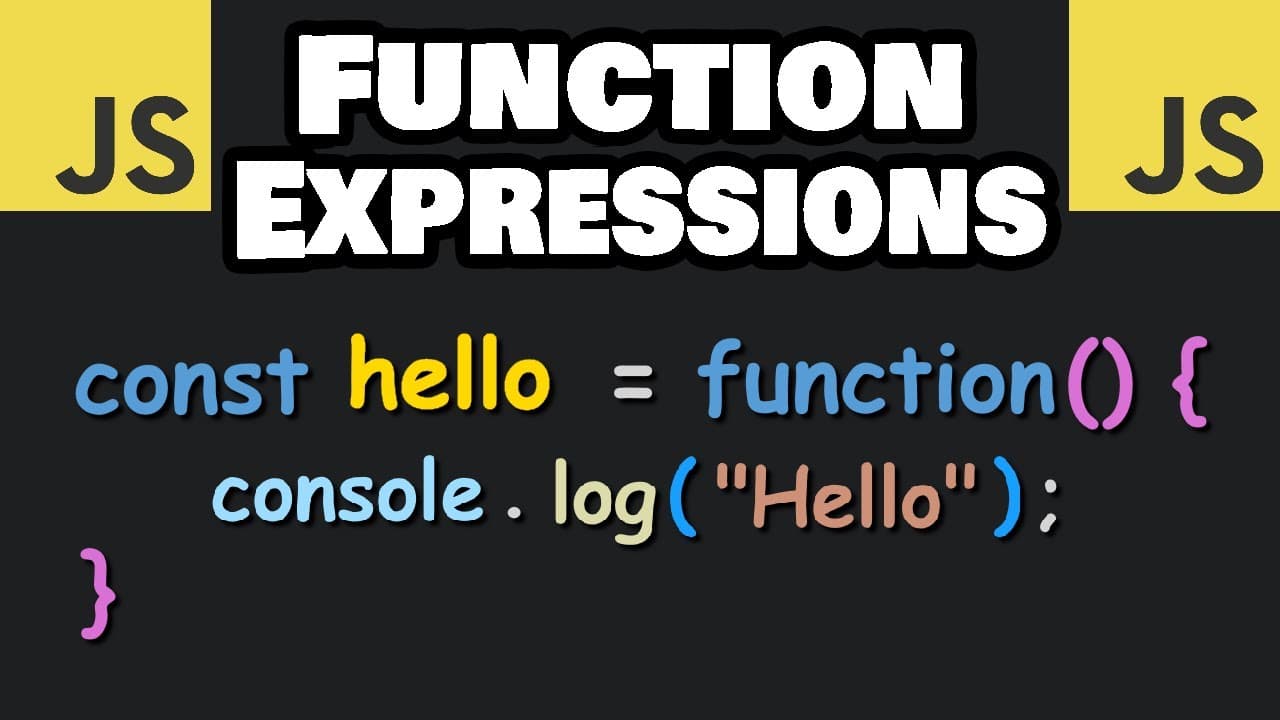
- A function expression is a way to define a JavaScript function as a value or variable. For example, an anonymous function can be assigned to a constant named hello, which stores the function until the program invokes it.
- A stored function expression is invoked through its variable name followed by parentheses. After assigning a function to hello, calling hello() executes the stored code and logs the word "Hello" to the console.
- JavaScript functions can be passed as values to other functions. The setTimeout example accepts a function expression as its callback argument and waits 3,000 milliseconds, which translates to three seconds, before executing that function.
- An anonymous function expression does not require a function name. When a callback is only used once, it can be written directly inside setTimeout, map, filter, or reduce instead of being declared separately and referenced by name.
- The map method can use a function expression to transform every array element. In the examples, Math.pow raises each number from one through six to the power of two for squares or to the power of three for cubes.
- The filter method can use a function expression to select numbers by a condition. Testing an element with the modulus operator identifies even numbers when the remainder is strictly equal to zero and odd numbers when it is not equal to zero.
- The reduce method can use a function expression with an accumulator and an element. Returning the accumulator plus the current element sums the array containing the numbers one through six and produces a total of 21.
- Function expressions reduce unnecessary function names when a function performs one task and is then discarded. The transcript also identifies callbacks, asynchronous operations, higher-order functions, closures, and event listeners as situations where function expressions are used.
Install to Summarize YouTube Videos and Get Transcripts
Explore YouTube Video Summarizer or Get YouTube Transcript Extractor
Questions & Answers
Q: What is a JavaScript function expression?
A JavaScript function expression defines a function as a value or variable. One example assigns an anonymous function to a constant named hello. The function remains stored in that variable and can be executed with hello(). JavaScript also permits the expression to be passed directly as an argument to another function or an array method.
Q: How do you assign and invoke a function expression?
Assign the function to a variable by placing the function syntax on the right side of an assignment, as in a constant named hello receiving a function that logs "Hello." To invoke the stored function, use the variable name followed by parentheses: hello(). Those parentheses execute the function held by the variable rather than merely referring to its value.
Q: How do function expressions work with setTimeout?
A function expression can be passed directly as the callback argument to setTimeout. The second argument specifies the waiting time in milliseconds. In the example, setTimeout receives an anonymous function that logs a message and a delay of 3,000 milliseconds. The function runs after three seconds without needing a separate named function declaration.
Q: How can map use a JavaScript function expression?
The map method can receive a function expression that processes each element and returns a transformed value for a new array. With the array containing one through six, the callback returns Math.pow(element, 2) to create squares. Changing the exponent to three creates cubes, and no separately named square or cube function is required.
Q: How can filter find even and odd numbers?
The filter method can receive a function expression that returns a condition for each element. To select even numbers, the callback checks whether element modulus 2 is strictly equal to zero, producing 2, 4, and 6. To select odd numbers, it checks that the remainder is not equal to zero, producing 1, 3, and 5.
Q: How does reduce sum an array with a function expression?
The reduce method accepts a function expression with two parameters, an accumulator and the current element. The callback returns the accumulator plus that element, allowing the running value to collect the array's sum. Applied to the numbers one through six, the example returns a total of 21 and stores it in a constant named total.
Q: Why use an anonymous function expression for a callback?
An anonymous function expression is useful when a function will be used only once. It can be placed directly where the callback is needed, so there is no need to invent a function name or add that name to the global namespace. The examples use this pattern directly inside setTimeout, map, filter, and reduce calls.
Q: Where are JavaScript function expressions commonly used?
Function expressions are used when functions need to be treated as values. The source identifies callbacks in asynchronous operations, higher-order functions, closures, and event listeners as important uses. Its examples demonstrate callbacks with setTimeout and the array methods map, filter, and reduce. Arrow functions are introduced as a later topic that shortens the syntax further.
Summary & Key Takeaways
-
A function expression defines a JavaScript function as a value. The function can be stored in a variable, such as a constant named hello, and invoked by adding parentheses to that variable name. This differs from writing a named function declaration as a separate reusable block of code.
-
JavaScript permits an entire function expression to be passed as an argument. The setTimeout example receives an anonymous function and a waiting time of 3,000 milliseconds, then logs a message after three seconds. This demonstrates how function expressions serve as callbacks in asynchronous operations without requiring separately declared function names.
-
Function expressions can be supplied directly to map, filter, and reduce. The examples square or cube numbers with map, select even or odd numbers with filter, and total the numbers with reduce. Inline expressions are useful for functions needed once and avoid adding unnecessary names to the global namespace.
Read in Other Languages (beta)
Share This Summary 📚
Summarize YouTube Videos and Get Video Transcripts with 1-Click
Try YouTube Summary with ChatGPT & Claude or YouTube Transcript Generator
Explore More Summaries from Bro Code 📚
Summarize YouTube Videos and Get Video Transcripts with 1-Click
Try YouTube Summary with ChatGPT & Claude or YouTube Transcript Generator