How DES Encrypts 64-Bit Blocks and Keys Overview
TL;DR
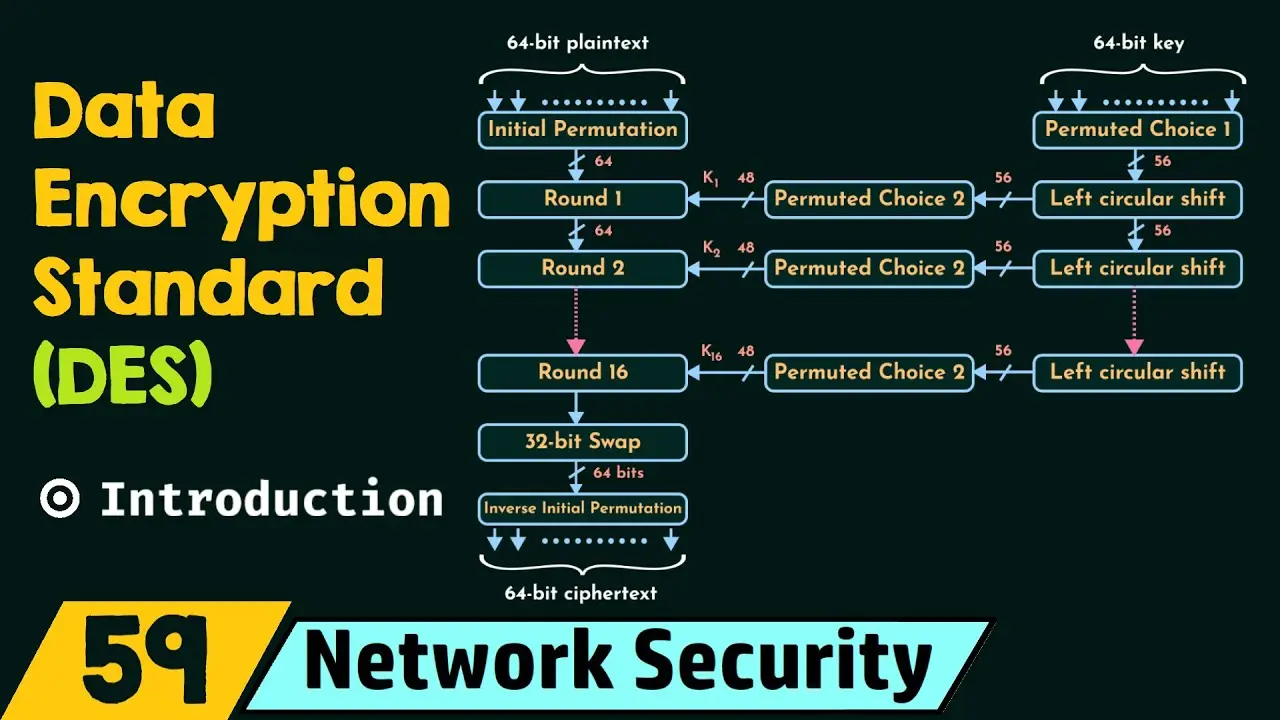
DES is a symmetric block cipher that processes 64-bit plaintext into 64-bit ciphertext. It uses a 56-bit key to generate 16 round keys of 48 bits each, and it relies on an initial permutation, a 16 round Feistel-like process, a 32-bit swap, and an inverse initial permutation. AES replaces DES due to security vulnerabilities noted in the material.
Transcript
foreign welcome back in this presentation we are going to focus on the introduction to this the data encryption standard as usual let's start the session with the outcomes upon the completion of the session the learner will be able to outcome number one understand the basics of this and outcome number two understand the encryption algorithm of this... Read More
Key Insights
- DES is a symmetric block cipher where the same key is used for both encryption and decryption
- DES operates on 64-bit blocks of plaintext
- The DES key length is 56 bits after key scheduling from a 64-bit input key
- There are 16 rounds in DES, each requiring a 48-bit round key
- Each round processes 64-bit input to 64-bit output
- Round keys are 48 bits long and there are 16 of them
- DES uses an initial permutation and an inverse initial permutation
- DES is replaced by AES in modern practice due to security vulnerabilities
Install to Summarize YouTube Videos and Get Transcripts
Explore YouTube Video Summarizer or Get YouTube Transcript Extractor
Questions & Answers
Q: What is DES in simple terms
DES is a symmetric block cipher that processes 64 bits of plaintext at a time, producing 64 bits of ciphertext. It uses a 56-bit key derived from a 64-bit input key to generate 16 round keys of 48 bits. The algorithm includes an initial permutation, 16 rounds, a 32-bit swap, and an inverse initial permutation, culminating in the ciphertext.
Q: How many bits are in the DES input and output
DES handles 64-bit input and 64-bit output for each encryption or decryption operation. The block size is fixed at 64 bits, meaning the plaintext is grouped into 64-bit blocks and each block is transformed into a 64-bit ciphertext block through the DES process.
Q: What is the key length used by DES
DES uses a 64-bit key as input but the effective key length is 56 bits. This 56-bit key is used to generate 16 round keys, each of 48 bits in length, which are applied in the 16 rounds of the DES encryption process.
Q: How many rounds are there in DES
DES uses 16 rounds in its encryption process. For each round a 64-bit input is processed to produce a 64-bit output, and the 16 rounds together transform the initial 64-bit plaintext into the final 64-bit ciphertext after the necessary permutation steps.
Q: What happens after the 16 DES rounds
After completing the 16 DES rounds, the algorithm performs a 32-bit swap function to exchange the left and right halves of the 64-bit data. This swapped result then passes through the inverse initial permutation to yield the final 64-bit ciphertext.
Q: What is the purpose of the initial and inverse initial permutation
The initial permutation is applied to the 64-bit plaintext at the start of DES to rearrange bits before the rounds. After the 16 rounds and the 32-bit swap, the inverse initial permutation is applied to reassemble the bits back into the final 64-bit ciphertext, completing the encryption process.
Q: What happens to the 64-bit key during DES
The 64-bit key provided to DES is reduced to a 56-bit key, which is the effective key length, and this 56-bit key is used to generate 16 round keys of 48 bits each. These 48-bit round keys are used in the 16 rounds to perform the DES transformations.
Q: Why is DES considered outdated
DES is considered outdated because the material states it has security vulnerabilities and is replaced by the AES standard. The notes indicate that AES became the more popular and stronger encryption standard after DES, highlighting the weaknesses that led to its replacement in modern cryptographic practice.
Summary & Key Takeaways
-
DES is a symmetric block cipher that uses the same key for encryption and decryption, and it operates on 64-bit blocks.
-
DES transforms 64-bit plaintext to 64-bit ciphertext through 16 rounds and a 56-bit key scheduling that yields 48-bit round keys.
-
The course notes highlight the initial permutation, round function, inverse initial permutation, and 32-bit swap as core DES steps and mention AES as its modern replacement.
Read in Other Languages (beta)
Share This Summary 📚
Summarize YouTube Videos and Get Video Transcripts with 1-Click
Try YouTube Summary with ChatGPT & Claude or YouTube Transcript Generator
Explore More Summaries from Neso Academy 📚





Summarize YouTube Videos and Get Video Transcripts with 1-Click
Try YouTube Summary with ChatGPT & Claude or YouTube Transcript Generator