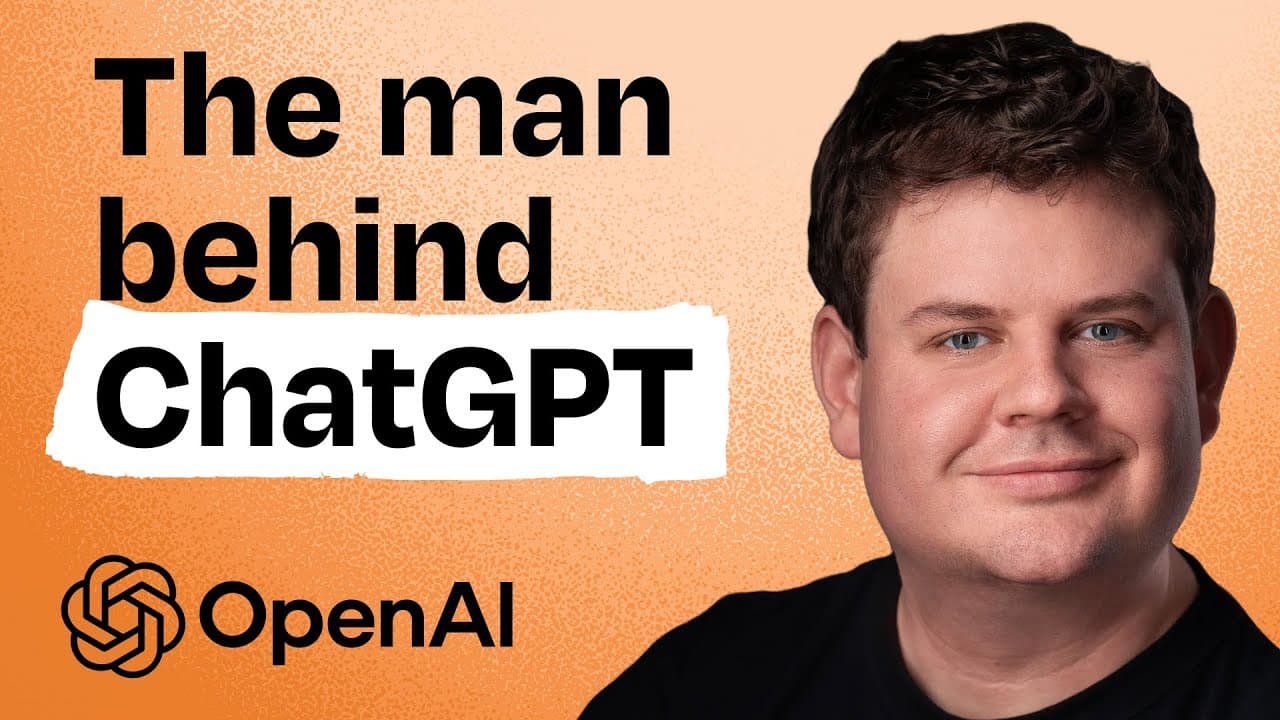
Nick Turley on How ChatGPT Became a Global Product
TL;DR
ChatGPT grew by shipping a simple chat interface quickly, observing real behavior, and improving the product after launch instead of waiting for perfect polish. Nick Turley describes a 10-day initial sprint, a $20 monthly price chosen through willingness-to-pay research, and a product culture guided by one question: whether work is moving as quickly as possible.
Transcript
You were a product leader at Dropbox, then Instacart. Now you're the PM of the most consequential product in history. I didn't know what I would do here. It was a research lab. The first task was like fix the blinds or something like that. When someone offers you a rocket ship, don't ask which seat. We set out to build a super assistant. It was sup... Read More
Key Insights
- ChatGPT was created through a 10-day sprint as a simple way to release conversational AI. The codebase had hackathon origins, and the proposed name, Chat with GPT-3.5, reflected the team's limited expectation that it would become a successful standalone product.
- ChatGPT was originally conceived as a super assistant, not merely a permanent chat box. Chat was the simplest interface the team could ship at the time, and Turley compares the current stage to MS-DOS, suggesting that a more obvious interface paradigm remains to be built.
- OpenAI's product philosophy is guided by the question, "Is it maximally accelerated?" Turley describes his role as setting the organization's pace and resting heartbeat, frequently pushing teams to identify why a valuable capability cannot be delivered immediately.
- AI products reveal their most important polishing needs only after release. The team favors exposing useful but imperfect capabilities, observing how people actually use them, and then deciding what to improve instead of assuming that prelaunch refinement will identify the right priorities.
- ChatGPT's $20 monthly subscription price was informed by a Van Westendorp willingness-to-pay survey conducted in the community Discord. The resulting price became influential enough that, according to the description, many other products subsequently adopted the same monthly amount.
- ChatGPT retention can follow a smiling curve because some users leave and later return with greater engagement. As models improve and people discover additional applications, a person who initially found limited value may come back months later and use the product more frequently.
- GPT-5 dynamically determines when reasoning is necessary instead of requiring users to select a thinking mode manually. It can respond immediately to simpler requests while spending more time on harder ones, producing an experience that Turley characterizes as faster than using the earlier reasoning model.
- ChatGPT reached 700 million weekly active users, described as roughly 10 percent of the world's population, and serves about five million business customers. Its scale creates responsibility while also allowing OpenAI to make GPT-5 available to free users rather than reserving it for subscribers.
Install to Summarize YouTube Videos and Get Transcripts
Explore YouTube Video Summarizer or Get YouTube Transcript Extractor
Questions & Answers
Q: How was ChatGPT first built and launched?
ChatGPT emerged from a hackathon-style effort to build a super assistant. Once the team decided to release it, the initial product was assembled in a 10-day sprint using a codebase never intended for massive adoption. It nearly carried the literal name Chat with GPT-3.5, launched without a waitlist, and received its public introduction through a tweet from Sam Altman.
Q: Why did OpenAI launch ChatGPT before it was polished?
OpenAI believed real usage was necessary to identify which parts of an AI product deserved refinement. AI capabilities can produce unexpected behaviors and applications, making it difficult to predict the most important product work before release. By shipping an imperfect experience, watching user behavior, and gathering reactions from channels such as TikTok comments, the team could prioritize improvements based on evidence.
Q: How did OpenAI choose the $20 ChatGPT subscription price?
The team used a Van Westendorp willingness-to-pay survey in its Discord community to investigate acceptable subscription pricing. That research helped it settle on a price of $20 per month. The process illustrates how OpenAI combined rapid execution with direct user research rather than selecting the amount solely through internal judgment. The description says the price was subsequently copied by many others.
Q: What does maximally accelerated mean at OpenAI?
Maximally accelerated is a product principle that asks whether valuable work is moving as quickly as it reasonably can. Turley applies it by pushing toward the practical conclusion and asking why something cannot be done now. He also views part of his leadership role as establishing the organization's pace, including a culture in which the ChatGPT team ships updates daily.
Q: Why does ChatGPT have a smiling retention curve?
ChatGPT's retention curve can smile because users who stop using the product may return months later and become more active than before. Improvements in the models and the discovery of new use cases can make the product newly relevant to someone who initially left. Retention therefore does not depend only on preventing departures, since returning users can deepen their engagement over time.
Q: What improvements does GPT-5 bring to ChatGPT?
GPT-5 is presented as smarter, faster, and more useful than OpenAI's previous frontier models. Turley highlights its coding performance, including front-end coding, as well as its ability to write and edit with better taste. He also points to health-related performance and a more human feeling. The model combines reasoning with other training approaches and is available to free users.
Q: How does GPT-5 decide when to use reasoning?
GPT-5 dynamically decides whether a request needs additional thinking. Users do not have to manually select a reasoning model or explicitly tell the system to think. For a difficult task, the model can spend time reasoning, while a simpler request can receive an immediate response. Turley says this unified behavior feels faster than using the earlier reasoning model, identified as o3 in the transcript.
Q: Is chat expected to remain ChatGPT's final interface?
Chat is not presented as the final form of the product. OpenAI originally wanted to create a super assistant, and conversational chat was simply the easiest interface to release at the beginning. Turley compares today's ChatGPT to MS-DOS and says the equivalent of Windows has not yet been built, implying that a clearer future interaction model may eventually appear.
Summary & Key Takeaways
-
ChatGPT began as an attempt to build a super assistant, but its initial implementation was only a hackathon codebase. The team decided to release a basic chat product within 10 days, without a waitlist, and Sam Altman announced it in a tweet. Its unexpectedly rapid adoption transformed an experiment into a major consumer product.
-
OpenAI learned that AI product development benefits from releasing capabilities before every detail is polished. Actual usage reveals which problems deserve attention, while channels such as TikTok comments can expose unexpected behavior and needs. This approach supports daily shipping and reflects the internal question of whether important work is being maximally accelerated.
-
GPT-5 combines reasoning technology with other training methods in a model designed to feel smarter, faster, more useful, and more human. It dynamically decides when additional thinking is needed, performs strongly in coding, writing, and health-related tasks, and is available to free users. ChatGPT serves 700 million weekly active users.
Read in Other Languages (beta)
Share This Summary 📚
Summarize YouTube Videos and Get Video Transcripts with 1-Click
Try YouTube Summary with ChatGPT & Claude or YouTube Transcript Generator
Explore More Summaries from Lenny's Podcast 📚


Summarize YouTube Videos and Get Video Transcripts with 1-Click
Try YouTube Summary with ChatGPT & Claude or YouTube Transcript Generator