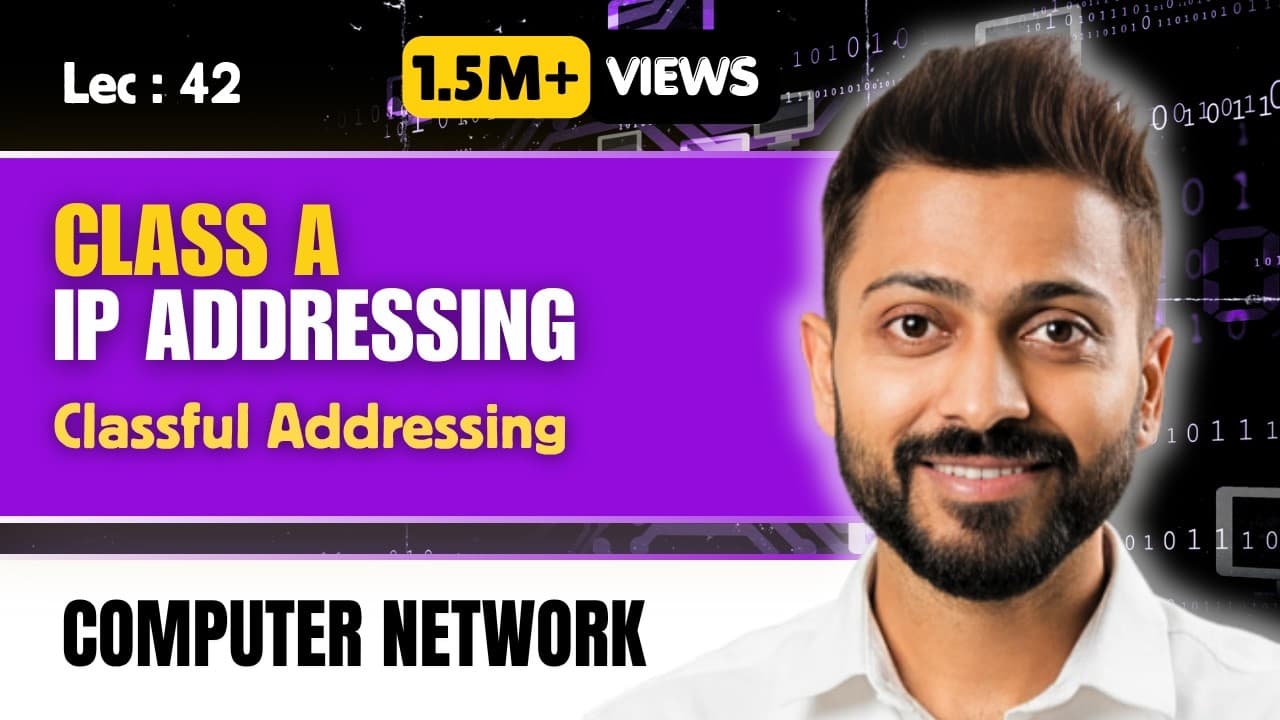
Lec-42: What Is Class A in IP Addressing and Its Range? | Classful Addressing | Network Layer | HINDI
TL;DR
Class A IP addressing uses a first-octet range of 0 to 127, with the first bit fixed at 0. Its 32-bit address assigns 8 bits to the network ID and 24 bits to the host ID, allowing 2^7 = 128 possible network numbers, 126 of which are usable, and 2^24 minus 2 usable hosts per network. Read on for the calculations, reserved values, and a 64.0.0.0 example.
Transcript
Hello friends, welcome to Gate Smashers. The topic is Class A in IP addressing. This topic comes under Classful Addressing. Classful Addressing means where we have divided IP Addresses in 5 classes, Class A, B, C, D and E. The concept of Classful Addressing came around 1980s where all IP Addresses were divided into 5 classes, Class A, B, C, D and E... Read More
Key Insights
- Class A is identified by a fixed prefix bit: the very first bit of the first octet is always 0 and cannot be changed. When a router or destination sees a 0 in that first bit position, it knows by default that the address is a Class A IP address.
- The number of IP addresses in Class A is 2^31, because one bit out of the 32 is fixed at 0 and the remaining 31 bits (7 in the first octet plus 8, 8 and 8 in the other three octets) are free to vary.
- Class A splits the address as 8 bits of network ID and 24 bits of host ID. The first octet identifies which network you are connected to, and the remaining 24 bits identify how many hosts or users exist inside that network.
- The number of networks in Class A is 2^7 = 128, not 2^8, because the first bit of the 8-bit network field is fixed at 0 and only the remaining 7 bits can be varied between all 0s and seven 1s.
- Only 126 Class A networks are actually assigned to organizations. The all-0s address, which is decimal 0, is held by IANA (Internet Assigned Number Authority) and never given out, and the last address, 0 followed by seven 1s, which is decimal 127, is also excluded.
- 127 is reserved for loopback and diagnostic functions, which is why it is subtracted from the 128 possible Class A network numbers along with 0, leaving 128 minus 2 = 126 networks available to organizations.
- The Class A range is 0 to 127 in the first octet. To classify any address you only need to read the first octet: if its value falls between 0 and 127 the address belongs to Class A, without examining the host bits at all.
- Each Class A network can hold 2^24 hosts, but two of those addresses are not usable, so the number of hosts per network is 2^24 minus 2. For the network 64.0.0.0 the first address is 64.0.0.0 and the last is 64.255.255.255.
Install to Summarize YouTube Videos and Get Transcripts
Explore YouTube Video Summarizer or Get YouTube Transcript Extractor
Questions & Answers
Q: What is Class A in IP addressing, and what is its range?
Class A is one of the five classes, A, B, C, D, and E, used in Classful Addressing. Its first bit is fixed at 0, and its first-octet range is 0 to 127. The first 8 bits identify the network, while the remaining 24 bits identify hosts within that network.
Q: How can you identify a Class A IP address?
Look at the first bit or the decimal value of the first octet. A first bit of 0 identifies Class A, corresponding to a first-octet value from 0 through 127. For example, 64.0.0.0 is a Class A address because its first octet is 64.
Q: How many IP addresses are in Class A?
Class A contains 2^31 IP addresses. One of the 32 bits is fixed at 0, leaving 31 bits free to vary.
Q: How many Class A networks are possible and usable?
Class A has 2^7 = 128 possible network numbers because only 7 bits of the first octet can vary. The values 0 and 127 are excluded, leaving 126 networks available for assignment to organizations.
Q: Why are Class A network numbers 0 and 127 excluded?
The all-zero network number, decimal 0, is held by IANA and is not assigned to an organization. Network number 127 is reserved for loopback and diagnostic functions. Subtracting these two values from 128 leaves 126 usable Class A networks.
Q: How many hosts can a Class A network support?
A Class A network has 24 host bits, producing 2^24 possible host addresses. Two addresses are unusable, so the usable host count per network is 2^24 minus 2.
Q: What address range belongs to the Class A network 64.0.0.0?
For the network 64.0.0.0, the first address is 64.0.0.0. The last address is 64.255.255.255 because the first octet identifies the network and the remaining three octets contain the 24 host bits.
Q: Why was Classful Addressing introduced in the 1980s?
Before the 1980s, a fixed 8-bit network field allowed about 2^8 = 256 networks, while each network had 24 host bits and could contain 2^24 hosts. As demand for IP addresses and scalability increased, that fixed division did not fit organizations needing different numbers of hosts. Classful Addressing therefore divided IP addresses into Classes A, B, C, D, and E.
Summary & Key Takeaways
-
Before the 1980s, a 32-bit IP address was split with a fixed 8 bits for the network number and 24 bits for host numbers, as in network 10 (ARPANET). This allowed only about 2^8 = 256 networks while each network could hold 2^24 hosts, which was acceptable when the internet was not popular.
-
As demand for IP addresses and scalability grew in the 1980s, Classful Addressing was introduced, dividing all IP addresses into five classes: A, B, C, D and E. The motivation was that some companies need very many hosts while others need only a limited number, so one fixed split no longer fit.
-
A 32-bit IPv4 address is written in Dotted Decimal Representation, which is the most widely used form, by splitting the address into four octets of 8 bits each. Other representations such as binary exist, but dotted decimal is what is normally used to write class A addresses like 64.0.0.0.
Read in Other Languages (beta)
Share This Summary 📚
Summarize YouTube Videos and Get Video Transcripts with 1-Click
Try YouTube Summary with ChatGPT & Claude or YouTube Transcript Generator
Explore More Summaries from Gate Smashers 📚



Summarize YouTube Videos and Get Video Transcripts with 1-Click
Try YouTube Summary with ChatGPT & Claude or YouTube Transcript Generator