How Was the Universe Born According to Theories
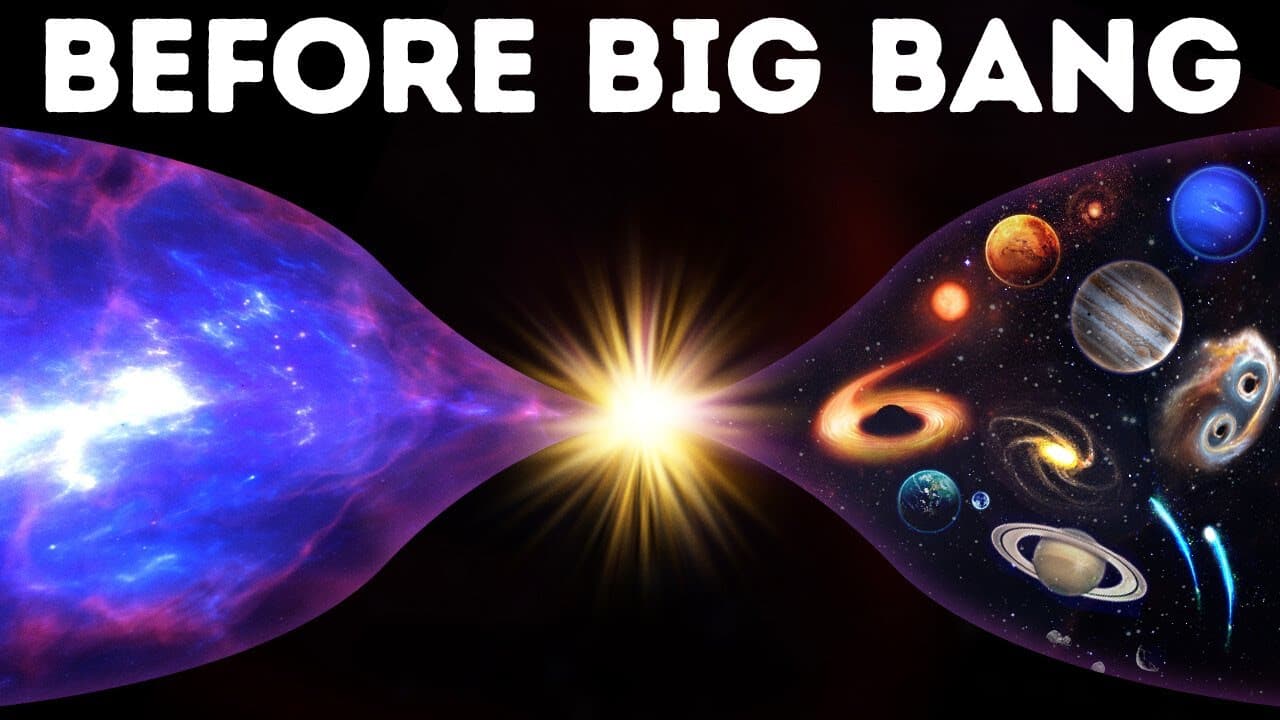
TL;DR
The universe likely began in a hot dense state that expanded, with inflation explaining the even distribution and several competing ideas about a preexisting or repeating cosmos. Evidence points to an expansion from a singularity like start, but no single explanation is confirmed yet, leaving room for ongoing theories.
Transcript
how was our universe born and if this seems hard to answer then how about this what was before our universe while scientists are looking for the answer to the most difficult question in history let's find out what they've come up with so far in the 20th century we've shed the light on this mystery all thanks to this man Edwin Hubble one day on Moun... Read More
Key Insights
- The universe is described as expanding, which implies a beginning in time and space.
- Inflation is presented as a mechanism to distribute matter evenly across the early universe.
- The Big Bang is described as an outburst of energy and matter that formed everything we see today.
- A Cosmic Singularity is debated as the initial condition in some theories.
- Alternative ideas include cyclic universes and multiverse scenarios.
- Some scientists propose preexisting frameworks like string theory and M theory to explain origins.
- Researchers like Guth, Bojowald, Turk, and Steinhardt contribute competing viewpoints to the origin debate.
- The video emphasizes that without definitive evidence, multiple theories remain equally possible.
- More videos from this channel:
- More from this channel: BRIGHT SIDE
Install to Summarize YouTube Videos and Get Transcripts
Explore YouTube Video Summarizer or Get YouTube Transcript Extractor
Questions & Answers
Q: How did Edwin Hubble contribute to our understanding of the universe
Edwin Hubble observed that distant galaxies are moving away from us, which showed the universe is expanding. This key insight led scientists to infer that the universe likely had a beginning in time and space. The observation anchored later theories about how the cosmos originated and evolved over billions of years.
Q: What is the inflation theory and why is it important
Inflation theory proposes that the early universe underwent a rapid acceleration that spread matter instantly and evenly across space. This helps explain the uniform distribution of cosmic matter seen today. Inflation is considered a successful idea by many scientists because it accounts for large scale uniformity without fine tuning.
Q: What is the concept of a Cosmic Singularity
A Cosmic Singularity is described as a state where the universe was incredibly small, dense, and hot. Some theories hold that the universe began from this singular state, while others argue that such a starting point cannot be the complete explanation and that our understanding may require a preexisting or cyclic framework.
Q: Who are Guth and Bojowald and what are their theories
Alan Guth is associated with the inflationary model that explains rapid early expansion. Martin Bojowald offers an alternative view suggesting a sequence of universes where the beginning of one marks the end of another, implying a non isolated origin rather than a single bang. Both contribute to the debate on cosmic beginnings.
Q: What do Turk and Steinhardt propose about parallel universes
Neil Turitt and Paul Steinhardt propose the idea of a multiverse where infinite universes exist in a cyclic pattern of births and rebirths. In their view, our universe could be one of many, connected by higher dimensional structures, with collisions potentially triggering new cosmological events in adjacent realms.
Q: How does string theory relate to the origin of the universe
String theory and M theory are used to explain fundamental forces and particles by proposing extra dimensions. In the context of cosmic origins, these ideas provide a framework for understanding how different universes might arise and interact, offering a basis for speculative models like branes and parallel cosmos.
Q: What is the role of evidence in choosing between theories
Evidence is crucial because multiple theories currently fit the available data, and no single explanation has been proven. Scientists rely on observations, experiments, and mathematical consistency to test ideas like inflation, singularity origins, and multiverse scenarios, with new data potentially favoring one model over others in the future.
Q: Why is the origin of the universe still uncertain
The origin remains uncertain because no theory has been definitively validated by conclusive evidence. The three main approaches—Big Bang with inflation, singularity based ideas, and multiverse concepts—offer plausible explanations, but each requires further empirical support, advanced mathematics, and perhaps new physics to become the accepted description of our cosmic beginnings.
Summary & Key Takeaways
-
A concise overview of how scientists trace the universe’s origin from a hot dense state to an expansive cosmos, highlighting inflation and competing ideas about preexisting conditions.
-
The video contrasts the Big Bang with alternative views such as cyclic or multiverse theories, noting that none is definitively proven yet.
-
The discussion emphasizes that current evidence supports multiple plausible theories, with future discoveries needed to settle the question of how our universe began.
Read in Other Languages (beta)
Share This Summary 📚
Summarize YouTube Videos and Get Video Transcripts with 1-Click
Try YouTube Summary with ChatGPT & Claude or YouTube Transcript Generator
Explore More Summaries from BRIGHT SIDE 📚






Summarize YouTube Videos and Get Video Transcripts with 1-Click
Try YouTube Summary with ChatGPT & Claude or YouTube Transcript Generator