Why Does the US Spend So Much on Defense?
TL;DR
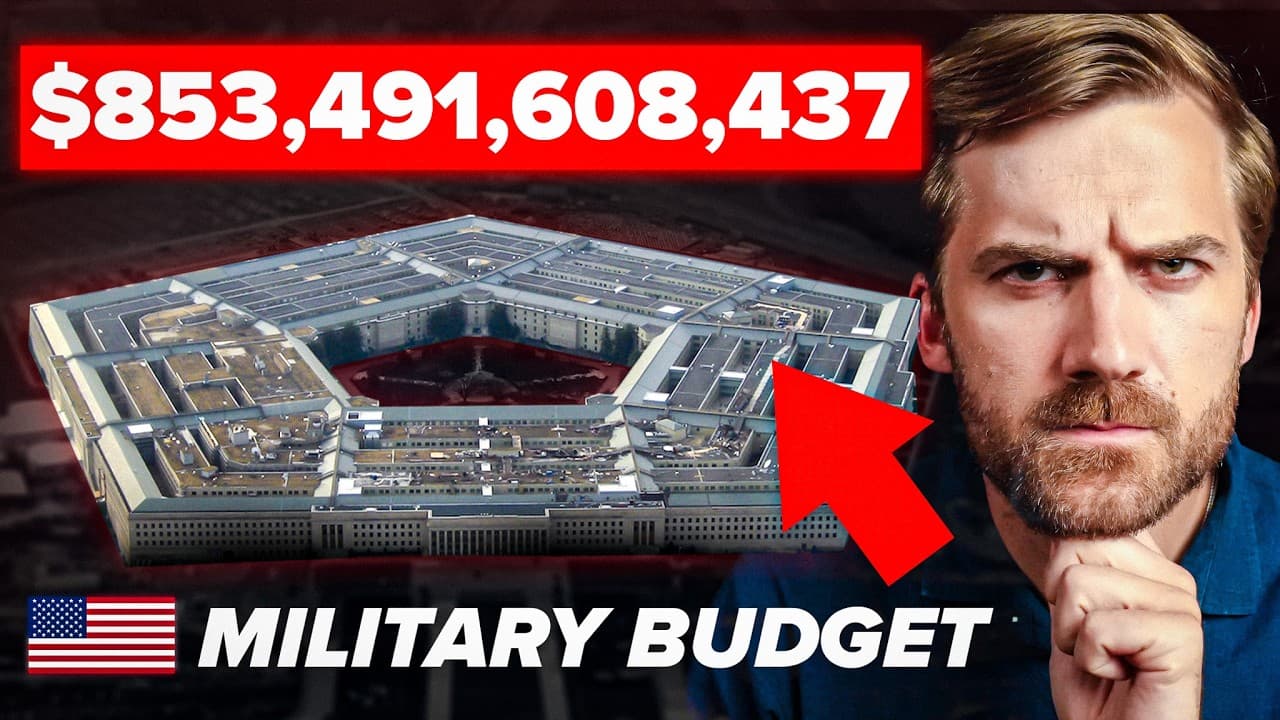
The US spends far more on its military than any other country because it maintains global presence and power projection, with costs spread across personnel, operations, maintenance, and ongoing R&D. The video breaks down where money goes, from bases and salaries to weapons procurement and technology development, and asks if all that spending actually keeps us safer.
Transcript
(intriguing music) - Let me show you how much the United States spends on its military. (intriguing music) Over here you've got Russia, China, India, and other big military powers. And yet, if you combine them all into one, the US still spends more. More than the next 10 countries combined. But I'm interested in what happens inside of this circle. ... Read More
Key Insights
- The US spends more on defense than the next 10 countries combined, reflecting its global military footprint.
- Operations and maintenance is the largest cost segment, covering base operations, training, transportation, fuel, and environmental cleanup.
- The defense budget allocates substantial funds to personnel including pay, benefits, and healthcare for over 3.4 million military and civilian staff.
- R&D is a major pillar, funding future tech such as AI, autonomous systems, and battlefield innovations while enabling technologies used in civilian life.
- Procurement channels billions into aircraft like fighters, ships, and other equipment, illustrating the scale and cost of modern weapon systems.
- The US maintains approximately 1,250 bases, including about 800 abroad, which entails substantial ongoing costs for presence and logistics.
- The video argues that spending is tied to maintaining global influence and enforcement of international rules, not just national defense.
- There is transparency in the data used, comparing public DoD budgets to overall government spending to illuminate where money goes.
- More videos from this channel:
- More from this channel: Johnny Harris
Install to Summarize YouTube Videos and Get Transcripts
Explore YouTube Video Summarizer or Get YouTube Transcript Extractor
Questions & Answers
Q: How much does the Pentagon spend on defense and how is it broken down?
The video presents a detailed view of the Pentagon budget with a total around $853 billion as a core figure for 2023, then breaks this into categories like operations and maintenance, personnel, and procurement. It explains that roughly half of the total funds support operations and maintenance, which includes base operations, fuel, and logistics, while a sizable portion goes to personnel costs, and another large share funds procurement and development of new weapons and technology.
Q: Why is the US defense budget so much larger than other countries' budgets?
The video frames the large U.S. defense budget as a result of the United States acting as a global hegemon with widespread military presence across the globe. This entails maintaining bases abroad, rapid deployment capabilities, and the ability to project power anywhere, which requires extensive funding in personnel, base operations, procurement, and cutting-edge research and development.
Q: What are some specific examples of spending categories mentioned besides salaries?
The video mentions several categories beyond salaries, including operations and maintenance for base infrastructure and environmental cleanup, funding for research and development to maintain technological superiority, and procurement which finances aircraft, missiles, and other major weapons systems. It also notes spending on health services for active duty personnel and disaster relief missions.
Q: How many military bases does the US operate, and where are they located?
The video notes that the United States runs about 1,250 military bases, with roughly 800 located outside the United States. These overseas bases contribute to the high overall cost of defense and illustrate the reach of the U.S. military across different regions, including facilities that resemble a slice of American life abroad.
Q: What technologies originated from the military that are now widely used?
The video asserts that technologies such as GPS, drones, voice recognition, the computer mouse, and the Internet have their roots in military research and development. It emphasizes how defense spending drives advances that later become essential parts of civilian life and commercial technologies.
Q: How does the video describe the relationship between defense spending and safety?
The video questions whether spending at such a high level actually translates into greater safety, contrasting the immense cost with outcomes like risk reduction and threat mitigation. It suggests that while spending enables global presence and technological advances, the direct link to safety is complex and requires scrutiny of effectiveness and strategic goals.
Q: What educational or policy sources does the video reference for defense spending data?
The video cites sources such as the Watson Institute Costs of War Project and the Quincy Institute, and mentions a Google Docs collection of sources for the numbers and decisions shown. It emphasizes transparency and scrutiny by pointing to these public sources to understand how the numbers were derived and what decisions were made.
Q: What practical tip does the sponsor Rocket Money offer in connection with personal budgeting?
Rocket Money is described as a service that identifies reoccurring subscriptions, helps cancel unwanted ones, and negotiates bills to lower rates. The video promotes Rocket Money as a tool to analyze personal spending, set budgets, and gain insights, claiming customers have saved significant amounts by using the app to streamline recurring charges and optimize expenses.
Summary & Key Takeaways
-
The video highlights the scale of the US defense budget and compares it to other countries, emphasizing the global role of the US military.
-
It explains major spending categories such as operations and maintenance, personnel, and procurement, showing how funds are allocated and why the numbers are so large.
-
It argues that the US budget reflects its status as a global hegemon and questions whether such spending translates into increased safety and security.
Read in Other Languages (beta)
Share This Summary 📚
Summarize YouTube Videos and Get Video Transcripts with 1-Click
Try YouTube Summary with ChatGPT & Claude or YouTube Transcript Generator
Explore More Summaries from Johnny Harris 📚





Summarize YouTube Videos and Get Video Transcripts with 1-Click
Try YouTube Summary with ChatGPT & Claude or YouTube Transcript Generator