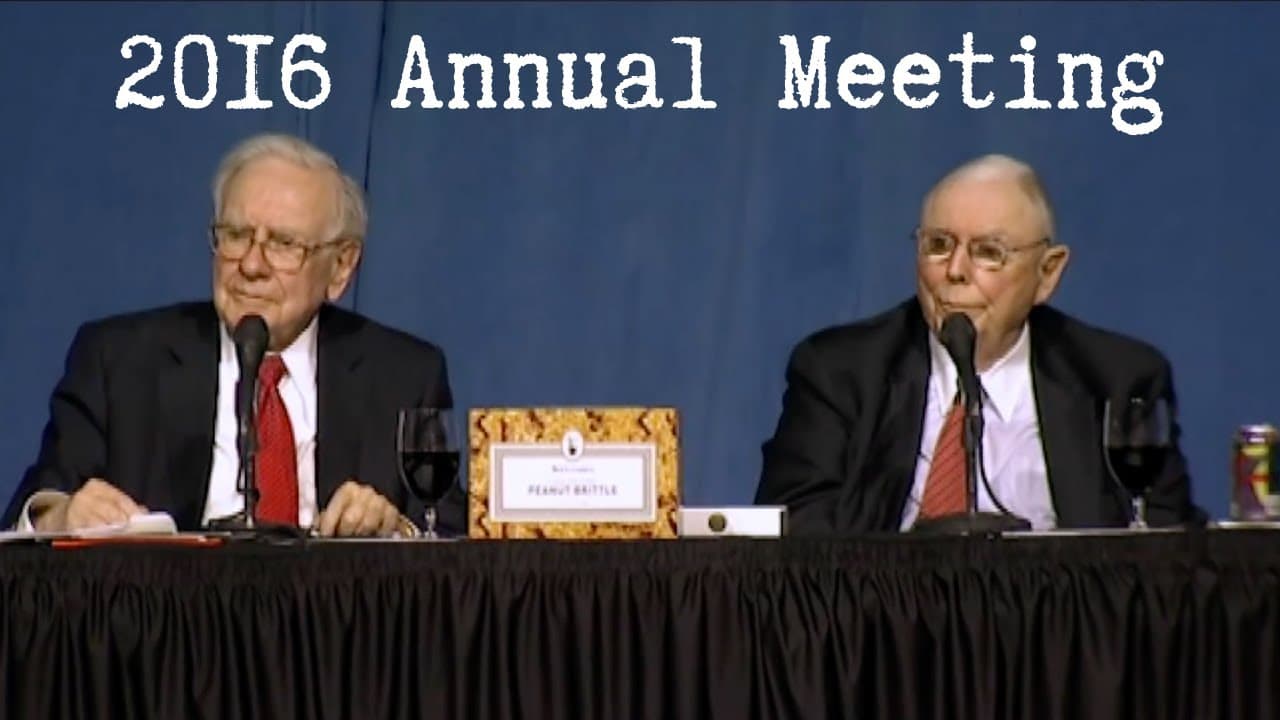
2016 Berkshire Hathaway Annual Meeting (Full Version)
TL;DR
The ideal business takes almost no capital yet keeps growing, letting nearly all earnings be redeployed into new opportunities. As Berkshire grew larger, it was forced into capital-intensive, regulated businesses that earn lower returns, a tradeoff Buffett calls a problem of prosperity. Berkshire never manages quarterly earnings, gives no guidance, and focuses only on building sustainable, growing earning power.
Transcript
good morning i'm warren buffett this is charlie munger i'm the young one and you may notice in the movie incidentally that charlie is always the one that gets the girl and he has one explanation for that but i think mine is more accurate that as you know every mother in this country tells her daughter at an early age if you're choosing between two ... Read More
Key Insights
- The ideal business requires very little capital yet still grows, so almost all of its earnings can be freed up and deployed into new opportunities rather than plowed back to sustain operations.
- As Berkshire grew more prosperous, it was pushed toward businesses that need heavy capital expenditure, are over-regulated, and earn lower returns on equity, which Buffett describes as a problem of prosperity.
- Berkshire deliberately refuses to manage earnings smoothly across quarters, saying it could do so easily but that it would be ridiculous; investment decisions are made solely on merit, not their effect on reported results.
- The company gives no earnings guidance and makes no forecasts, and it runs no budget at the parent level, though most subsidiaries keep budgets they are not required to submit to headquarters.
- Operating earnings will not rise every year because of the business cycle; in recessions Berkshire earns less, and its heavy insurance exposure makes results volatile due to catastrophe losses.
- Insurance catastrophe losses can push results into the red, as happened the year of the September 11 attacks, when Berkshire posted negative operating earnings despite the underlying businesses being sound.
- Berkshire grows earning power through several levers at once: retaining and reinvesting earnings, improving existing operations, making bolt-on acquisitions, and using securities gains to buy even more businesses.
- Foreign-currency borrowing distorts reported interest expense because accounting runs the exchange-rate change through that line each quarter, an effect Buffett urges shareholders to ignore below operating earnings.
Install to Summarize YouTube Videos and Get Transcripts
Explore YouTube Video Summarizer or Get YouTube Transcript Extractor
Questions & Answers
Q: What makes a business ideal according to Warren Buffett?
The ideal business is one that takes little or no capital yet still grows over time. Because so little capital is required to run it, almost all of its earnings become available for deployment into new opportunities rather than being consumed just to keep the business going. Buffett says a few businesses like that exist and Berkshire owns some, but they are rare and hard to acquire at a large scale.
Q: Why did Berkshire shift toward capital-intensive businesses?
Buffett frames it as a problem of prosperity. As Berkshire accumulated more and more money, it could no longer find enough capital-light businesses large enough to move the needle, so it was pushed into companies that require heavy capital expenditure, are over-regulated, and earn lower returns on equity. He notes this hurts compounding of earnings growth, and while he would love to find a large business that is not capital intensive, such opportunities have become much harder to find.
Q: How does Berkshire approach quarterly earnings management?
Berkshire makes no attempt to smooth or manage earnings from quarter to quarter. Buffett says the company could easily do so but that it would be ridiculous. Investment decisions are made solely on the basis of what is judged the best decision, never on how they will affect earnings in any given quarter or year. He urges shareholders to pay no attention to the figures below operating earnings, since those numbers bounce around and are not meaningful in any single period.
Q: Does Berkshire give earnings guidance or use budgets?
No. Buffett states plainly that Berkshire never makes an earnings forecast and does not give out earnings guidance, considering the practice silly. The parent company keeps no budget at all. Most of its subsidiaries do maintain budgets, but they are not required to submit those budgets to headquarters. Instead, management focuses day after day, year after year, and decade after decade on adding sustainable and growing earning power to the company.
Q: Why can Berkshire's operating earnings fall in some years?
Earnings will not increase every year because of the business cycle. In times of recession Berkshire earns less money than when conditions are better. On top of that, the company is heavily involved in insurance, where earnings can be quite volatile because of catastrophes. Buffett points to the year of the September 11 attacks, when significant insurance losses pushed Berkshire into the red on operating earnings, illustrating how irregular the year-to-year figures can be.
Q: How does Berkshire grow its earning power over time?
Berkshire builds earning power through several methods working together. It retains and reinvests earnings from operations, improves the profitability of the businesses it already owns, and makes bolt-on acquisitions to existing subsidiaries. It also adds entirely new subsidiaries and uses gains achieved from securities and derivatives to buy even more businesses. Buffett says the real focus is on making the operations substantially larger five, ten, or twenty years in the future rather than hitting any given short-term number.
Q: How did the first-quarter insurance and railroad results look?
Insurance underwriting was down somewhat on an after-tax basis. The basic underwriting at GEICO was actually improving, but important hail storms in Texas toward the end of the quarter, plus more since, produced heavier catastrophe losses than the prior year. Railroad earnings were down significantly, and car loadings across all the major railroads in the industry fell sharply in the quarter, a trend Buffett expected almost certainly to continue through the balance of the year.
Q: Why does foreign-currency borrowing affect Berkshire's reported interest expense?
When Berkshire borrows money in another currency, the only one being the euro, accounting runs the foreign-exchange change in value through interest expense each quarter. If the euro rises, Berkshire shows extra interest expense; if it falls, the change offsets interest expense. Buffett calls this a technicality, since Berkshire holds many assets in Europe expressed in euros whose gains flow directly to other comprehensive income rather than the income account, so he urges shareholders to disregard the effect.
Summary
Warren Buffett and Charlie Munger discuss various topics, including their investments, the insurance industry, and the shift from push to pull marketing. They also address questions about Coca-Cola and its health effects.
Questions & Answers
Q: How do Warren Buffett and Charlie Munger feel about the shift from push to pull marketing?
Warren Buffett and Charlie Munger recognize the significant shift from push to pull marketing, primarily driven by companies like Amazon. They believe this trend is transformative and have incorporated it into their decision-making process. They acknowledge that companies like Amazon are better at this type of marketing and are adapting accordingly. However, they also believe that Berkshire Hathaway's flexible and diverse business model, which focuses on capital allocation, allows them to navigate this changing landscape effectively.
Q: Why did Berkshire Hathaway reduce its holdings in Munich Re and Swiss Re?
Berkshire Hathaway sold its holdings in Munich Re and Swiss Re because Warren Buffett believes that the reinsurance industry's prospects are not as attractive as they were in the past. The challenges they face include lower investment returns due to low interest rates, the difficulty in finding profitable investments, and increased competition. Buffett also cited the advantage Berkshire Hathaway has in having more capital and a wider range of businesses, giving them more flexibility and better returns on capital. However, he clarified that their decision was not a reflection of the competence of the management teams of Munich Re and Swiss Re.
Q: Is Coca-Cola's sugary drinks and their health effects a concern for Berkshire Hathaway shareholders?
Warren Buffett's personal consumption of Coca-Cola aside, he does recognize the potential health effects of sugary drinks. However, he suggests that individuals should focus on their overall caloric intake rather than solely blaming Coca-Cola or any specific beverage for their health issues. Buffett points out that Coca-Cola has an extensive range of products beyond sugary beverages, and the company has been successful for many years. Moreover, he believes that personal happiness plays a role in overall health, and it is essential to find a balanced approach to calorie consumption.
Q: How does Berkshire Hathaway view the growth and profitability of Geico compared to Progressive Direct?
Warren Buffett and Charlie Munger acknowledge that Progressive Direct has shown higher growth and profitability than Geico in recent times. However, they emphasize that Geico has already grown significantly in market share, surpassing Progressive Direct and Allstate. They also mention that the insurance industry experiences fluctuations driven by factors such as accident frequency and severity, which can impact profitability. Despite Progressive Direct's recent performance, Buffett and Munger remain confident in Geico's long-term prospects and believe it will continue to be a strong competitor in the auto insurance industry.
Q: Is Charlie Munger happy with his and Warren Buffett's business and investment decisions?
Charlie Munger expresses contentment and happiness with his and Warren Buffett's decisions throughout their lives. He emphasizes that personal wealth or fame does not play a significant role in their happiness. Both Munger and Buffett prioritize their personal well-being and enjoyment in their work, which they have managed to achieve over the years. They credit their success to their partnership and their focus on making decisions that align with their values and interests.
Q: How has Berkshire Hathaway adapted to the shift from push to pull marketing?
Berkshire Hathaway has recognized the importance of the shift from push to pull marketing and has incorporated it into their decision-making process. However, they do not see themselves as direct competitors with companies like Amazon. Instead, they focus on their strengths in capital allocation and diverse business interests. By prioritizing the ability to make wise investment decisions and adjusting strategies to changing market dynamics, Berkshire Hathaway aims to remain successful despite the growing influence of pull marketing.
Q: Why did Berkshire Hathaway invest heavily in Precision Castparts and reduce its holdings in Munich Re?
Warren Buffett and Charlie Munger explain that their investment decisions are driven by various factors, including the attractiveness of the industry, capital requirements, and the quality of management. Precision Castparts was an attractive investment because it operated in an industry with high barriers to entry and had a talented CEO, Mark Donegan. In contrast, they reduced their holdings in Munich Re due to concerns about the outlook for the reinsurance industry. They emphasize that these decisions are not a reflection of the competencies of the respective companies' managements but are driven by their assessment of the future prospects in each industry.
Q: How does Warren Buffett view the effect of Coca-Cola products on people's health?
Warren Buffett acknowledges that excessive consumption of sugary drinks can have negative health effects. However, he argues that one should consider the overall balance of their caloric intake and lifestyle choices rather than singling out Coca-Cola products. Buffett personally consumes a significant amount of Coca-Cola but manages his caloric intake from other sources. He also highlights the long history and popularity of Coca-Cola, with billions of servings consumed annually. Ultimately, Buffett believes that personal happiness and moderation are key to a balanced and healthy lifestyle.
Q: How does Berkshire Hathaway view the future profitability of the reinsurance industry?
Warren Buffett expresses a cautious outlook for the reinsurance industry, expecting it to be less profitable in the next 10 years compared to previous years. He attributes this outlook to the low-interest-rate environment and increased competition. While he believes that companies like Munich Re and Swiss Re will continue to do well, he recognizes that Berkshire Hathaway has an advantage due to its large capital base and the flexibility it provides for various investments. He also mentions the challenges faced by reinsurance companies in generating satisfactory returns on their float due to limited investment opportunities.
Q: How does Berkshire Hathaway plan to compete with companies like Amazon in the retail industry?
Warren Buffett and Charlie Munger acknowledge the transformative impact of companies like Amazon on the retail industry. However, they emphasize that Berkshire Hathaway's business model is different, focusing on capital allocation rather than direct competition in specific industries. They believe that their approach, which allows them to invest in a wide range of businesses, gives them a unique advantage. While they acknowledge Amazon's dominance and expertise in certain areas, they highlight Berkshire Hathaway's flexibility and ability to adapt to changing market dynamics, ensuring their success in the long term.
Takeaways
Warren Buffett and Charlie Munger discuss various topics in the video, including their investment decisions, the insurance industry, and the shift from push to pull marketing. They address concerns about the health effects of Coca-Cola products and emphasize the importance of balance and overall caloric intake in maintaining a healthy lifestyle. They also express caution about the profitability of the reinsurance industry and highlight the advantage of Berkshire Hathaway's flexible business model. Despite the challenges posed by companies like Amazon, they remain confident in their ability to adapt and make wise investment decisions.
Summary & Key Takeaways
-
Buffett and Munger open the meeting, noting it is being webcast for the first time and translated live into Mandarin for a global audience, then review first-quarter results before turning to shareholder questions from journalists, analysts, and the audience.
-
Insurance underwriting was down as hail storms in Texas drove catastrophe losses even though GEICO's underlying underwriting improved, railroad earnings and car loadings fell across the industry, and newly added manufacturing businesses had not yet contributed full results.
-
Answering a question about the 1987 shareholder letter, Buffett explains that capital-light businesses that grow while freeing up earnings are ideal but hard to find at Berkshire's scale, forcing it into capital-intensive, lower-return ventures as a cost of its own success.
Read in Other Languages (beta)
Share This Summary 📚
Summarize YouTube Videos and Get Video Transcripts with 1-Click
Try YouTube Summary with ChatGPT & Claude or YouTube Transcript Generator
Explore More Summaries from Investor Archive 📚

Summarize YouTube Videos and Get Video Transcripts with 1-Click
Try YouTube Summary with ChatGPT & Claude or YouTube Transcript Generator