How to Self-Teach Effectively and Build Curriculum
TL;DR
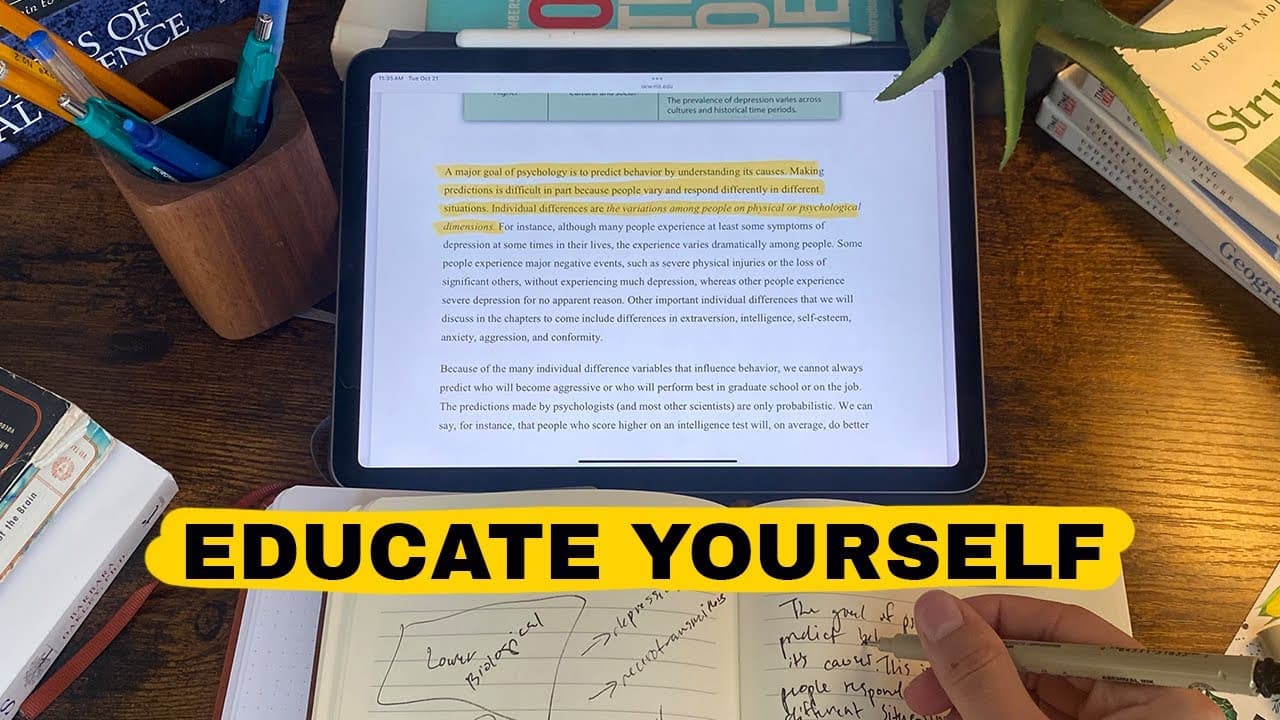
To teach yourself effectively, start by clarifying your motivations and setting clear goals. Create a personalized learning roadmap and gather resources such as textbooks and online courses. Use active recall and spaced repetition to reinforce knowledge, and establish consistent study habits by deciding when, where, and how long you'll study each day.
Transcript
Okay, so if you've ever tried to teach yourself anything, you've probably realized that it is incredibly freaking hard and I understand the struggle as I've been doing it for years. I dropped out of university in 2020 and since then I've taught myself all sorts of things like everything from YouTube and online business and now to stuff like psychol... Read More
Key Insights
- Motivation is crucial for self-learning; genuine curiosity sustains progress through difficult phases.
- A learning roadmap outlines what to study and in what order, tailored to your personal goals.
- Massive Open Online Courses (MOOCs) provide structured syllabi that can be adapted for self-study.
- Effective learning requires a blend of acquiring, reviewing, and creating to solidify understanding.
- Active recall and spaced repetition are essential techniques for long-term memory retention.
- Creating projects or teaching others helps deepen understanding and identify knowledge gaps.
- Studying consistently requires establishing specific times, locations, and durations for study sessions.
- A supportive study environment enhances focus and reduces reliance on willpower.
Install to Summarize YouTube Videos and Get Transcripts
Explore YouTube Video Summarizer or Get YouTube Transcript Extractor
Questions & Answers
Q: How to maintain motivation while self-teaching?
Maintaining motivation while self-teaching requires starting with genuine curiosity rather than obligation. Clarify your reasons for learning and ensure they align with your interests. Recognize the natural learning phases, such as the initial excitement and the subsequent 'dip,' and prepare strategies to push through challenging periods. Set clear, achievable goals and celebrate small victories to sustain motivation.
Q: What is a learning roadmap and how to create one?
A learning roadmap is a personalized plan outlining what you'll study and in what sequence, tailored to your goals. To create one, determine your desired depth of knowledge, whether foundational or mastery. Use resources like MOOCs for structured course outlines. Adapt the roadmap to suit your pace and preferences, and include checkpoints or deadlines if they help maintain focus.
Q: What resources are essential for self-education?
Essential resources for self-education include an up-to-date foundational textbook with practice questions, engaging lecture series, and a comprehensive reading list. Use MOOCs for structured course material and consider adding curiosity-driven books to maintain interest. Joining online or local communities provides support and motivation, combating the isolation often associated with self-study.
Q: How to effectively reinforce knowledge while learning?
To effectively reinforce knowledge, integrate active recall and spaced repetition into your study routine. Active recall involves testing yourself on the material, using tools like flashcards or quizzes. Spaced repetition involves reviewing the material at increasing intervals to strengthen memory retention. These techniques ensure information moves from short-term to long-term memory, enhancing understanding.
Q: Why is creating projects important in self-learning?
Creating projects is crucial in self-learning because it allows you to apply and synthesize knowledge, deepening understanding. Projects, such as essays or presentations, reveal gaps in your knowledge and encourage critical thinking. They transform theoretical knowledge into practical skills, making learning more engaging and memorable. Assign yourself tasks that challenge and encourage exploration of the subject matter.
Q: How to establish effective study habits?
Establishing effective study habits involves answering three key questions: when, where, and how long you'll study. Choose specific times when your energy levels are high, and create a conducive study environment free from distractions. Decide on a realistic daily study duration and stick to it consistently. A well-structured routine minimizes reliance on willpower and makes studying an automatic part of your day.
Q: What role does environment play in self-education?
The environment plays a significant role in self-education by influencing focus and productivity. A well-organized, distraction-free study space enhances concentration and reduces the need for motivation. Remove potential distractions like phones or loud music, and add elements that aid focus, such as comfortable seating or study materials. A supportive environment fosters consistent study habits and facilitates learning.
Q: How to balance consuming information and applying it?
Balancing information consumption and application involves integrating review and creation into your study routine. While acquiring knowledge is essential, ensure you also review it through active recall and spaced repetition. Apply what you've learned by creating projects or teaching others, which solidifies understanding and reveals knowledge gaps. This balanced approach prevents passive consumption and promotes active learning.
Summary & Key Takeaways
-
To successfully teach yourself, start by identifying your true motivations for learning and set clear, achievable goals. Create a personalized learning roadmap that outlines your study plan, using resources like MOOCs for guidance. Effective learning involves acquiring knowledge, reviewing it through techniques like active recall and spaced repetition, and applying it through projects.
-
Gather essential resources such as textbooks, lectures, and reading lists to support your self-education journey. Establish a study routine by deciding when, where, and how long you'll study each day. A conducive study environment is crucial for maintaining focus and consistency, reducing the need for willpower.
-
Avoid the trap of continuous consumption by balancing knowledge acquisition with review and creation. Use tools like flashcards and quizzes for active recall, and consider online communities for support and motivation. By nurturing success habits, you can make learning a daily, automatic part of your life.
Read in Other Languages (beta)
Share This Summary 📚
Summarize YouTube Videos and Get Video Transcripts with 1-Click
Try YouTube Summary with ChatGPT & Claude or YouTube Transcript Generator
Explore More Summaries from bri does things 📚






Summarize YouTube Videos and Get Video Transcripts with 1-Click
Try YouTube Summary with ChatGPT & Claude or YouTube Transcript Generator