How to Retain New Knowledge Using ChatGPT
TL;DR
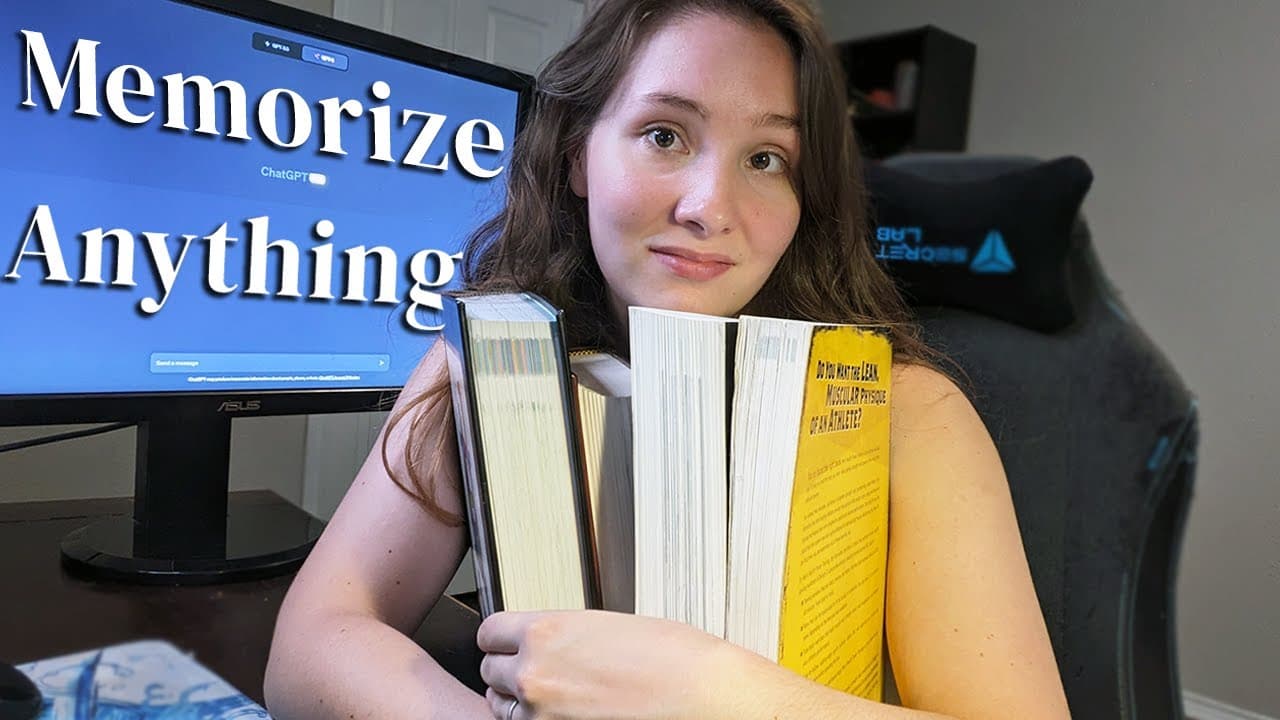
Use ChatGPT to turn passive information consumption into active practice through spaced review, self-explanation, targeted feedback, and memorable associations. Ask it to schedule reviews, quiz you according to your mistakes, challenge your explanations, uncover missing knowledge, supply deeper reasons, create humorous stories, adopt fictional characters, or connect facts to familiar locations.
Transcript
this video is sponsored by short form but more on them later okay so I consume a lot of information on a day-to-day basis I am completely obsessed with teaching myself all sorts of different skills and subjects so I'm constantly learning new things on top of all the information I consume in my day-to-day life from books to podcasts to newsl... Read More
Key Insights
- Spaced repetition is a review technique that revisits information at increasing intervals over time. ChatGPT can create a schedule for a chosen topic and learning period, identifying when particular material should be reviewed to counter the rapid forgetting that follows initial exposure.
- Adaptive quizzing is a way to connect review timing with actual performance. After receiving a class topic, learning objectives, and test timeline, ChatGPT can ask questions, distinguish correct responses from mistakes, and recommend when weaker material should be studied again.
- The Feynman technique is practiced by explaining a subject in simple language. ChatGPT can act like an inquisitive five-year-old, ask follow-up questions, identify incorrect explanations, and provide an answer when the learner reaches a question they cannot resolve independently.
- Rephrasing is an active comprehension check that requires learners to state their knowledge in their own words. ChatGPT can analyze that explanation, suggest improvements, highlight errors, and identify gaps, giving the learner a focused list of areas requiring further study.
- Character-based teaching is a method that assigns ChatGPT a personality suited to the subject. Asking a character such as Socrates to discuss death can turn an abstract lesson into an emotional, imaginative, and story-driven exchange that may be more memorable than conventional studying.
- Elaborative interrogation is the practice of asking why a known fact is true. Instead of memorizing only that Paris is France's capital, a learner can ask ChatGPT to explain why, creating deeper context around the fact and making it more likely to be remembered.
- Narrative creation is a technique that converts information into a short, memorable story. ChatGPT can make the story humorous or absurd, such as portraying cellular organelles as participants with different responsibilities at a party, so each concept gains a distinctive narrative role.
- A memory palace is a mnemonic method that associates information with locations in a familiar setting. ChatGPT can guide the learner through a chosen place, linking concepts such as Mesopotamia, Egypt, and the Roman Empire to the door, cash register, and seating area.
Install to Summarize YouTube Videos and Get Transcripts
Explore YouTube Video Summarizer or Get YouTube Transcript Extractor
Questions & Answers
Q: How can ChatGPT create a spaced repetition schedule?
Tell ChatGPT what subject you want to study, how long you have, and that the schedule should use spaced repetition. Ask it to place reviews at increasing intervals across that period and specify which topics to revisit on each day. The resulting plan provides repeated exposure while gradually increasing the time between reviews, helping the material remain available longer.
Q: How can ChatGPT prepare me for a test using quizzes?
Provide ChatGPT with the class subject, the number of weeks before the test, and either the relevant topics or your learning objectives. Ask it to quiz you and track which answers are right or wrong. It can then use your performance to recommend when each area should be reviewed, giving more attention to material that caused difficulty.
Q: How do I use the Feynman technique with ChatGPT?
Ask ChatGPT to behave like a five-year-old who asks questions, admits confusion, and waits for each response. Explain the topic in simple terms as though you were teaching that child. Request corrections whenever your explanation is wrong. If a question exposes something you cannot explain, ask ChatGPT how it would answer, then use that response to fill the gap.
Q: How can rephrasing improve my understanding of a topic?
Write an explanation of the topic entirely in your own words, including everything you currently believe you know. Ask ChatGPT to analyze it, suggest improvements, identify mistakes, and point out missing knowledge. The response separates material you understand from areas that remain unclear, allowing later review and memorization practice to focus on the gaps instead of repeating everything.
Q: How can fictional characters make studying more memorable?
Choose a character whose personality or perspective fits the topic, then ask ChatGPT to explain or ponder the subject in that character's voice. For example, the transcript suggests assigning Socrates to a discussion about the meaning of death. This creates an imaginative, story-like lesson that can feel more engaging and emotionally distinctive than a standard factual explanation.
Q: What is elaborative interrogation with ChatGPT?
Elaborative interrogation means asking why a fact is true instead of stopping after memorizing the fact itself. Give ChatGPT a statement you want to retain, then ask why it is that way and request deeper guidance. Its explanation adds reasons and context around the original fact, producing a richer understanding that is more likely to remain memorable.
Q: How can ChatGPT turn study material into a memorable story?
Ask ChatGPT to convert the target information into a short story and request that it be humorous, unusual, or absurd. You can supply a premise, such as cells holding a party where each organelle has a different role, or let ChatGPT invent one. The story gives individual terms distinctive actions and relationships that can support later recall.
Q: How do I build a memory palace with ChatGPT?
Choose a familiar place and tell ChatGPT which topic you want to memorize. Ask it to guide you through that setting while assigning each concept to a specific location. One example connects Mesopotamia with a coffee shop door, Egypt with the cash register, and the Roman Empire with the main seating area, creating spatial cues for recall.
Summary & Key Takeaways
-
ChatGPT can organize spaced repetition by scheduling reviews at increasingly wider intervals across a chosen learning period. It can also quiz you, evaluate correct and incorrect responses, and recommend when to revisit specific material before a test. This approach repeatedly strengthens information that might otherwise be forgotten soon after learning.
-
Active explanation reveals whether knowledge is genuinely understood. You can teach a topic to ChatGPT while it behaves like a questioning five-year-old, or write everything you know in your own words and request corrections. Its questions and feedback expose errors, unclear reasoning, and missing details that deserve additional review and practice.
-
Imaginative associations can make information easier to recall. ChatGPT can present lessons through a suitable fictional or historical character, explain why a fact is true, transform technical material into an absurd story, or build a memory palace by linking concepts to distinct locations inside a familiar place such as a coffee shop.
Read in Other Languages (beta)
Share This Summary 📚
Summarize YouTube Videos and Get Video Transcripts with 1-Click
Try YouTube Summary with ChatGPT & Claude or YouTube Transcript Generator
Explore More Summaries from bri does things 📚


Summarize YouTube Videos and Get Video Transcripts with 1-Click
Try YouTube Summary with ChatGPT & Claude or YouTube Transcript Generator