Roger Penrose: Was the Big Bang Really the Beginning of the Universe?
TL;DR
Roger Penrose argues that the Big Bang was not the universe’s beginning but the start of one eon in a continuing cycle. His Conformal Cyclic Cosmology connects a previous eon’s remote future to a new Big Bang because mass becomes irrelevant at both boundaries, leaving conformal geometry without a fixed scale. He also rejects inflation and considers quantum mechanics fundamentally flawed. Read on for his reasoning about cosmology, mass, consciousness, and AI.
Transcript
My idea is a crazy idea, and I admit it's a crazy idea. But you need something crazy because the conventional ideas don't work. And I think people just sort of go with the crowd. I'm just not persuaded by going with the crowd. It doesn't make sense. I don't believe a word of it. The Big Bang was not the beginning. The same as quantum mechanic... Read More
Key Insights
- Roger Penrose argues the Big Bang was not the beginning of the universe.
- Conformal Cyclic Cosmology posits that each Big Bang is a continuation of a previous universe's remote future.
- In Penrose's model, mass becomes irrelevant at both the Big Bang and the universe's remote future.
- Quantum mechanics is considered incomplete by Penrose, who believes it requires significant revision.
- Penrose suggests that consciousness involves non-computational processes, which current AI cannot replicate.
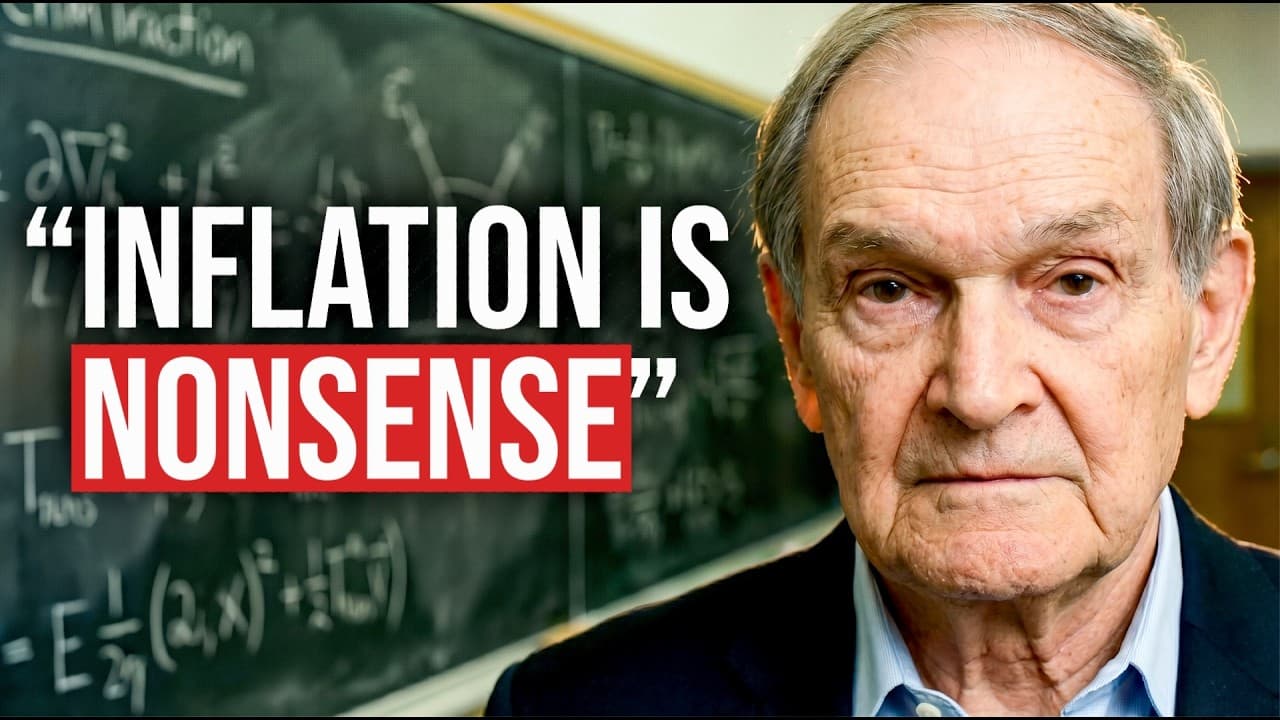
- Standard cosmology's inflation theory is criticized by Penrose for not explaining the universe's uniformity.
- Penrose's theory suggests a gravitational wave function collapse that ties into consciousness.
- The collapse of the wave function, according to Penrose, is a gravitational effect not yet fully understood.
Install to Summarize YouTube Videos and Get Transcripts
Explore YouTube Video Summarizer or Get YouTube Transcript Extractor
Questions & Answers
Q: Why does Roger Penrose believe the Big Bang was not the beginning of the universe?
Penrose proposes that the universe passes through cycles, with each cycle beginning in its own Big Bang and ending in a remote future. In Conformal Cyclic Cosmology, that remote future becomes the conformal continuation of the next eon’s Big Bang.
Q: What is Roger Penrose’s Conformal Cyclic Cosmology?
Conformal Cyclic Cosmology is Penrose’s model in which successive cosmic eons are joined together. Each eon starts with a Big Bang, reaches a remote future, and connects conformally to the following eon.
Q: Why does mass become irrelevant at both ends of a cosmic eon?
Near the Big Bang, temperatures are so high and particles move so fast that their rest-mass contribution becomes trivial compared with their kinetic motion. In the remote future, the mass terms of Dirac particles scale away, while photons are already massless, so particles become effectively massless.
Q: How does conformal geometry connect the remote future to another Big Bang?
When mass is absent, there is no scale, leaving conformal geometry as the relevant structure. Because conformal geometry preserves angles while allowing sizes to change, Penrose says a remote future can match a stretched-out Big Bang.
Q: Why does Penrose reject cosmic inflation?
Penrose does not believe inflation adequately explains why the universe began smoothly. He asks why the proposed smoothing works toward the Big Bang but does not smooth the singularities inside black holes when considered in the reverse direction.
Q: How does Penrose contrast the Big Bang with black holes?
Penrose describes the universe’s origin as smooth but black-hole singularities as tumultuous. He argues that inflation does not satisfactorily explain this contrast, whereas his cyclic model connects the smooth origin to the conformal remote future of an earlier eon.
Q: What is Penrose’s critique of quantum mechanics?
Penrose says quantum mechanics is extremely accurate but has something major missing and even calls it wrong rather than merely incomplete. He associates the unresolved collapse of the wave function with a gravitational effect and connects that problem to consciousness.
Q: Why does Penrose believe AI cannot achieve true understanding?
Penrose argues that consciousness involves non-computational processes. Because current AI lacks those processes, he believes it cannot truly reproduce human understanding or awareness.
Summary & Key Takeaways
-
Roger Penrose proposes that the Big Bang was not the universe's starting point but part of a cyclical process he calls Conformal Cyclic Cosmology. This theory suggests each Big Bang is the continuation of a previous universe's remote future, challenging standard cosmological models that rely on inflation to explain the universe's uniformity.
-
Penrose critiques quantum mechanics as incomplete, arguing it fails to account for consciousness, which he believes involves non-computational processes. He posits that consciousness and the collapse of the wave function are linked, with the latter being a gravitational effect that remains unresolved within current scientific frameworks.
-
Penrose's views extend to questioning the capabilities of AI, which he claims cannot truly understand or replicate human consciousness. He emphasizes the limitations of AI, which lacks the non-computational elements he associates with human awareness and understanding.
Read in Other Languages (beta)
Share This Summary 📚
Summarize YouTube Videos and Get Video Transcripts with 1-Click
Try YouTube Summary with ChatGPT & Claude or YouTube Transcript Generator
Explore More Summaries from Curt Jaimungal 📚

Summarize YouTube Videos and Get Video Transcripts with 1-Click
Try YouTube Summary with ChatGPT & Claude or YouTube Transcript Generator