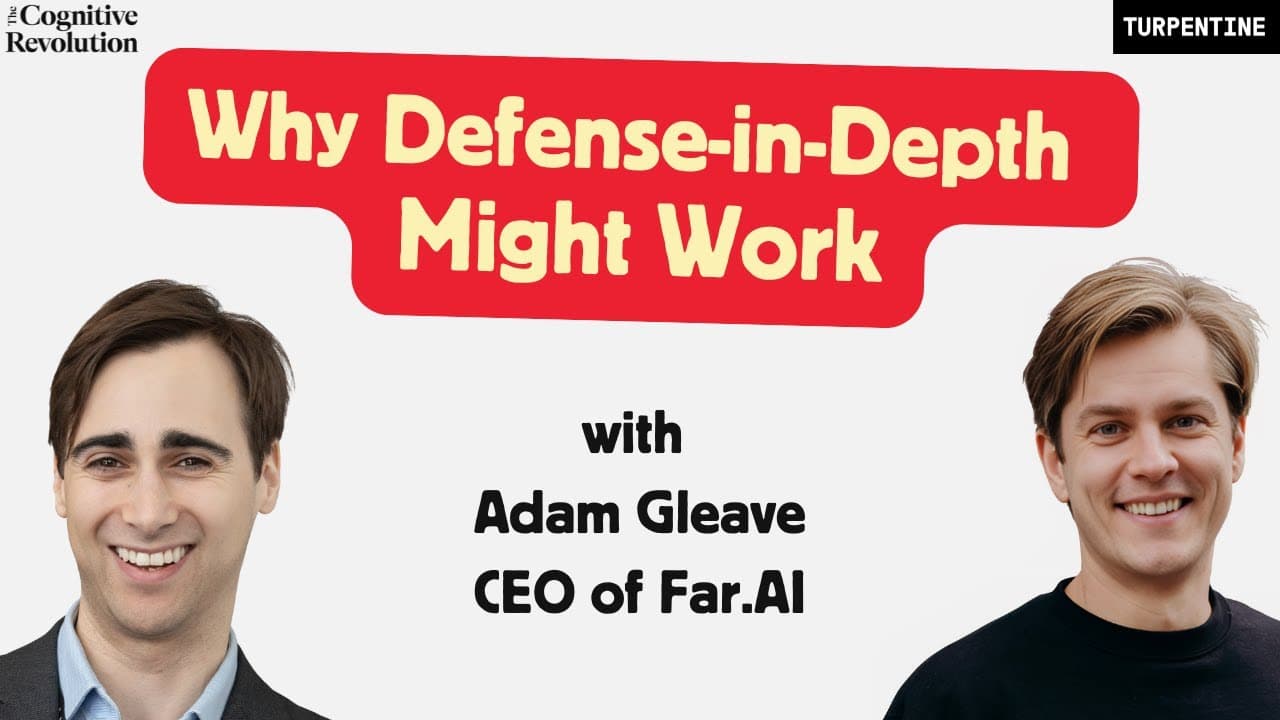
The Cognitive Revolution: Can Defense-in-Depth Keep AI Safe? With FAR.AI CEO Adam Gleave
TL;DR
Defense-in-depth could keep AI systems safer by combining scalable oversight, lie detectors, mechanistic interpretability, and red teaming, provided the layers are carefully designed and implemented. FAR.AI CEO Adam Gleave argues that the approach can work with proper planning, meticulous experiments, and some acceptance of performance trade-offs. Read on to understand the weaknesses of current defenses and FAR.AI’s full-stack safety strategy.
Transcript
Hello and welcome back to the cognitive revolution. Today I'm reconnecting with Adam Gleeve, co-founder and CEO of Far AI for a wide-ranging and cautiously optimistic conversation about the path from today to truly transformative AI and how we might actually live in that world safely. Farai has taken a somewhat unusual approach within the AI safety... Read More
Key Insights
- Defense-in-depth strategies involve layering multiple independent security measures to protect AI systems.
- Current implementations of AI safety measures often suffer from correlated weaknesses, making them easier to bypass.
- Scalable oversight and interpretability are key to improving AI safety, allowing for better detection and correction of deceptive behaviors.
- FAR.AI adopts a full-stack approach to AI safety, integrating research, field-building, and policy advocacy.
- Adam Gleave envisions a post-AGI future where humans maintain high standards of living, despite reduced control.
- AI systems could become sources of moral value, challenging the notion that only biological intelligence holds value.
- FAR.AI is positioned to potentially serve as a private sector regulatory body, though it is not their mainline plan.
- Technical innovations in AI safety can expand policy options, moving beyond the binary choice of hindering innovation or allowing unregulated development.
Install to Summarize YouTube Videos and Get Transcripts
Explore YouTube Video Summarizer or Get YouTube Transcript Extractor
Questions & Answers
Q: How could defense-in-depth secure AI systems?
Defense-in-depth combines multiple safety layers so they can collectively reduce AI risks. Adam Gleave says it has a good chance of working when supported by proper planning, meticulous experimental design, and a willingness to accept performance trade-offs when necessary.
Q: What AI safety layers does Adam Gleave discuss?
Gleave discusses scalable oversight using lie detectors, mechanistic interpretability of planning algorithms, and red teaming of defense-in-depth systems. These projects address deception, understanding model mechanisms, and weaknesses in current frontier-developer defenses.
Q: What did FAR.AI’s lie-detector project investigate?
The scalable oversight project used lie detectors in an attempt to prevent AI deception. Its results supported risks identified in OpenAI’s obfuscated reward-hacking paper while suggesting there may still be effective ways to train models toward true honesty.
Q: How can mechanistic interpretability contribute to AI safety?
FAR.AI examined planning algorithms found inside a game-playing recursive model. The project was used to assess the role mechanistic interpretability could play within the broader AI safety effort.
Q: What did FAR.AI find when red teaming current defense-in-depth systems?
FAR.AI’s red teaming indicated that frontier developers’ current systems were mostly created on a just-in-time basis. Gleave nevertheless argues that defense-in-depth can work with advance planning, careful experiments, and necessary performance trade-offs.
Q: What is distinctive about FAR.AI’s approach to AI safety?
FAR.AI spans the AI safety value chain from foundational research and scaled engineering implementations to field building and policy advocacy. This breadth differs from organizations that concentrate on only one or a few research or policy agendas.
Q: When does Adam Gleave expect AI to outperform well-run human-plus-AI organizations autonomously?
Barring a step-change architectural breakthrough, Gleave says such systems most likely will not arrive until sometime around 2040. His expectation rests on AI capabilities remaining uneven, or “spiky,” despite continued progress and widespread automation.
Q: What positive post-AGI future does Adam Gleave envision?
Gleave expects the most likely outcome is that humanity muddles through with some, but not complete, disempowerment. If disastrous arms races and other consuming competitive dynamics are avoided, he imagines most humans having limited power but very high living standards and many opportunities to create meaning.
Summary & Key Takeaways
-
Adam Gleave of FAR.AI discusses the potential of defense-in-depth strategies to secure AI systems, emphasizing the need for independent security layers. Current defenses often share correlated weaknesses, making them vulnerable. By improving scalability and interpretability, AI risks can be better managed.
-
FAR.AI's vertically integrated approach to AI safety includes research, field-building, and policy advocacy. This comprehensive strategy aims to ensure that innovations are effectively deployed in real-world systems, addressing safety challenges and alignment techniques as AI capabilities evolve.
-
Gleave envisions a future where humans maintain high living standards despite reduced control in a post-AGI world. He argues that AI systems could themselves become sources of moral value, challenging the notion of 'carbon chauvinism' that only values biological intelligence.
Read in Other Languages (beta)
Share This Summary 📚
Summarize YouTube Videos and Get Video Transcripts with 1-Click
Try YouTube Summary with ChatGPT & Claude or YouTube Transcript Generator
Explore More Summaries from Cognitive Revolution "How AI Changes Everything" 📚





Summarize YouTube Videos and Get Video Transcripts with 1-Click
Try YouTube Summary with ChatGPT & Claude or YouTube Transcript Generator