How to choose between AI agents and business rules
TL;DR
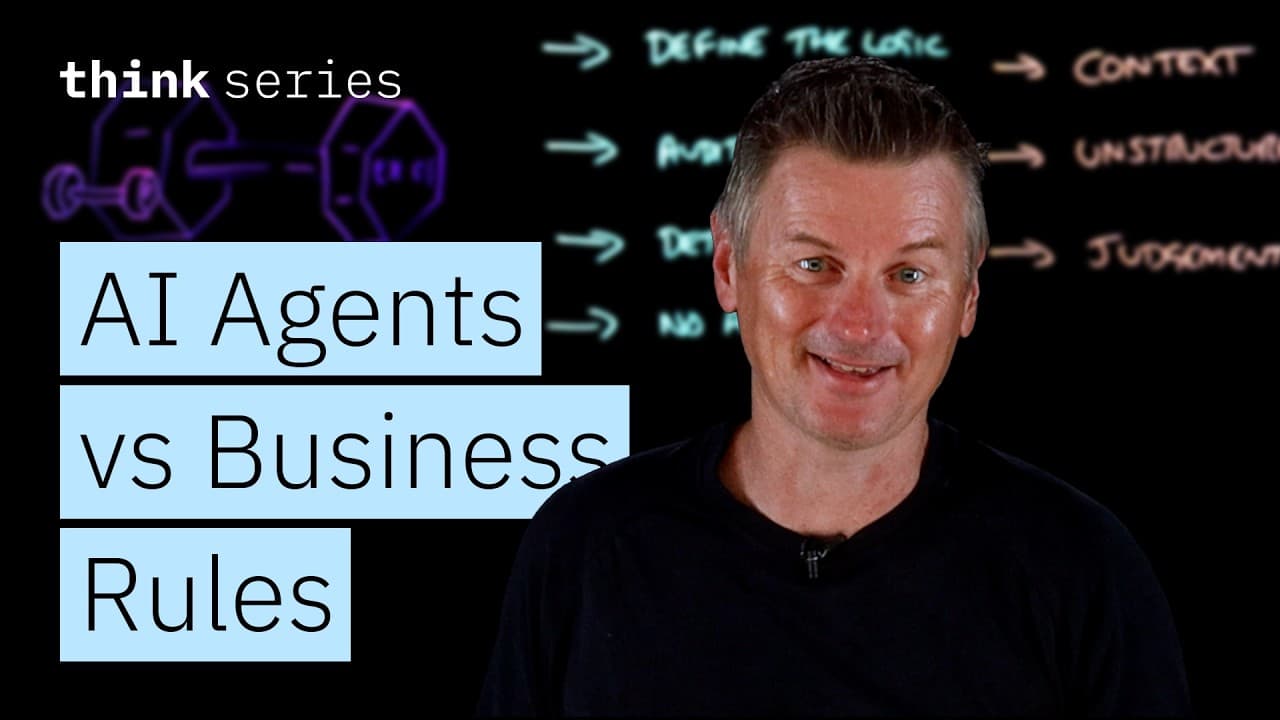
Deterministic rules are best for well defined decisions, while AI agents excel when data is messy or context matters. Use a hybrid approach with guardrails and human oversight to route uncertain cases. This combination leverages the strengths of both approaches rather than replacing one with the other.
Transcript
Both business rules and AI agents are ways to automate a decision. So maybe that's to approve a refund or maybe to flag a transaction, but they go about this in different ways. So my question to you is this. Have AI agents superseded business rules or do they both have their place? And what's the difference between these things anyway? Well, let's ... Read More
Key Insights
- Rules are deterministic and check fixed facts to produce a fixed output.
- AI agents are probabilistic and choose outcomes from a distribution of likely answers.
- A hybrid flow uses rules first for quick, cheap decisions and agents for cases beyond predefined policy.
- Agents expand context by calling tools and evaluating unstructured data like text or images.
- Guardrails and human in the loop help manage high-stakes or ambiguous decisions.
- Rules engines provide explanations by pointing to the exact condition that triggered the decision.
- Deterministic rules are easier to test and do not incur AI inference costs.
- Ultimately, AI agents and business rules complement each other in real systems.
Install to Summarize YouTube Videos and Get Transcripts
Explore YouTube Video Summarizer or Get YouTube Transcript Extractor
Questions & Answers
Q: What is the main difference between AI agents and business rules in decision making
The main difference is that business rules are deterministic, meaning they produce a fixed output given the input after evaluating explicit conditions. AI agents are probabilistic, meaning they generate likely outcomes based on patterns learned from data and may differ across runs. This fundamental distinction drives when each approach is appropriate.
Q: When should a business rule be preferred over an AI agent
A business rule should be preferred when the decision is well defined and structured, such as checking if an order is under 30 days and not final sale to approve a refund. In these cases the logic is explicit, easy to audit, and can be tested deterministically without calling AI models.
Q: What makes AI agents suitable for unstructured data
AI agents are suitable for unstructured data because they can operate with goals, context, and various tools to interpret free text, images, or messy input. They decide actions by considering the policy and customer data, and they call appropriate tools to gather information needed to make a decision.
Q: How does a hybrid flow decide between rules and agents
In a hybrid flow, rules are checked first because they are cheap and fast. If the rules can clearly determine the decision, that output is used. If the rules cannot decide, the case is escalated to an AI agent for further analysis, potentially with tool calls and context evaluation.
Q: What role do guardrails play in AI-driven decisions
Guardrails act as safety checks that limit what the AI agent can do and ensure outputs stay within acceptable boundaries. They can route high risk or high confidence decisions to humans, while lower risk cases may proceed automatically, balancing automation with oversight.
Q: Why are explanations important in a rules-based system
Explanations are important because the rules engine can point at the exact condition that triggered the decision, supporting auditability and traceability. This transparency is valuable for regulated work and for validating that the decision followed predefined policies.
Q: Can AI agents replace business rules completely
No, AI agents cannot reliably replace business rules entirely. Rules provide deterministic outcomes and low-cost, auditable decisions for well defined scenarios. AI agents add flexibility for uncertain or unanticipated cases, and the most effective systems blend both approaches with guardrails.
Q: What benefits do both approaches offer when used together
Using both approaches together leverages the predictability of rules and the adaptability of agents. Rules handle straightforward cases quickly, agents handle complex or unstructured scenarios, and human oversight ensures accountability in high-stakes decisions, resulting in more robust and scalable automation.
Summary & Key Takeaways
-
Rules provide consistent, deterministic outcomes by evaluating fixed conditions, making audits and testing straightforward.
-
AI agents handle unstructured input and complex contexts by using goals and tools, offering flexible reasoning at the cost of probabilistic outcomes.
-
A practical flow often starts with rules, escalates to agents for unclear cases, and uses guardrails and human oversight to ensure accuracy.
Read in Other Languages (beta)
Share This Summary 📚
Summarize YouTube Videos and Get Video Transcripts with 1-Click
Try YouTube Summary with ChatGPT & Claude or YouTube Transcript Generator
Explore More Summaries from IBM Technology 📚


Summarize YouTube Videos and Get Video Transcripts with 1-Click
Try YouTube Summary with ChatGPT & Claude or YouTube Transcript Generator