How to Clone a $100K Website in 15 Minutes with Claude Code
TL;DR
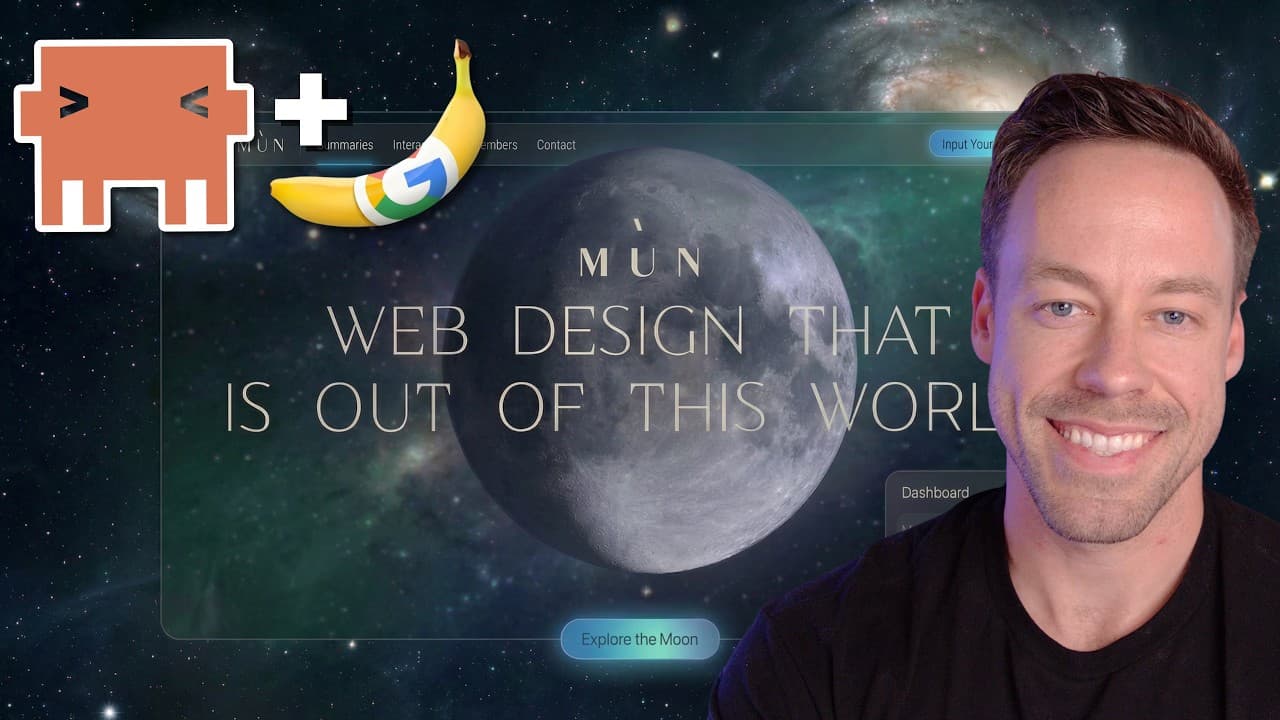
You can clone a $100,000 website in 15 minutes with Claude Code by following five steps: find inspiration, tear down the site, create assets, build the clone, and iterate. The demonstration uses the Moon website as a template and recreates its shadowing, parallax motion, and scroll animation, producing what the speaker calls a “90% solution.” Read on for the specific inputs and workflow behind the rebuild.
Transcript
Today, we're going to steal a $100,000 website like this one in 15 minutes using Claude Code. And I'm going to show you exactly how to do it in a simple, repeatable fivestep process. So, you can then go out there and take any site you want and use it as a template for your own creations. This is a great way to build a foundation for your website th... Read More
Key Insights
- Claude Code allows users to clone websites through a structured five-step process.
- Finding inspiration from award-winning websites helps in identifying creative designs.
- Site teardown involves understanding the HTML, CSS, and JavaScript of a website.
- Asset creation is crucial and can be done using AI tools like Nanobanana Pro.
- Building the site involves using Claude Code to reconstruct the website with the provided assets.
- Iteration helps refine the cloned website to achieve a closer resemblance to the original.
- The process teaches front-end design skills, enhancing understanding of animations and effects.
- Deconstructing websites exposes users to design techniques they can apply to their own projects.
Install to Summarize YouTube Videos and Get Transcripts
Explore YouTube Video Summarizer or Get YouTube Transcript Extractor
Questions & Answers
Q: How do you clone a website with Claude Code?
Follow five steps: find inspiration, perform a site teardown, create the necessary assets, build the website with Claude Code, and iterate on the result. The demonstration applies this process to the Moon website and produces what the speaker describes as a “90% solution,” rather than a one-for-one copy.
Q: How can you clone a $100,000 website in 15 minutes with Claude Code?
Use an existing site as a template, collect its HTML and representative screenshots, and have Claude Code examine its CSS and JavaScript files. Then create the required visual assets, assemble the clone, and refine it through iteration.
Q: What does Claude Code need for a website teardown?
Claude Code needs the site’s HTML, CSS, and JavaScript. The HTML provides the page structure, the CSS supplies its styling, and the JavaScript controls interactions such as what happens when a button is pressed.
Q: How do you provide a website’s HTML to Claude Code?
Open the target page and press Control-U to display its HTML source. Select all of that source, copy it, and paste it into Claude Code.
Q: Why should you give Claude Code screenshots of the target website?
Screenshots show Claude Code how the website looks at important points that source code alone may not communicate clearly. For the Moon example, the speaker recommends capturing the main page, the ending section, and the shadowing effect.
Q: How can Claude Code inspect a website’s CSS and JavaScript?
After receiving the HTML, Claude Code can identify the linked CSS and JavaScript files listed in the source. It can then use web fetch to examine those files and determine how the site’s styling and interactions work.
Q: Which effects were recreated from the Moon website?
The recreated version includes similar shadowing, parallax motion, and a scroll animation. The original animation moves from the hero page into a cocktail glass, while the clone aims for a similar result rather than an exact one-for-one reproduction.
Q: How does cloning a website help improve front-end design skills?
Reconstructing a site requires you to determine how professional designers created effects such as parallax, shading, and scroll animations. Repeatedly copying, failing, improving, and eventually adding your own twist builds practical front-end design knowledge and supports more original work over time.
Summary & Key Takeaways
-
The video demonstrates a five-step process to clone a $100,000 website using Claude Code. It starts with finding inspiration from creative websites and proceeds to site teardown, where HTML, CSS, and JavaScript are analyzed. Asset creation follows, utilizing AI tools to generate necessary visuals.
-
Building the website involves using Claude Code to assemble the cloned site, followed by an iteration phase to refine the design. This process not only replicates the website but also imparts valuable front-end design skills by deconstructing complex animations and effects.
-
The ultimate goal is not just cloning but learning how websites are constructed, enabling users to apply these techniques creatively. The video emphasizes the importance of understanding design elements and animations to create unique, standout websites.
Read in Other Languages (beta)
Share This Summary 📚
Summarize YouTube Videos and Get Video Transcripts with 1-Click
Try YouTube Summary with ChatGPT & Claude or YouTube Transcript Generator
Explore More Summaries from Chase AI 📚



Summarize YouTube Videos and Get Video Transcripts with 1-Click
Try YouTube Summary with ChatGPT & Claude or YouTube Transcript Generator