How to Improve Claude Code With a CLAUDE.md File

TL;DR
Install the referenced CLAUDE.md file from GitHub to give Claude Code explicit operating rules for planning, simplicity, precise edits, and goal-based verification. In the demonstrated comparison, the configured instance asked clarifying questions before building, produced a similar page with roughly half as many lines of code, and limited a requested button change to the intended element.
Transcript
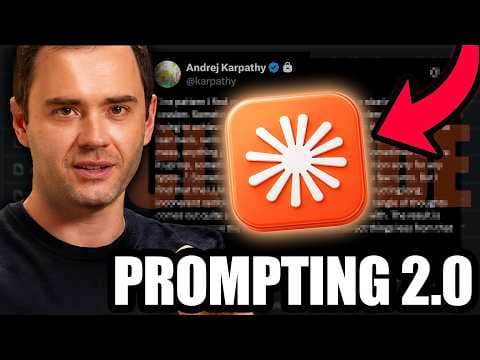
Andre Kapathy, co-founded OpenAI, was the head of AI at Tesla, and even had the creator of Claude Code, thanking him for feedback on his AI model. So, when a man of this caliber makes a tweet that gets seen by 7.7 million people about how he thinks we're all using Claude code wrong, I'm all ears. And according to Andre Kapathy, you can 10x the qual... Read More
Key Insights
- The CLAUDE.md file is a written rulebook that changes how Claude Code approaches tasks by emphasizing planning, simple implementation, narrow edits, and measurable completion rather than immediately producing output from an underspecified request.
- The planning rule is designed to prevent hidden assumptions by requiring Claude Code to identify confusion, surface trade-offs, ask relevant questions, push back when warranted, and stop when it lacks enough information to proceed confidently.
- The configured lead magnet test began with four clarifying needs: the desired hook, output format, mailing list destination, and hosting URL or slug. It also proposed local review before deployment, giving the user control over important decisions.
- The simplicity rule favors the minimum code needed to achieve the requested result because a smaller, cleaner foundation is easier to understand and extend. In the demonstration, a visually similar page reportedly used about half the code of the 212-line comparison.
- The surgical-editing rule instructs Claude Code to touch only what the request requires, clean up changes it introduced, avoid unrelated refactoring, preserve the existing style, and mention unrelated dead code without deleting it.
- The button-color demonstration is presented as an example of a narrow change: the configured instance changed the requested button to an orange gradient while leaving the rest of the page unchanged. The exaggerated all-green comparison is explicitly revealed as a joke.
- Goal-driven execution is based on defining success criteria for each task and continuing until those criteria have been verified. The approach shifts attention from merely performing work to producing evidence that the requested outcome was actually achieved.
- Bug fixing becomes test-oriented under the proposed rules: a vague request such as fixing a bug is reframed as first writing a test that reproduces the problem, then changing the implementation until that test passes.
Install to Summarize YouTube Videos and Get Transcripts
Explore YouTube Video Summarizer or Get YouTube Transcript Extractor
Questions & Answers
Q: How do you install the Karpathy CLAUDE.md file?
Copy the GitHub repository URL provided in the description, open Claude Code in either a terminal or the app, and ask it to install the file using that URL. The demonstration says Claude Code will pull the CLAUDE.md file onto the local device. After installation, its instructions operate as a rulebook for planning, coding, editing, and verifying tasks.
Q: What problems is the CLAUDE.md file intended to solve?
The file targets four problems identified in the presentation: starting work without thinking or planning, creating more complicated output than necessary, struggling to make narrowly targeted edits, and performing work without focusing on a defined goal. Its rules address these issues through clarification, simpler code, surgical changes, and verification against explicit success criteria.
Q: How does the CLAUDE.md file make Claude think before acting?
The file directs Claude Code not to assume missing details or conceal uncertainty. It should surface trade-offs, ask questions when requirements are unclear, push back when appropriate, and stop if confusion prevents responsible progress. In the lead magnet test, the configured instance requested four important decisions and proposed showing a local draft before deploying anything.
Q: Why does simpler code matter when using Claude Code?
Simpler code provides a clearer foundation for later additions and can support faster loading, according to the presentation. The rulebook therefore encourages Claude Code to use the minimum code necessary for the requested result. In the demonstrated comparison, two lead magnet pages looked nearly identical, but the configured version reportedly used about half as many lines as the 212-line alternative.
Q: What are surgical edits in Claude Code?
Surgical edits are narrowly scoped changes that touch only what is required. The file tells Claude Code not to improve neighboring code, comments, or formatting, not to refactor working components, and to match the project's existing style. If it notices unrelated dead code, it should mention that code instead of deleting it without the user's permission.
Q: How did the configured Claude Code handle the lead magnet request?
When asked broadly to create a DreamLabs lead magnet, the configured instance did not begin building immediately. It asked for the desired hook, format, mailing list, and hosting URL or slug. It then proposed drafting a single-file HTML page in the established dark aesthetic, presenting it locally, and deploying it only after receiving the user's approval.
Q: How does goal-driven execution improve Claude Code tasks?
Goal-driven execution begins by defining what success means for a task or project. Claude Code can then continue working and checking its results until the stated criteria are satisfied. The presentation contrasts this with work-driven behavior, where an AI may generate output without confirming that it solved the actual problem or achieved the user's intended outcome.
Q: How should Claude Code fix a bug under these rules?
The proposed workflow converts a vague instruction such as “Fix the bug” into a verifiable task. Claude Code should first write a test that reproduces the failure, establishing clear evidence of the problem. It should then modify the implementation until the test passes, using that result as the success criterion instead of merely claiming that the bug was corrected.
Summary & Key Takeaways
-
The recommended CLAUDE.md file addresses four reported weaknesses in AI-assisted work: acting before planning, producing unnecessarily complex output, changing more than requested, and completing activities without verifying the intended goal. Its written instructions encourage Claude Code to clarify ambiguity, surface trade-offs, keep implementations simple, preserve existing styles, and evaluate success against explicit criteria.
-
Installation is presented as a simple GitHub-based process. The user copies the repository URL and asks Claude Code, either through a terminal or the app, to install the file locally. Once installed, the file serves as an operating rulebook that influences how Claude approaches planning, implementation, editing, deployment, testing, and communication with the user.
-
A side-by-side lead magnet demonstration highlights the intended behavioral differences. The unconfigured instance immediately built from a vague request and made several assumptions. The configured instance first requested four decisions concerning the hook, format, mailing list, and hosting URL, then proposed creating a local draft and waiting for approval before deployment.
Read in Other Languages (beta)
Share This Summary 📚
Summarize YouTube Videos and Get Video Transcripts with 1-Click
Try YouTube Summary with ChatGPT & Claude or YouTube Transcript Generator
Explore More Summaries from Dream Labs AI 📚




Summarize YouTube Videos and Get Video Transcripts with 1-Click
Try YouTube Summary with ChatGPT & Claude or YouTube Transcript Generator