How to build AI agents with Gemini 3 Pro
TL;DR
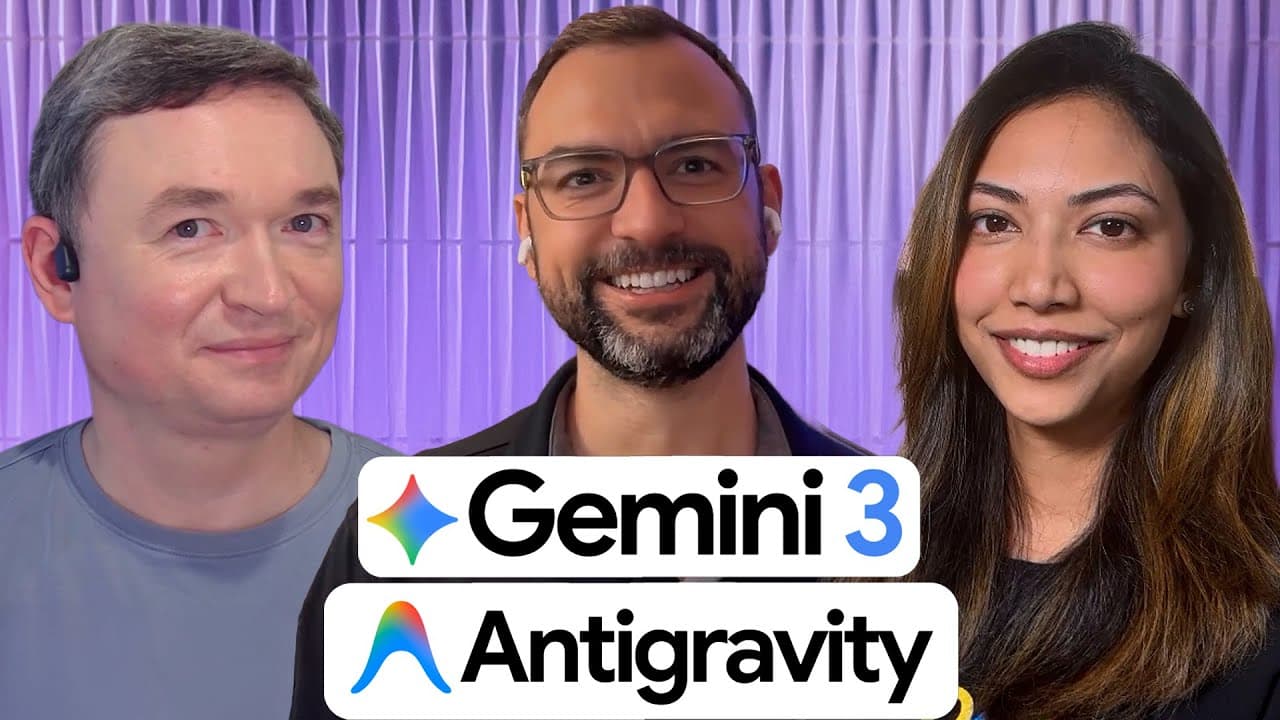
Gemini 3 Pro enables advanced reasoning and agentic tasks, while Gemini CLI and Antigravity accelerate building AI employees. The video demonstrates rapid AI-driven workflows from AI Studio to deployable web assets, showing how to create scalable, multi-model workflows and a bootstrap for an AI-powered team. Expect practical steps and tooltips for production readiness.
Transcript
[music] Hi everyone and welcome to the agent factory the podcast that goes beyond the hype and dives into building production ready AI agents. I'm Smitha Cullen >> and I'm Vlad Kalisnikov >> and today we're joined by Brandon Hancock who is a full stack engineer and who is also known on YouTube as AI with Brandon where he teaches AI to over 80,000 d... Read More
Key Insights
- Gemini 3 Pro delivers fast, high level reasoning and supports agentic operations for building AI agents.
- Gemini CLI enables scalable agent creation through markdown-based instructions and multi-model orchestration.
- Antigravity provides an agent-first IDE experience with browser control and asynchronous interaction patterns.
- AI Studio accelerates prototyping by combining profile data, inspiration imagery, and automated website generation.
- The approach uses SOPs written by capable models to guide fast, reliable actions by worker-like agents.
- A mix of high-capability and cheaper models (Gemini 3 Pro vs 2.5 Flash) balances performance and cost.
- In the demo, users can deploy projects to Cloud Run with a single click, lowering the barrier to production.
- The presenters encourage building a weekly AI employee to gradually assemble a full AI workforce.
Install to Summarize YouTube Videos and Get Transcripts
Explore YouTube Video Summarizer or Get YouTube Transcript Extractor
Questions & Answers
Q: How does Gemini 3 Pro improve agent reasoning for building AI agents?
Gemini 3 Pro provides enhanced reasoning capabilities and multimodal support that improve the accuracy and reliability of agent tasks. It handles complex prompts and tasks with faster iteration, enabling developers to script more sophisticated agent behavior. This results in more capable agents that can plan, execute, and adjust strategies on the fly with fewer prompts and retries.
Q: What is Gemini CLI used for in creating AI employees?
Gemini CLI is used to orchestrate multiple AI models through markdown driven workflows. It allows you to define standard operating procedures, specify search and data gathering tasks, and assign execution duties to different model variants. This creates a scalable, repeatable process for building AI employees that can perform specialized tasks at speed.
Q: How does Antigravity change the IDE experience for AI development?
Antigravity evolves the IDE toward an agent first workflow, integrating browser control capabilities and asynchronous interaction patterns. This enables developers to build, test, and deploy agent-driven features within a cohesive environment, reducing context switching and enabling more fluid experimentation with agent behaviors and tool integrations.
Q: What role does Google AI Studio play in the Gemini 3 workflow?
Google AI Studio is used to prototype and visualize AI workflows, such as building personal websites or automating content generation. It supports rapid iteration by combining profile data, inspiration imagery, and automated deployment steps, allowing developers to validate ideas before committing to production-grade code or infrastructure.
Q: Why is deploying to Cloud Run a theme in the demo?
Deploying to Cloud Run demonstrates a low-friction path from prototype to production. The demo emphasizes one-click deployment so developers without deep cloud expertise can ship functional apps quickly, reinforcing the idea that AI-generated outputs, prototypes, and webpages can be turned into live services with minimal setup.
Q: What is meant by building an AI workforce in this video?
Building an AI workforce refers to creating multiple AI employees, each with specialized SOPs and model configurations, that can handle distinct tasks. This includes market research, ghostwriting, reporting, and other business processes. The goal is to scale capabilities by coordinating several AI agents to perform end-to-end work autonomously.
Q: How do SOPs contribute to AI agents in Gemini workflows?
SOPs provide clear, structured instructions that tell agents what to do, what data to gather, and how to act. By codifying workflows into SOPs, you ensure consistency, repeatability, and reliability across multiple agents. This is especially important when coordinating large tasks or handling complex data gathering and analysis.
Q: What is the suggested cadence for building AI employees according to the video?
The speakers challenge viewers to build a new AI employee every week, creating a gradual but scalable workforce of Gemini models. This approach emphasizes iterative learning, rapid experimentation, and the gradual expansion of capabilities as you accumulate a portfolio of specialized agents ready to tackle diverse business tasks.
Summary & Key Takeaways
-
The video demonstrates building production-ready AI agents using Gemini 3 Pro, Gemini CLI, and Antigravity, emphasizing speed and multi-model workflows.
-
A practical demo shows creating an AI employee workflow, using SOPs, and deploying results via Cloud Run with minimal setup.
-
The discussion covers building multi-agent systems for tasks like market research, ghostwriting, and reporting, highlighting actionable workflows and future potential.
Read in Other Languages (beta)
Share This Summary 📚
Summarize YouTube Videos and Get Video Transcripts with 1-Click
Try YouTube Summary with ChatGPT & Claude or YouTube Transcript Generator
Explore More Summaries from Google Cloud Tech 📚

Summarize YouTube Videos and Get Video Transcripts with 1-Click
Try YouTube Summary with ChatGPT & Claude or YouTube Transcript Generator