How to Build a Graph Engine for Multi Agent AI
TL;DR
Graph Engineering organizes workflows as connected nodes where functions fetch data and agents reason. This structure prevents hallucinations from single monolithic prompts by separating data gathering from reasoning and enabling patterns like fan-out, join, and router. The minimal two-node example shows cost savings and clearer orchestration, with dynamic patterns for input dependent shapes.
Transcript
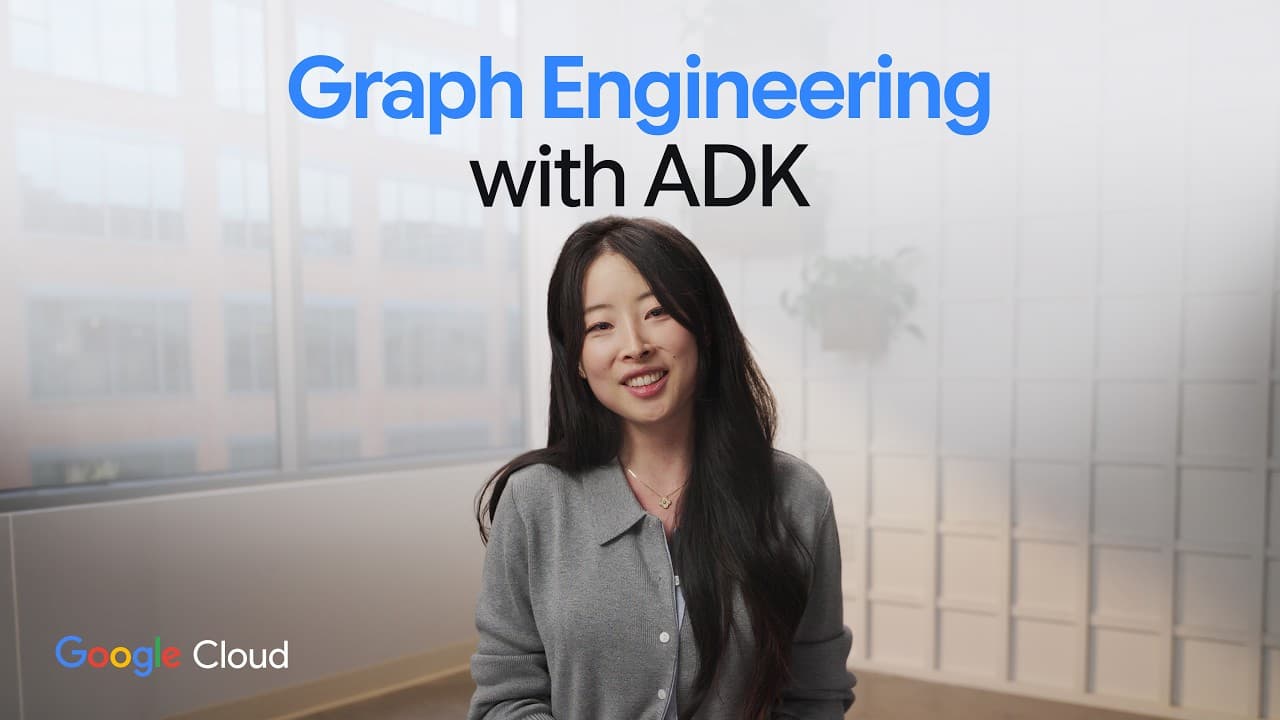
In this video, you will know what Graph Engineering is and how to build one and when you should use it. Hey, I'm Annie. So in the last video we discussed why Loop Engineering failed and why you should consider Graph Engineering. And today let's define Graph Engineering with code that actually runs. So first what is Graph Engineering? You can think ... Read More
Key Insights
- Graph Engineering is a graph workflow for your system where nodes perform functions or run agents.
- The biggest problem with single prompts is hallucination due to lack of real data access, which Graph Engineering fixes.
- A minimal graph can be two nodes: a plain function to fetch data and an agent to use that data for advice.
- Fan out is the parallel execution pattern that runs multiple inputs at once.
- Join nodes collect outputs from parallel branches and normalize them into a single dictionary.
- Router patterns select a strategy or path, with deterministic routers offering reliability and lower cost.
- Deterministic routers use fixed rules while LLM routers classify inputs, each with tradeoffs in cost and reliability.
- Graph workflows can be static or dynamic, with dynamic workflows adapting the graph shape at runtime.
Install to Summarize YouTube Videos and Get Transcripts
Explore YouTube Video Summarizer or Get YouTube Transcript Extractor
Questions & Answers
Q: What is Graph Engineering and why use it?
Graph Engineering is a structured graph workflow approach where the system is built from nodes that perform either plain functions or agent reasoning, connected by edges. It helps prevent hallucinations by separating data fetching from model-based reasoning and enables reliable, testable orchestration across multiple components. This makes complex AI tasks more predictable and scalable.
Q: How does a minimal two-node graph work in practice?
In a minimal two-node graph, one node is a plain function that fetches race day conditions or similar data without calling an LLM, and the second node is an agent that reads the data and generates advice. The orchestration is the edge from fetch to advise, resulting in one LLM call and real data in, real advice out.
Q: What is fan-out in Graph Engineering?
Fan-out is the pattern that allows parallel processing by sending inputs to multiple nodes at once. In the race example, weather, course, and fitness can be fetched in parallel. The graph can support dynamic fan-out where the number of parallel branches can vary at runtime, improving efficiency when workloads are uncertain.
Q: What is the join node in Graph Engineering?
The join node acts as a synthesizer that waits for all parallel branches to complete and then merges their outputs into a single dictionary keyed by node name. This eliminates the need for custom aggregators and ensures that downstream logic has a complete, synchronized view of all inputs before proceeding.
Q: What is a router pattern and when should you use it?
The router pattern selects a strategy based on the input and data signals. You can use a deterministic router with fixed rules when signals are present and clear, or an LLM-based router if the input is open-ended. Deterministic routers are more reliable and cheaper, while LLM routers offer flexibility at a token cost.
Q: What determines when Graphs are suitable versus not needed?
Graph usage is favorable when you can draw the workflow before input arrives and when the shape can depend on input, allowing dynamic graphs to adapt at runtime. If the workflow is unknown in advance or cannot be decomposed into edge-connected steps, a graph might not be necessary.
Q: How does dynamic workflow support differ from static graphs?
Dynamic workflows in ADK 2.0 allow the graph shape to be decided at runtime based on inputs, enabling flexible orchestration. Static graphs have a fixed structure, which is simpler but less adaptable. The choice depends on whether you need runtime adaptability or a predictable, fixed pipeline.
Q: What is the practical takeaway for building multi-agent AI systems?
The practical takeaway is to design with graph patterns that separate data gathering from reasoning, use fan-out for parallel data acquisition, join to synchronize results, and apply routers to select strategies. This approach minimizes monolithic prompts, reduces hallucinations, and provides scalable, cost-efficient orchestration for complex AI tasks.
Summary & Key Takeaways
-
Graph Engineering defines a graph workflow with nodes and edges to orchestrate tasks and AI reasoning.
-
The video demonstrates a minimal two-node setup and three core patterns to optimize multi-agent workloads.
-
Dynamic fan-out and router patterns enable scalable, cost-efficient graph-based AI orchestration.
Read in Other Languages (beta)
Share This Summary 📚
Summarize YouTube Videos and Get Video Transcripts with 1-Click
Try YouTube Summary with ChatGPT & Claude or YouTube Transcript Generator
Explore More Summaries from Google Cloud Tech 📚





Summarize YouTube Videos and Get Video Transcripts with 1-Click
Try YouTube Summary with ChatGPT & Claude or YouTube Transcript Generator