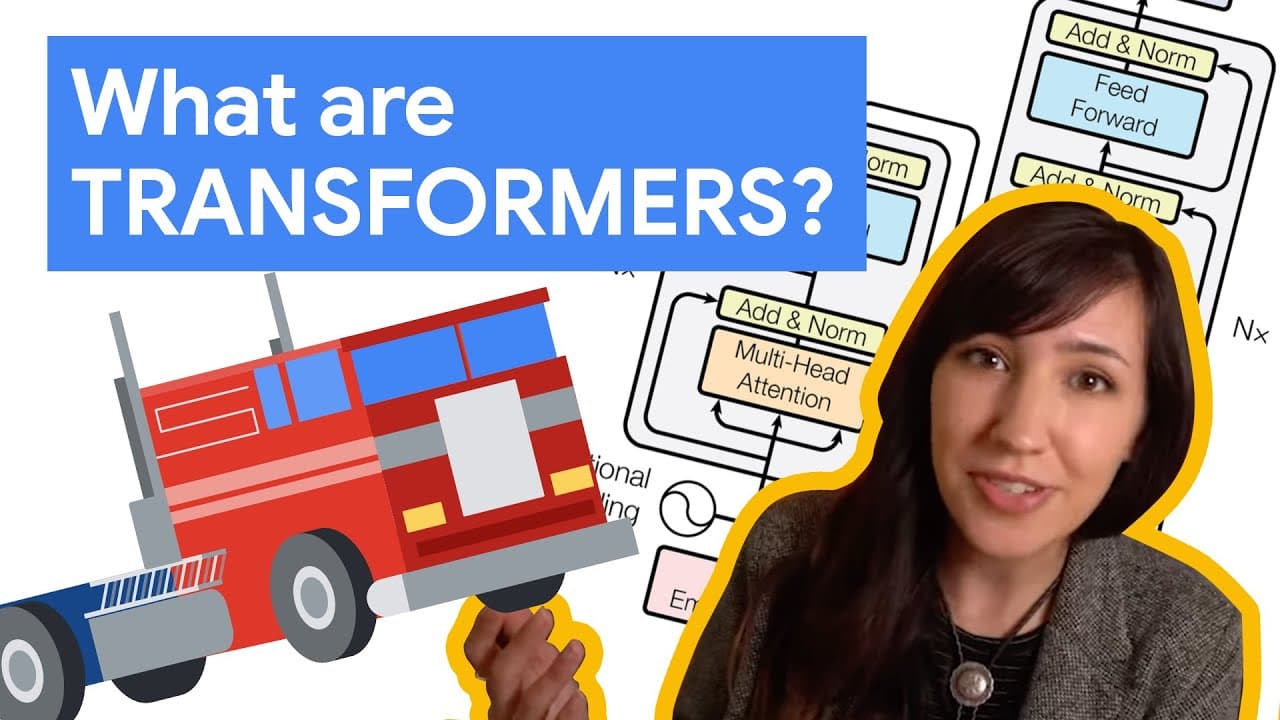
Transformers, explained: Understand the model behind GPT, BERT, and T5
TL;DR
Transformers are a type of neural network that can translate text, generate computer code, and solve various language processing tasks.
Transcript
[MUSIC PLAYING] DALE MARKOWITZ: The neat thing about working in machine learning is that every few years, somebody invents something crazy that makes you totally reconsider what's possible, like models that can play Go or generate hyper-realistic faces. And today, the mind-blowing discovery that's rocking everyone's world is a type of neural networ... Read More
Key Insights
- 🅰️ Transformers, a type of neural network, have significantly impacted natural language processing tasks and have become the foundation for models like BERT, GPT-3, and T5.
- 🔑 The key innovations of transformers are efficient parallelization, which allows for training large models, and the use of attention mechanisms and self-attention to understand word context and order.
- 💁 Positional encodings store information about word order in the data itself, making transformers easier to train and more effective than previous models like RNNs.
Install to Summarize YouTube Videos and Get Transcripts
Explore YouTube Video Summarizer or Get YouTube Transcript Extractor
Questions & Answers
Q: What are transformers and how do they differ from RNNs?
Transformers are a type of neural network that excel at processing language and can be used for translation, text generation, and other language tasks. Unlike RNNs, which process words sequentially, transformers can parallelize computations, making them more efficient and capable of handling larger text sequences.
Q: How do transformers handle word order in language?
Transformers use positional encodings, which assign a unique number to each word in a sentence based on their order. This allows the neural network to learn the importance of word order directly from the data, enabling it to understand the context and structure of language.
Q: What is attention in transformers and how does it work?
Attention is a mechanism in transformers that allows the model to focus on relevant words in the input sentence when making predictions. By attending to specific words, the model can better understand the meaning and context of language. Attention is learned over time from data and helps the model recognize gender, word order, and other grammatical features.
Q: How has the introduction of transformers impacted natural language processing?
Transformers, especially models like BERT, have greatly advanced natural language processing tasks. They have improved text summarization, question answering, sentiment analysis, and even power search engines like Google. Transformers have also shown the effectiveness of semi-supervised learning, where models can be trained on large amounts of unlabeled data.
Key Insights:
- Transformers, a type of neural network, have significantly impacted natural language processing tasks and have become the foundation for models like BERT, GPT-3, and T5.
- The key innovations of transformers are efficient parallelization, which allows for training large models, and the use of attention mechanisms and self-attention to understand word context and order.
- Positional encodings store information about word order in the data itself, making transformers easier to train and more effective than previous models like RNNs.
- Transformers, especially BERT, have become popular tools for various language-related tasks, and pretrained models can be easily accessed through platforms like TensorFlow Hub and the transformers Python library.
Summary & Key Takeaways
-
Transformers are a type of neural network that has revolutionized the field of natural language processing, allowing for efficient translation, text generation, and other language-based tasks.
-
Unlike previous models like Recurrent Neural Networks (RNNs), transformers can efficiently process large amounts of text and can be trained on massive datasets.
-
The key innovations of transformers are positional encodings, attention mechanisms, and self-attention, which enable the model to understand word order and context in language.
Read in Other Languages (beta)
Share This Summary 📚
Summarize YouTube Videos and Get Video Transcripts with 1-Click
Try YouTube Summary with ChatGPT & Claude or YouTube Transcript Generator
Explore More Summaries from Google Cloud Tech 📚





Summarize YouTube Videos and Get Video Transcripts with 1-Click
Try YouTube Summary with ChatGPT & Claude or YouTube Transcript Generator