How Does Model Context Protocol Connect AI Tools?
TL;DR
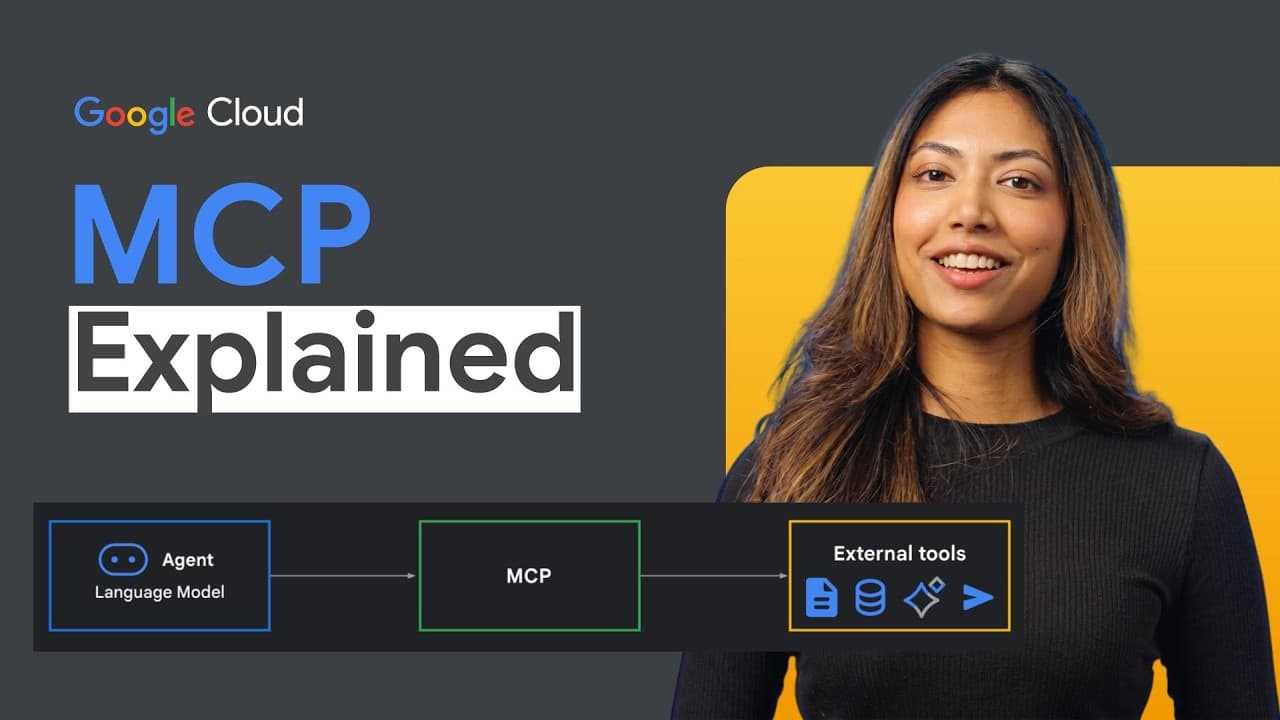
Model Context Protocol gives AI models a consistent, structured way to discover and use external tools, data, prompts, and context. It connects clients and servers through a shared schema, allowing models to inspect capabilities, validate inputs, perform actions, and combine tools without requiring a separate custom integration for every API or model.
Transcript
If you've ever tried to make an AI model, talk to your tools or your data, you've probably realized something. It's messy. Every API behaves differently, every integration needs custom code, and every time the model changes, your connection breaks. The model context protocol, or MCP, was created to fix exactly that. By the end of this video, you'l... Read More
Key Insights
- Model Context Protocol is an open standard for connecting AI models to tools, data, prompts, and external context through a consistent, structured interface that hides the specific implementation details of individual systems.
- Traditional APIs are designed for deterministic programs that already know which precise requests to make, while language models generate probabilistically and may need to explore available capabilities before deciding how to complete a task.
- MCP clients are usually language models or agent systems that need to perform tasks, while MCP servers are environments that expose resources and actions from databases, file systems, internal tools, or document search engines.
- MCP servers advertise their supported capabilities, available resources, possible actions, and required inputs when clients connect, allowing models to discover integrations dynamically instead of being programmed with every endpoint beforehand.
- MCP communication uses a defined schema in which clients request resources, invoke actions, or retrieve data, and servers return structured JSON that describes available capabilities, expected inputs, outputs, and execution results.
- MCP tools represent actions such as searching a database, sending an email, or analyzing a file, while resources represent data or state such as documents, database rows, and images.
- MCP prompts are reusable templates for guiding model behavior on specific tasks, while context supplies external information such as recent conversations, company data, or user preferences for use during reasoning.
- MCP is an abstraction above existing APIs, not a replacement for them, because an MCP server can call REST or GraphQL services internally while giving the model a uniform interface for discovery, validation, and execution.
Install to Summarize YouTube Videos and Get Transcripts
Explore YouTube Video Summarizer or Get YouTube Transcript Extractor
Questions & Answers
Q: What is Model Context Protocol and what does it do?
Model Context Protocol, or MCP, is an open standard that gives AI models a consistent and structured way to connect with tools, data, prompts, and external context. It functions as a shared language between models and surrounding systems, enabling a model to discover capabilities, understand required inputs, retrieve information, and perform actions without knowing each system's implementation details.
Q: Why do AI models need MCP when APIs already exist?
AI models need MCP because conventional APIs were designed for deterministic programs that already know what they want and can create precise requests. Language models operate probabilistically and may need to explore or clarify before acting. MCP adds a model-friendly layer that standardizes capability discovery, input validation, and execution while allowing existing APIs to continue operating underneath the MCP server.
Q: How does the MCP client-server architecture work?
An MCP client is usually a language model or agent system that wants to complete a task. An MCP server represents an environment that exposes useful resources or actions. When they connect, the server advertises its capabilities, resources, actions, and required inputs. The client can then inspect those offerings, request data, or invoke an action through the protocol's structured schema.
Q: What information does an MCP server provide to a client?
An MCP server provides descriptions of its supported capabilities, available resources, permitted actions, and required inputs. Each exposed tool or resource includes metadata explaining what it does, what information it expects, and what it returns. This structured description allows a client to discover and use the server dynamically without being pre-programmed with every underlying API endpoint or implementation detail.
Q: What are tools, resources, prompts, and context in MCP?
Tools are actions a model can invoke, such as searching a database, sending email, or analyzing a file. Resources are data or state, including documents, database rows, and images. Prompts are reusable templates that guide behavior for particular tasks. Context is external information, such as recent chat history, company data, or user preferences, that the model can bring into its reasoning.
Q: How does MCP communicate requests and results?
MCP communication follows a simple, defined schema. A client sends structured requests to list available resources, retrieve particular data, or call an exposed action. The server responds with structured JSON describing what is available or reporting what happened during execution. This common format lets clients interact consistently with different servers, even when those servers rely on different systems behind the interface.
Q: How can MCP simplify a personal assistant agent?
A personal assistant might need to check a calendar, retrieve meeting notes, and draft follow-up emails. Without MCP, developers integrate each service separately and manage its authentication, rate limits, edge cases, and model instructions. With MCP servers, each service advertises available tools, letting the model choose their order and pass data between them through one consistent interaction pattern.
Q: Does MCP replace REST and GraphQL APIs?
MCP does not replace REST or GraphQL APIs. It operates as an abstraction above them, making existing services easier for models to understand and use. An MCP server can call those APIs internally, while the model interacts only with the server's uniform schema. That layer handles discovery, validation, and execution consistently across otherwise different integrations and underlying technical implementations.
Summary & Key Takeaways
-
Model Context Protocol is an open standard that connects AI models with tools, data, prompts, and external context. It addresses the mismatch between probabilistic language models and APIs designed for deterministic programs by giving models a consistent interface for discovering capabilities, understanding required inputs, and receiving structured results from external systems.
-
MCP uses a client-server architecture. The client is typically a model or agent system, while the server exposes resources and actions from systems such as databases, file systems, internal tools, calendars, or document search engines. Servers advertise their capabilities and exchange structured JSON messages with clients through a defined schema.
-
MCP acts as a model-friendly abstraction above existing APIs rather than replacing them. An MCP server can call REST or GraphQL APIs internally while presenting discovery, validation, and execution through one uniform interface. This reduces custom glue code and allows agents to select, sequence, and pass data among multiple compatible tools.
Read in Other Languages (beta)
Share This Summary 📚
Summarize YouTube Videos and Get Video Transcripts with 1-Click
Try YouTube Summary with ChatGPT & Claude or YouTube Transcript Generator
Explore More Summaries from Google Cloud Tech 📚

Summarize YouTube Videos and Get Video Transcripts with 1-Click
Try YouTube Summary with ChatGPT & Claude or YouTube Transcript Generator