How Does MCP Enhance AI Integration?
TL;DR
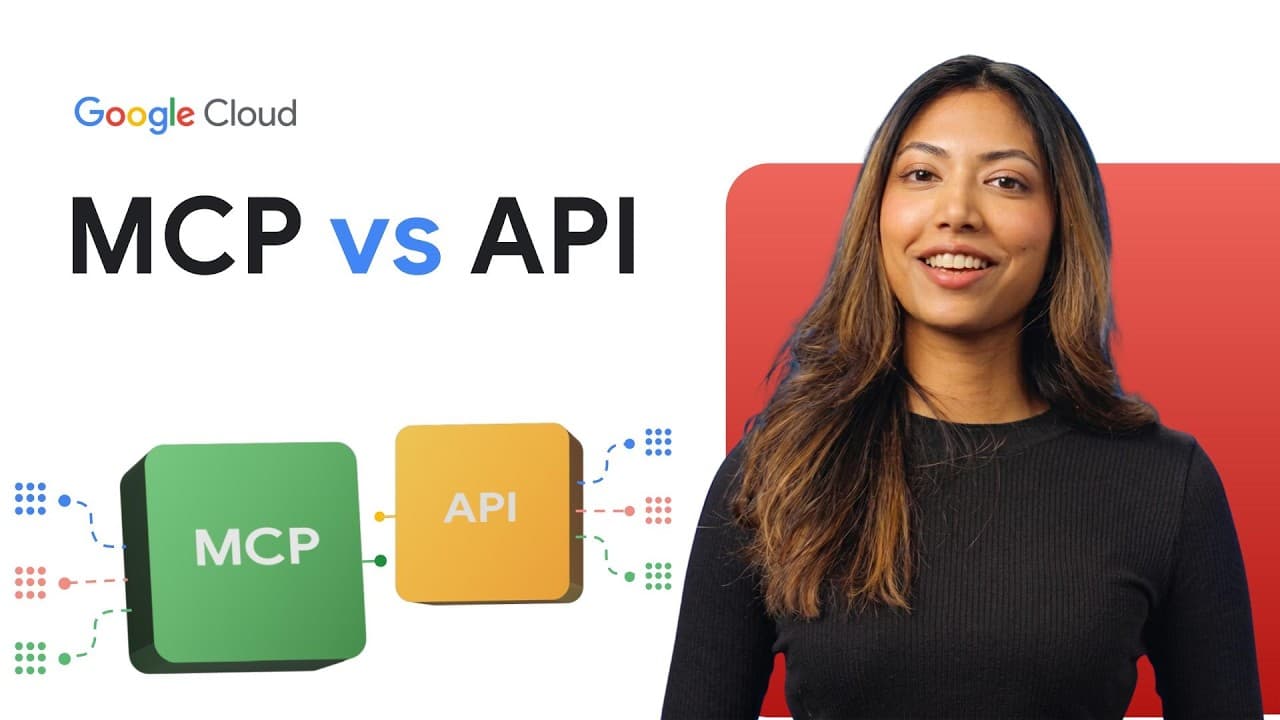
MCP, or Model Context Protocol, revolutionizes how AI models interact with tools by providing a standardized, context-rich interface, unlike traditional APIs which require manual endpoint configuration. MCP allows AI to autonomously discover and utilize tools, making model integration more seamless and reducing the need for custom code.
Transcript
If you've ever built an app that talks to an AI model, MCP changes everything. Because the way AI connects to your tools, data, and systems is being completely rewritten. For years, APIs used to be the glue that held everything together. But now there's a new standard rising fast, and that something is called the model context protocol, or MCP. And... Read More
Key Insights
- MCP is a new protocol that allows AI models to autonomously discover and use tools without manual coding.
- Traditional APIs require predefined endpoints and structured requests, which are not ideal for AI models needing context.
- MCP provides a machine-readable map of APIs, enabling models to understand available functions and their inputs and outputs.
- With MCP, models can dynamically reason about which tools to use, reducing the need for extensive prompt engineering.
- MCP acts as a middleware, translating existing APIs into a format that models can understand automatically.
- MCP is built on top of APIs, leveraging them while changing the client from a program to the model itself.
- The adoption of MCP requires standardization across servers, clients, and tools, posing a challenge for widespread implementation.
- MCP introduces security challenges that need to be addressed, such as permission layers to prevent unauthorized actions by models.
Install to Summarize YouTube Videos and Get Transcripts
Explore YouTube Video Summarizer or Get YouTube Transcript Extractor
Questions & Answers
Q: How does MCP change AI model integration?
MCP, or Model Context Protocol, changes AI model integration by providing a standardized, context-rich interface that allows models to autonomously discover and use tools. Unlike traditional APIs, which require manual endpoint configuration, MCP enables models to dynamically reason about which tools to use, reducing the need for custom code and extensive prompt engineering.
Q: What are the limitations of traditional APIs for AI models?
Traditional APIs are limited for AI models because they require predefined endpoints and structured requests, which are not ideal for models that need to interpret unstructured data and reason about what to do next. APIs are designed for deterministic systems, where programs talk to programs, whereas AI models require context to function effectively.
Q: What is the core difference between APIs and MCP?
The core difference between APIs and MCP is that APIs are code-level contracts between applications, requiring manual endpoint configuration, while MCP is a semantic protocol that provides a standardized, context-rich interface for models to understand and use tools autonomously. MCP reduces the need for prompt engineering and custom integration code.
Q: How does MCP enhance security in AI model integration?
MCP enhances security in AI model integration by defining capabilities, scopes, and authentication methods within its protocol layer. This ensures clear permission layers, preventing models from performing unauthorized actions like sending emails or deleting files. MCP aims to incorporate similar guardrails to those found in traditional APIs, such as authentication keys and rate limits.
Q: Why is standardization important for MCP adoption?
Standardization is crucial for MCP adoption because it ensures that servers, clients, and tools agree on a common protocol, enabling seamless interoperability. Without standardization, each company might develop its own integration layer, leading to fragmentation. MCP aims to create a shared ecosystem where any compliant model can use a connector instantly.
Q: What challenges does MCP face in widespread implementation?
MCP faces challenges in widespread implementation, including the need for standardization across the ecosystem and addressing security concerns. Developers must shift their mindset from thinking in terms of endpoints to capabilities and context. Additionally, ensuring that MCP's security features are robust enough to prevent unauthorized actions by models is essential.
Q: How does MCP relate to the concept of model-native software architecture?
MCP relates to the concept of model-native software architecture by providing a framework where models consume context rather than REST endpoints. This allows models to reason, plan, and act based on structured descriptions, schemas, and examples, aligning with the shift towards building systems for models instead of just humans and code.
Q: What is the potential impact of MCP on the future of AI tools?
The potential impact of MCP on the future of AI tools is significant, as it aims to create an interoperable ecosystem where models become first-class users of software. By providing a standardized protocol, MCP reduces the need for custom integrations, allowing any compliant model to use a connector instantly, similar to how HTTP standardized the internet.
Summary & Key Takeaways
-
MCP, or Model Context Protocol, redefines AI integration by allowing models to autonomously discover and use tools through a context-rich interface. Unlike traditional APIs, which require manual endpoint configuration, MCP provides a standardized approach that reduces the need for custom code and enhances model reasoning capabilities.
-
Traditional APIs are designed for deterministic systems, where one program requests data from another. MCP, however, is tailored for probabilistic systems, where models need to reason about tools and context. This shift enables more seamless integration and reduces the reliance on prompt engineering.
-
The adoption of MCP poses challenges, including the need for standardization and addressing security concerns. However, its potential to create an interoperable ecosystem for AI agents, similar to how HTTP standardized the internet, makes it a promising development in AI integration.
Read in Other Languages (beta)
Share This Summary 📚
Summarize YouTube Videos and Get Video Transcripts with 1-Click
Try YouTube Summary with ChatGPT & Claude or YouTube Transcript Generator
Explore More Summaries from Google Cloud Tech 📚



Summarize YouTube Videos and Get Video Transcripts with 1-Click
Try YouTube Summary with ChatGPT & Claude or YouTube Transcript Generator