How do Python statements differ from expressions?
TL;DR
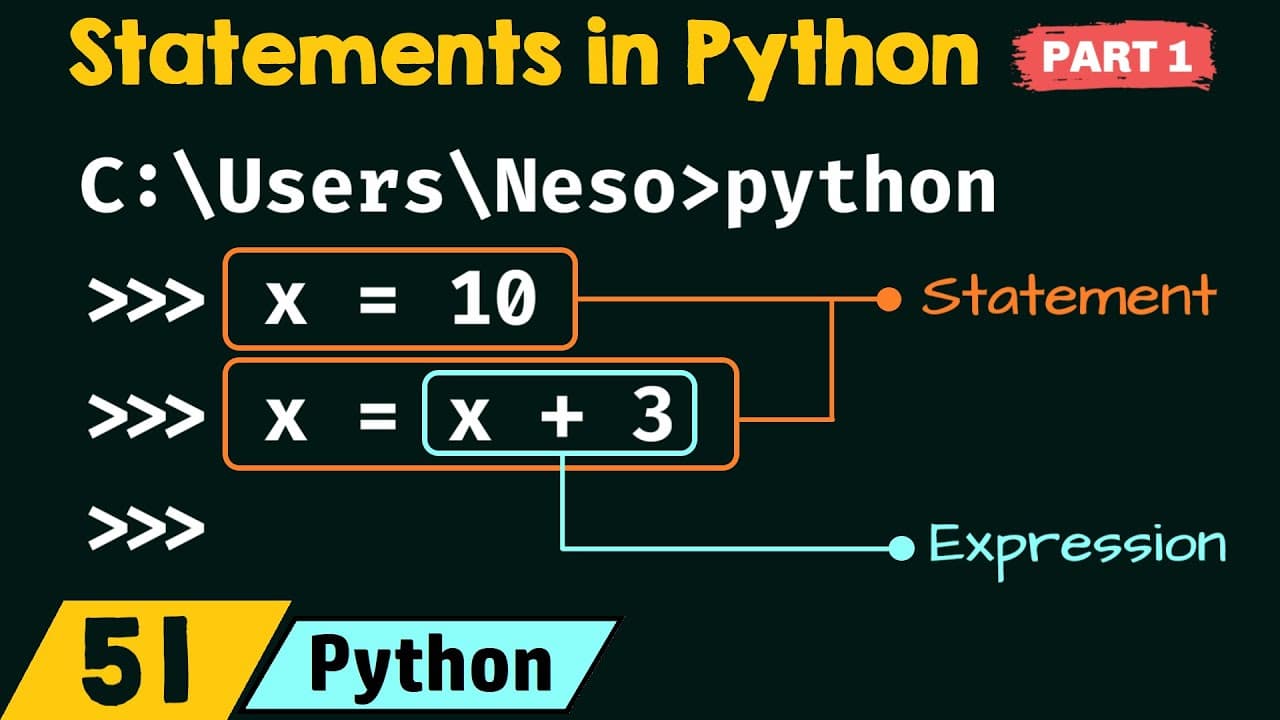
A statement is an instruction to perform an action, while an expression yields a value. In Python, assigning a value or printing content are statements, and an expression like X + 3 produces a result that can be used in an assignment. Understanding this distinction clarifies code flow and evaluation.
Transcript
foreign we will understand statements in Python this is part one of statements in Python so without any further delay let's get started the topics of this presentation are introduction to statement statement versus expression let's start from the first topic that is Introduction to statement so what is a statement a statement is an instruction for ... Read More
Key Insights
- A statement is an instruction that asks the computer to perform an action, such as assigning a value or printing content.
- A variable assignment like name = Sam is a statement because it directs the computer to bind the variable to a value.
- print(name) is a statement that outputs the current value of the variable to the screen.
- An expression is something that evaluates to a value, such as X + 3, which yields a numeric result.
- X + 3 is an expression because it computes a value rather than performing an action on its own.
- A statement can contain an expression on its right side, and the result of that expression is assigned to a variable.
- The difference between statements and expressions explains why some lines of code perform actions while others produce results.
- Understanding this distinction helps beginners predict program behavior and flow from line to line.
Install to Summarize YouTube Videos and Get Transcripts
Explore YouTube Video Summarizer or Get YouTube Transcript Extractor
Questions & Answers
Q: How to identify a statement in Python
A statement in Python is a line of code that performs an action such as assigning a value to a variable or printing a value. It directs the computer to do something rather than producing a value itself. Statements can include expressions on their right side but their primary purpose is action.
Q: What makes an expression different from a statement
An expression evaluates to a value and can be used where a value is expected. For example, 10 + 3 evaluates to 13. Expressions do not perform actions by themselves; they produce data that may be used in assignments or function calls, whereas statements perform tasks.
Q: Why is name = Sam a statement
name = Sam is a statement because it instructs the computer to bind the string Sam to the variable name. It does not produce a value by itself but changes the program state by creating or updating a binding.
Q: Why is print(name) a statement
print(name) is a statement because it directs the computer to display the current value of name. It performs an action, which is producing output, rather than computing and returning a value for use elsewhere.
Q: Can a statement include an expression
Yes, a statement can include an expression on its right side, such as x = x + 3. The expression x + 3 evaluates to a value, which is then assigned to x by the surrounding statement, combining evaluation with action.
Q: What happens if X is 10 in x = X + 3
If X is 10, the expression X + 3 evaluates to 13. The statement x = X + 3 then assigns this value 13 to x, updating the variable so that future references to x reflect the new value.
Q: Why is understanding statements essential for beginners
Understanding statements helps beginners predict what a line of code will do, including actions like assigning values and printing output. It also clarifies how expressions contribute values, enabling correct use in assignments and computations, and improves comprehension of program flow and state changes.
Q: What is the practical difference in writing code
Practically, you separate actions (statements) from computations (expressions). Write statements to perform tasks such as setting variables or producing output, and use expressions to generate values that feed into those tasks. This separation makes code easier to read, reason about, and debug.
Summary & Key Takeaways
-
Statements in Python are instructions that perform actions such as assignments and prints. They do not themselves produce a value for further use in code, but they control what happens when run. The example shows name = Sam and print(name) as two separate statements.
-
Expressions in Python evaluate to values. They can be part of assignments or used directly in contexts that require a value. X + 3 is an expression that evaluates to 13 when X is 10, demonstrating the difference from a pure statement.
-
The key takeaway is that a statement may include an expression, but an expression alone produces a value. This distinction helps beginners understand how code executes and how results propagate through variables and operations.
Read in Other Languages (beta)
Share This Summary 📚
Summarize YouTube Videos and Get Video Transcripts with 1-Click
Try YouTube Summary with ChatGPT & Claude or YouTube Transcript Generator
Explore More Summaries from Neso Academy 📚





Summarize YouTube Videos and Get Video Transcripts with 1-Click
Try YouTube Summary with ChatGPT & Claude or YouTube Transcript Generator