What's the difference between accuracy and precision? - Matt Anticole
TL;DR
Accuracy refers to how close a measurement is to the true value, while precision measures how consistently results can be reproduced. Understanding this distinction is crucial in scientific fields, where high levels of both are necessary for reliable outcomes. For example, NASA's advancements in technology have significantly improved the precision of landing spacecraft on Mars.
Transcript
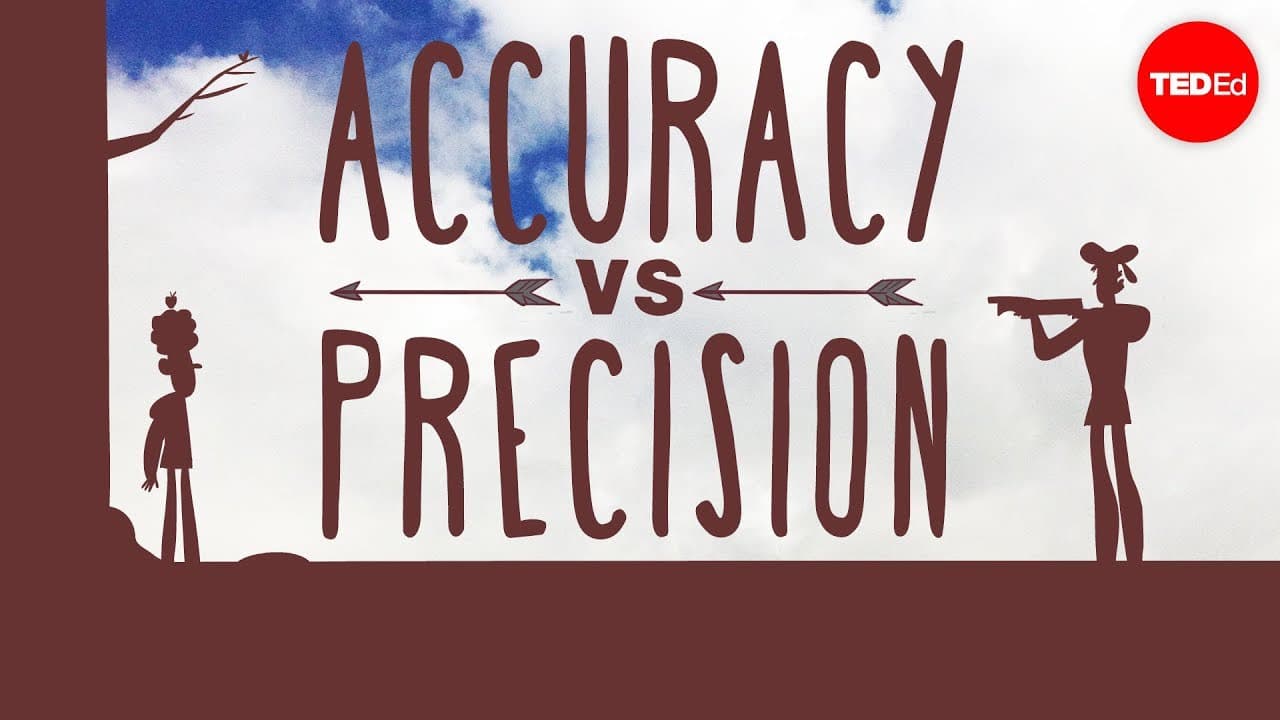
As the story goes, the legendary marksman William Tell was forced into a cruel challenge by a corrupt lord. William's son was to be executed unless William could shoot an apple off his head. William succeeded, but let's imagine two variations on the tale. In the first variation, the lord hires a bandit to steal William's trusty crossbow, so he is... Read More
Key Insights
- ❓ The distinctions between accuracy and precision are crucial in scientific endeavors for reliable and consistent results.
- ✋ Engineers and researchers require high levels of accuracy and precision, especially in microscopic tasks.
- 🇲🇭 NASA's advancements in spacecraft technology and simulations have significantly improved precision in landing probes on Mars.
- ❓ Precision without accuracy can yield the same incorrect results consistently, while accuracy without precision results in random outcomes.
- 🫷 Investing in precision can push the boundaries of what is possible in engineering and research.
- 🖐️ Computer simulations play a vital role in predicting the landing spots of probes on Mars with varying atmospheric conditions and entry angles.
- 👻 Precision allows for targeted landings in specific scientific areas of interest on Mars.
Install to Summarize YouTube Videos and Get Transcripts
Explore YouTube Video Summarizer or Get YouTube Transcript Extractor
Questions & Answers
Q: How did William Tell's tale illustrate the difference between accuracy and precision?
William Tell's story showcased precision without accuracy when his shots consistently missed the target and accuracy without precision when his shots hit the target randomly, highlighting the importance of both concepts in achieving desired results.
Q: Why is it crucial for engineers and researchers to prioritize accuracy and precision?
Engineers and researchers need accuracy and precision to ensure reliable and consistent results, especially in microscopic tasks where certainty and correctness are paramount for success in their endeavors.
Q: How do tools and training impact accuracy and precision in scientific pursuits?
Tools that are well-calibrated and proper training enhance accuracy, while finely incremented tools with less estimation improve precision, emphasizing the significance of equipment and expertise in achieving desired outcomes.
Q: How has NASA's approach to precision evolved in landing probes on Mars?
NASA's precision in landing probes on Mars has improved over the years through advanced spacecraft technology, improved simulations, and better understanding of the Martian atmosphere, reducing uncertainty and enabling targeted landings in specific areas of scientific interest.
Summary
This video discusses the difference between accuracy and precision using the story of William Tell and his challenge to shoot an apple off his son's head. It explains that accuracy is how close you come to the correct result, while precision is how consistently you can achieve that result using the same method. The variations in the story highlight the importance of both accuracy and precision in scientific endeavors. The video also mentions how precision plays a crucial role in NASA's calculations for landing probes on Mars, where computer simulations are used to determine potential landing areas.
Questions & Answers
Q: What is the distinction between accuracy and precision?
Accuracy refers to how close you come to the correct result, while precision is how consistently you can achieve that result using the same method. In other words, accuracy focuses on the correctness of the result, while precision focuses on the reliability and consistency of achieving that result.
Q: How does precision impact William Tell's challenge?
In the first variation of the story, where William is forced to use a borrowed crossbow that is not adjusted perfectly, his shots cluster in a tight spread beneath the bullseye. This indicates a lack of precision, as his hits are consistently off-target. However, he has time to correct for it before the crucial shot. In the second variation, William's hand develops a tremor, causing his practice shots to cluster around the apple but in a random pattern. Here, he lacks accuracy, as there is no certainty of hitting the bullseye. To save his son, he must settle his hand and restore certainty in his aim, emphasizing the need for accuracy.
Q: Why is precision important in scientific endeavors?
Precision is crucial in scientific endeavors because it determines the consistency and reliability of obtaining results. Scientists and researchers often require high precision, especially when working at microscopic levels or conducting experiments that demand a high certainty of being right every time. Precision allows for more finely incremented tools and less estimation, leading to more accurate and reliable data.
Q: How can precision be improved in factories and labs?
Precision can be enhanced in factories and labs through better equipment and more detailed procedures. Investing in tools that are finely calibrated and incrementally precise can significantly improve precision. Additionally, implementing more detailed procedures and guidelines can reduce the scope for estimation and increase consistency in achieving desired outcomes.
Q: Why do managers have to decide the acceptable uncertainty for each project?
Managers need to determine the acceptable uncertainty for each project because precision improvements can be costly. Investing in better equipment and more detailed procedures requires financial resources and time. It becomes crucial for managers to evaluate the level of precision required for a particular project and weigh the associated costs and benefits to make informed decisions.
Q: How does NASA calculate the potential landing area for probes on Mars?
Calculating the potential landing area for Mars probes involves extensive calculations fed by measurements that do not always have a precise answer. Factors such as changes in the Martian atmosphere's density at different elevations, the entry angle of the probe into the atmosphere, and the probe's speed upon entry need to be considered. Computer simulators run thousands of different landing scenarios, varying the values for each variable. The simulation eventually produces a landing ellipse that represents the potential area of impact.
Q: Why was NASA's Viking Lander limited in landing areas?
In 1976, NASA's Viking Lander had a landing ellipse of 62 x 174 miles, which was nearly the area of New Jersey. The large size of the landing ellipse restricted the potential landing areas for the probe. NASA had to ignore many interesting but risky locations due to the uncertainty associated with such a broad landing area. The limitations were due to the lack of precise information about the Martian atmosphere, lesser advanced spacecraft technology, and less powerful computer simulations at the time.
Q: How has uncertainty in Mars landing areas improved over the years?
Over the years, uncertainty in Mars landing areas has significantly improved due to several factors. New information about the Martian atmosphere, advancements in spacecraft technology, and more powerful computer simulations have all played a role. As a result, the landing ellipse for the Curiosity Lander in 2012 was only 4 miles wide by 12 miles long, more than 200 times smaller than the Viking's. This reduced uncertainty allowed NASA to target a specific spot in Gale Crater, an area of high scientific interest that was previously deemed un-landable.
Q: What do accuracy and precision allow us to do?
Accuracy and precision allow us to pursue scientific endeavors with confidence. While accuracy focuses on arriving at the correct result, precision reflects our certainty and ability to consistently achieve that result. Together, they provide the foundation for reliable and successful outcomes in various fields, including scientific research and space exploration.
Q: What is the relationship between precision and shooting for the stars?
Precision plays a crucial role in shooting for the stars. It allows us to aim for ambitious goals with an understanding of the reliability and consistency needed to achieve them. By striving for both accuracy and precision, we can confidently pursue grand endeavors and increase our chances of hitting our targets every time.
Takeaways
The video highlights the distinction between accuracy and precision, emphasizing the importance of both in scientific endeavors. Precision ensures consistency and reliability, while accuracy focuses on correctness. Achieving high accuracy and precision often requires calibrated tools, detailed procedures, and advanced simulations. The example of NASA's Mars probes shows how improvements in precision over the years have reduced uncertainty in landing areas, enabling more targeted exploration. These principles of accuracy and precision allow us to shoot for ambitious goals and be confident in achieving them consistently.
Summary & Key Takeaways
-
William Tell's tale explores variations where precision and accuracy play key roles in the outcome of shooting an apple off his son's head.
-
Precision is about consistency in results, while accuracy relates to getting close to the correct result consistently.
-
Engineers and researchers prioritize accuracy and precision for microscopic tasks with high certainty.
Read in Other Languages (beta)
Share This Summary 📚
Summarize YouTube Videos and Get Video Transcripts with 1-Click
Try YouTube Summary with ChatGPT & Claude or YouTube Transcript Generator
Explore More Summaries from TED-Ed 📚

Summarize YouTube Videos and Get Video Transcripts with 1-Click
Try YouTube Summary with ChatGPT & Claude or YouTube Transcript Generator