Can you solve the airplane riddle? - Judd A. Schorr
TL;DR
Three planes can fly non-stop around the world by strategically transferring fuel mid-air. By executing coordinated refueling maneuvers, each pilot ensures their planes remain operational despite limited fuel capacity. This approach allows them to achieve the goal of continuous flight, leveraging teamwork and precise timing.
Transcript
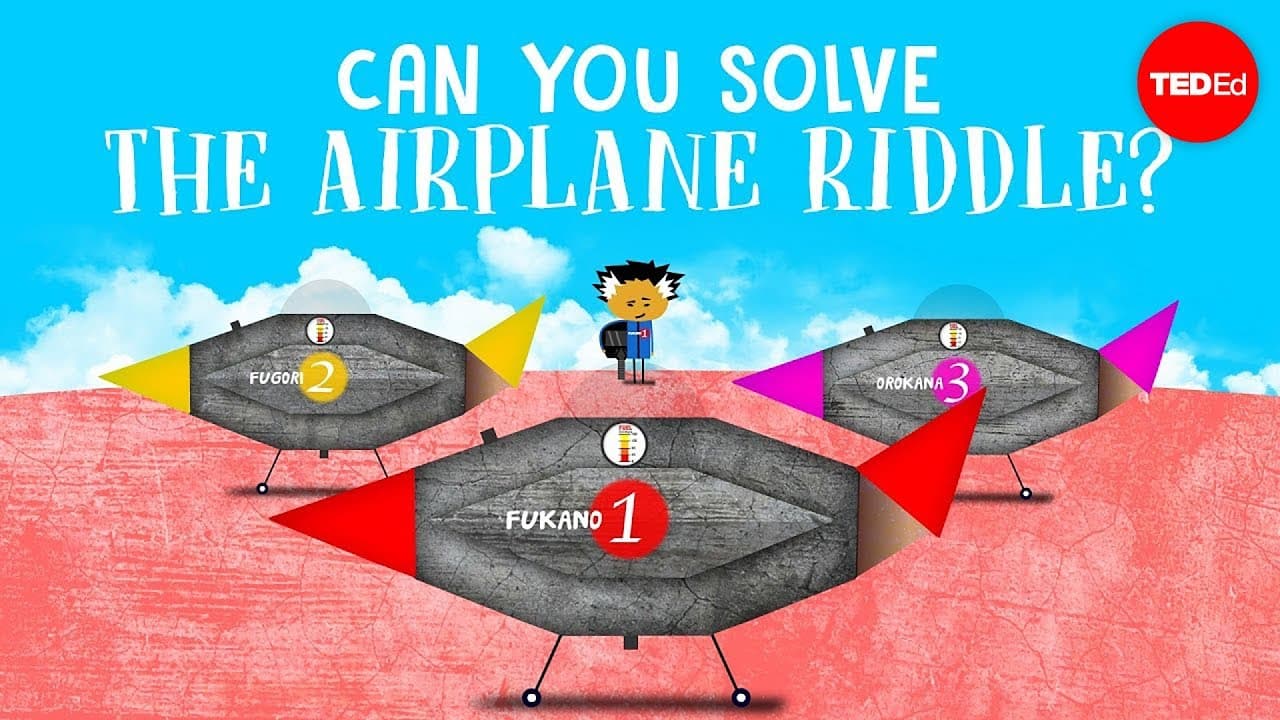
Professor Fukanō, the famous eccentric scientist and adventurer, has embarked on a new challenge: flying around the world nonstop in a plane of his own design. Able to travel consistently at the incredible speed of one degree longitude around the equator per minute, the plane would take six hours to circle the world. There's just one problem: the ... Read More
Key Insights
- ✋ Strategic planning and fuel sharing enabled the planes to fly non-stop around the world.
- 🎟️ The Professor and his assistants demonstrated teamwork and coordination throughout the mission.
- ⛽ Symmetrical flight patterns and timely fuel transfers were crucial in achieving the goal.
- ✈️ The innovative design of the planes allowed for mid-air refueling without landing.
- ✈️ The successful completion of the journey showcased the efficiency and capabilities of the planes.
- 🎟️ Professor Fukanō's creative approach to solving challenges was evident in the mission.
- 🫥 The airport on the equator served as the starting point, finish line, and refueling spot for the mission.
Install to Summarize YouTube Videos and Get Transcripts
Explore YouTube Video Summarizer or Get YouTube Transcript Extractor
Questions & Answers
Q: How does Professor Fukanō solve the challenge of flying non-stop around the world?
Professor Fukanō coordinates three planes to transfer fuel mid-air, ensuring each plane has enough fuel to complete the journey without landing.
Q: What special feature do the planes in the mission have?
The planes designed by Professor Fukanō can turn on a dime and instantly transfer any amount of fuel to each other in mid-air without slowing down.
Q: What role do each of the assistants play in the mission?
Fugōri and Orokana, the assistants, help refuel the Professor's plane mid-air at strategic points in the journey to ensure continuous flight without running out of fuel.
Q: How does the journey around the world end?
The three planes successfully land back at the airport just as their fuel runs out, completing the journey without any crashes.
Summary
Professor Fukanō, along with his assistants Fugōri and Orokana, plans to fly around the world nonstop in their specially designed planes. Each plane can hold only enough fuel for half the journey, but they can transfer fuel mid-air. The challenge is to coordinate the planes so that the professor can continue flying without running out of fuel.
Questions & Answers
Q: What is the challenge the professor and his assistants are facing?
The challenge is to fly around the world nonstop with limited fuel capacity by coordinating the planes' fuel transfer mid-air.
Q: How many planes are involved in the mission?
There are three planes involved in the mission: one piloted by the professor and two piloted by his assistants.
Q: Why did the professor choose to design three identical planes?
The professor designed three identical planes to maximize support and fuel transfer among them while avoiding fuel wastage.
Q: How much fuel can each plane hold?
Each plane can hold 180 kiloliters of fuel, which is enough for exactly half the journey.
Q: How do the planes transfer fuel mid-air?
The planes can transfer any amount of fuel instantly to each other as long as they are next to each other, without slowing down.
Q: What is the starting and finishing point for the mission?
The mission starts and finishes at the only airport located on the equator, which is also the only spot where the planes can refuel on the ground.
Q: How did they maximize fuel utilization and coordinate the planes?
The professor's solution is to fly the planes symmetrically, with each plane taking off at noon and flying west. The assistants refuel the professor, then return to the airport, while the professor continues on a long unsupported stretch in the middle.
Q: How do they ensure a constant fuel supply during the journey?
The assistants and the professor coordinate their flights and fuel transfers, ensuring that when one plane runs low on fuel, it is refueled by another plane before it runs out completely.
Q: When and how do they perform fuel transfers during the journey?
The fuel transfers occur at specified time intervals and distances. They transfer fuel when they are at one-eighth, one-quarter, and three-quarters of the way around the world.
Q: How do they ensure all planes land with zero fuel left?
The fuel transfers and strategic planning allow all three planes to land at the airport just as their fuel gauges reach zero.
Takeaways
Professor Fukanō, along with his assistants, successfully completed their nonstop journey around the world by strategically coordinating fuel transfers and planning flight paths. The solution involved maximizing fuel support from the assistants, allowing the professor to fly a long unsupported stretch in the middle. This challenge demonstrates the importance of efficient resource utilization and coordination in achieving complex goals.
Summary & Key Takeaways
-
Professor Fukanō designs three planes to fly around the world non-stop.
-
Each plane can transfer fuel mid-air, allowing continuous flight with only 180 kiloliters of fuel per plane.
-
Through strategic refueling and coordination, the planes successfully complete the journey without running out of fuel.
Read in Other Languages (beta)
Share This Summary 📚
Summarize YouTube Videos and Get Video Transcripts with 1-Click
Try YouTube Summary with ChatGPT & Claude or YouTube Transcript Generator
Explore More Summaries from TED-Ed 📚






Summarize YouTube Videos and Get Video Transcripts with 1-Click
Try YouTube Summary with ChatGPT & Claude or YouTube Transcript Generator