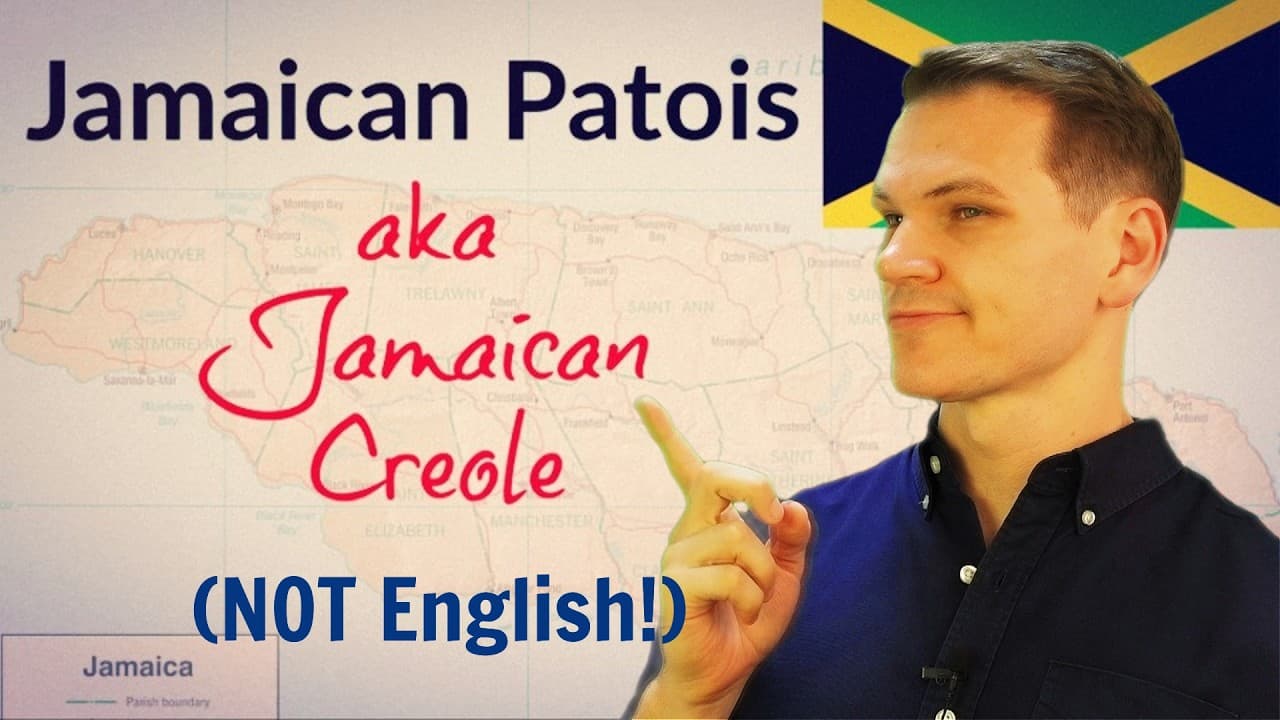
Jamaican Patois (NOT English!)
TL;DR
Explores Jamaican Patois, its history, structure, and cultural significance.
Transcript
hello everyone welcome to the Laing focused Channel and my name is Paul today's topic is Jamaican Creole also known as patois Jamaica is an island nation in the Caribbean with a population of only around 3 million people but it's made a cultural impact around the world because of its art forms such as reggae and dancehall music as well as dub poetr... Read More
Key Insights
- Jamaican Patois is an English-based creole language developed in the 17th and 18th centuries by African slaves in Jamaica.
- The language evolved from a pidgin, a simplified form of English, into a creole language used in daily life.
- Patois vocabulary is primarily derived from English, but it includes words from West African languages and other influences.
- Jamaican Patois exhibits a continuum with Standard Jamaican English, ranging from pure Patois to English with a Jamaican accent.
- The language's grammar features unique aspects, such as the absence of verb conjugations and distinct pronoun usage.
- Patois is often regarded as improper English, but it possesses its own grammatical, phonological, and lexical rules.
- Deep Patois, or Crow Monty, is a variant used in Maroon communities, heavily influenced by the Akan language.
- Jamaican Patois lacks a standardized writing system, reflecting its phonetic nature and divergence from English spelling.
Install to Summarize YouTube Videos and Get Transcripts
Explore YouTube Video Summarizer or Get YouTube Transcript Extractor
Questions & Answers
Q: What historical factors contributed to the development of Jamaican Patois?
Jamaican Patois developed during the 17th and 18th centuries when African slaves brought to Jamaica by British colonizers were forced to communicate with English-speaking slave owners. The slaves, separated from others who spoke their native languages, created a pidgin language using basic English vocabulary and simplified grammar, which eventually evolved into a creole language as it was passed down to subsequent generations.
Q: How does Jamaican Patois differ from Standard Jamaican English?
Jamaican Patois and Standard Jamaican English exist on a linguistic continuum. Patois is often used in informal settings and has distinct grammatical, phonological, and lexical features that differentiate it from English. It lacks verb conjugations, uses unique pronouns, and incorporates words from African languages. In contrast, Standard Jamaican English is the official language used in formal contexts and is closer to British English in structure and vocabulary.
Q: What are some key grammatical features of Jamaican Patois?
Jamaican Patois has several unique grammatical features, including the absence of verb conjugations, with verbs remaining in a single form regardless of the subject. Pronouns do not distinguish between subject and object forms, and possessive adjectives are formed by placing pronouns before nouns. The language also utilizes specific markers for tense and aspect, such as 'ah' for the present progressive and 'ben' for the present perfect progressive.
Q: What role does Jamaican Patois play in Jamaican culture?
Jamaican Patois is a significant cultural marker, reflecting the island's history and African heritage. It is used in music genres like reggae and dancehall, as well as in everyday communication. Patois embodies Jamaican identity and resilience, serving as a symbol of cultural pride and resistance against colonial linguistic dominance. Despite being viewed as improper by some, it remains an integral part of Jamaican cultural expression.
Q: How is Jamaican Patois connected to West African languages?
Jamaican Patois incorporates elements from several West African languages, reflecting the diverse origins of the African slaves brought to Jamaica. Words like 'duppy' (ghost) and 'Anansi' (spider) are derived from Akan, while the pronoun 'uno' comes from Igbo. These linguistic influences highlight the creole's African roots and the cultural blending that occurred during the formation of the language.
Q: What is Deep Patois, and where is it used?
Deep Patois, also known as Crow Monty, is a variant of Jamaican Patois used by the Maroons, descendants of escaped slaves who established communities in Jamaica's mountains. It retains more features from African languages, particularly Akan, and is used in ritual contexts within Maroon communities. While not commonly used in daily communication, Deep Patois is an important cultural and historical artifact.
Q: Why is there no standardized writing system for Jamaican Patois?
Jamaican Patois lacks a standardized writing system because it is primarily a spoken language with significant regional and individual variation. Its orthography is phonetic, reflecting the sounds of speech rather than adhering to fixed spelling rules. The lack of standardization allows for flexibility and adaptability but can also lead to inconsistencies in written communication, as Patois spellings diverge from standard English.
Q: How do speakers of Jamaican Patois navigate between Patois and English?
Speakers of Jamaican Patois navigate between Patois and English based on context and audience. In informal settings, Patois may be used exclusively or mixed with English. In formal or professional contexts, speakers often switch to Standard Jamaican English. This code-switching reflects the linguistic continuum between the two languages and allows speakers to adapt their communication style to suit different social environments.
Summary & Key Takeaways
-
Jamaican Patois, an English-based creole, emerged from the interaction between African slaves and English-speaking owners. It developed from a pidgin to a full creole language, incorporating elements from West African languages. Despite its English roots, Patois has distinct grammar, vocabulary, and phonology, making it a unique language.
-
Patois exists on a continuum with Standard Jamaican English, with speakers using varying degrees of Patois and English depending on context. While often seen as improper English, Patois has its own linguistic rules. Deep Patois, used in Maroon communities, retains more African linguistic features.
-
The language's vocabulary primarily derives from English but includes significant influences from West African languages. Patois grammar is characterized by the absence of verb conjugations and unique pronoun usage. The language lacks a standardized writing system, with spellings reflecting its phonetic nature.
Read in Other Languages (beta)
Share This Summary 📚
Summarize YouTube Videos and Get Video Transcripts with 1-Click
Try YouTube Summary with ChatGPT & Claude or YouTube Transcript Generator
Explore More Summaries from Langfocus 📚


Summarize YouTube Videos and Get Video Transcripts with 1-Click
Try YouTube Summary with ChatGPT & Claude or YouTube Transcript Generator