What Is the Normsky Architecture for AI Coding Agents?
TL;DR
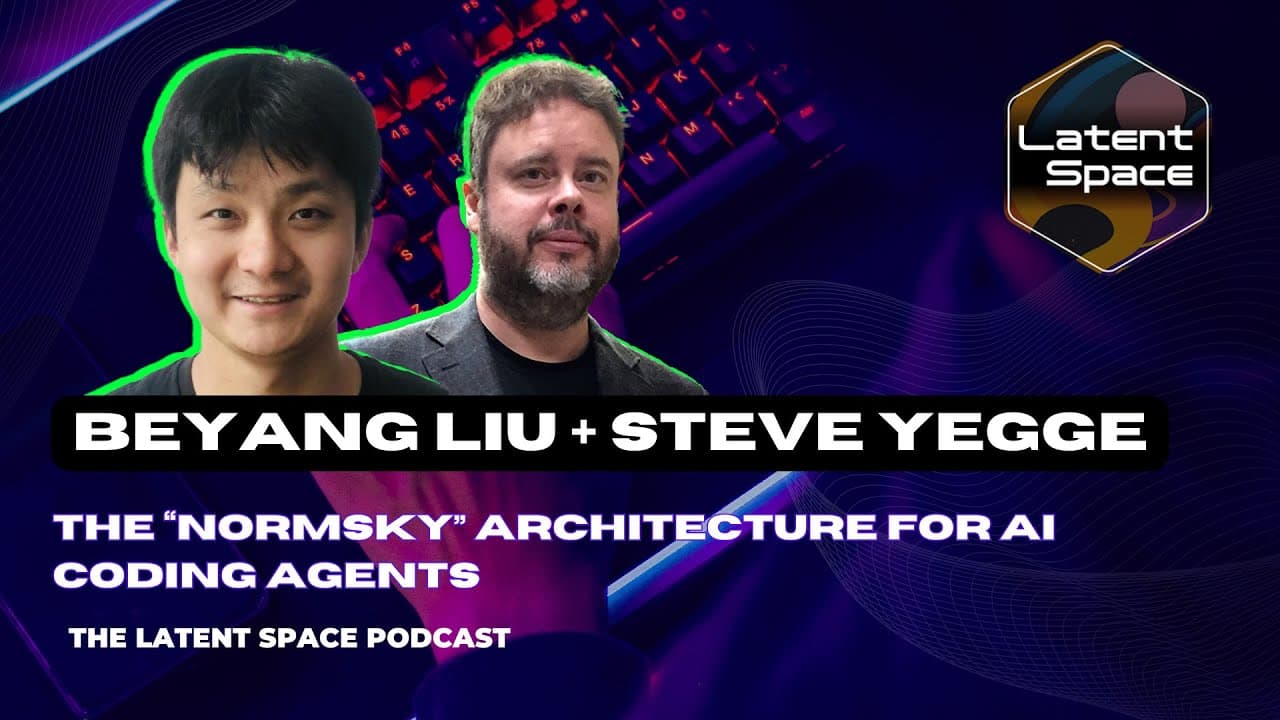
The Normsky architecture combines symbolic modeling and data-driven learning to enhance AI coding assistants. By prioritizing context and data pre-processing, Sourcegraph's Cody aims to improve coding productivity while reducing the need for extensive human intervention, signaling a future with more automated development workflows.
Transcript
hey everyone welcome to the laden space podcast this is alasio partner and CT resident at deel partners and I'm joining by my co-host swix founder of small AI hey and today we're christening our new uh podcast studio in the Newton and we have um biang and Steve from Source craft welcome hey thanks for having us uh so this has been a long time comin... Read More
Key Insights
- 👨💻 The combination of Chomsky and Norvig approaches (symbolic modeling and data-driven learning) creates a powerful hybrid architecture that leverages the strengths of both in AI coding intelligence.
- 😑 Pre-processing data and ensuring high-quality context is crucial for effective AI coding assistants. Sourcegraph focuses on context fetching and data summarization to enhance the capabilities of Cody.
- 👨💻 The future of coding may involve a shift towards more automated workflows driven by AI assistants, but it requires a careful balance between human involvement and AI capabilities.
- 📈 Sourcegraph's BFG (Big Friendly Graph) is a promising development in code graph generation, providing a fast and accessible knowledge graph without heavy build system integration.
Install to Summarize YouTube Videos and Get Transcripts
Explore YouTube Video Summarizer or Get YouTube Transcript Extractor
Questions & Answers
Q: What prompted the creation of Sourcegraph, and how does it address the pain points in dealing with large codebases?
The founders of Sourcegraph, Biang and Steve, were inspired by their experiences with Google Code Search and the challenges of working with complex codebases. Sourcegraph addresses these pain points by providing a powerful code understanding engine and context fetching capabilities.
Q: What is the core differentiator of Cody, Sourcegraph's AI coding assistant?
Cody stands out by focusing on the quality of context and leveraging the extensive code understanding capabilities developed over the past decade by Sourcegraph. Cody offers features like code generation, question answering, and task automation, all driven by high-quality context.
Q: How does Sourcegraph's approach to context differ from other AI coding assistants?
Sourcegraph places emphasis on context fetching from various sources, such as code repositories, reference graphs, documentation, logs, and discussions. By offering a wide range of context, Cody aims to provide comprehensive and reliable insights to developers, distinguishing itself from other tools.
Q: How does Sourcegraph integrate open-source and proprietary models in Cody?
Sourcegraph designed Cody to be pluggable, allowing integration of various models, both open-source and proprietary, based on the evolving AI ecosystem. The goal is to harness the best-in-class models while ensuring high-quality context and prompt responses.
Summary & Key Takeaways
-
The podcast introduces Biang and Steve from Sourcegraph, who discuss their backgrounds and the inspiration behind starting Sourcegraph.
-
They explain the evolution of Code Search and the pain points they experienced in large codebases, leading them to create Sourcegraph.
-
The conversation shifts to the development of Cody, an AI coding assistant, and how it leverages context and data pre-processing to enhance coding productivity.
Read in Other Languages (beta)
Share This Summary 📚
Summarize YouTube Videos and Get Video Transcripts with 1-Click
Try YouTube Summary with ChatGPT & Claude or YouTube Transcript Generator
Explore More Summaries from Latent Space - The AI Engineer Podcast (Video Podcast) 📚


Summarize YouTube Videos and Get Video Transcripts with 1-Click
Try YouTube Summary with ChatGPT & Claude or YouTube Transcript Generator