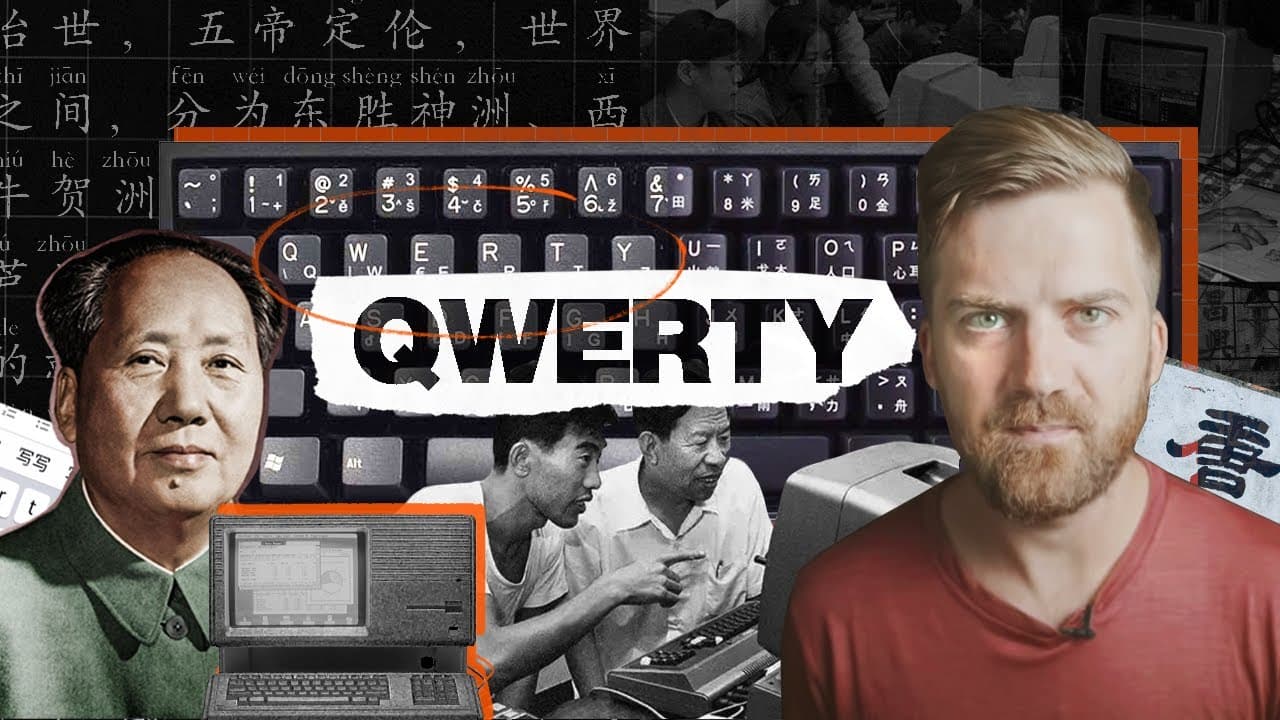
How China fit thousands of characters on a keyboard?
TL;DR
Chinese typing evolved from complex character input to efficient romanization and keying schemes. The breakthrough came with Cangjie, a shape based system, and pinyin adapted for keyboard use, alongside political and educational choices that kept Chinese characters central while enabling Western style typing. This story links culture, geopolitics, and tech progress.
Transcript
- [Narrator] There's no Chinese alphabet. Instead, each word is represented by a symbol or character. (air whooshing) - How on Earth did a language with tens of thousands of characters fit onto this keyboard? - [Narrator] Here is a world of communication, tailored for your needs of today and tomorrow. - [Narrator] What really accounts for China's m... Read More
Key Insights
- X is that Chinese language uses characters instead of an alphabet, creating a fundamental input challenge when early computers used a standard QWERTY keyboard.
- The key to progress was leveraging romanization and shape based input methods, including pinyin for teaching and Cangjie for character composition on keyboards.
- The movement from characters to typed input required a system to map sounds or visual elements to keystrokes, enabling fast practical typing without thousands of memorized strokes.
- Mao Zedong’s literacy push created a political context that favored simplifying Chinese input through romanization rather than abandoning characters entirely.
- Taiwan’s adoption of an alphabetic system for teaching literacy created a contrasting approach to input that influenced cross strait technology choices.
- Cangjie emerged as a pioneering, scalable method that used component based typing to assemble Chinese characters on a QWERTY layout.
- Pinyin provided a phonetic bridge that allowed China to systematically convert spoken Chinese into typable input across computing platforms.
- The broader narrative links China’s urban tech rise, Shenzhen's growth, and the global spread of keyboard based computing to a historically driven push to adapt complex writing into modern technology.
- More videos from this channel:
- More from this channel: Johnny Harris
Install to Summarize YouTube Videos and Get Transcripts
Explore YouTube Video Summarizer or Get YouTube Transcript Extractor
Questions & Answers
Q: A real search query question about the video I would type, How did China adapt to typing Chinese on a Western keyboard?
China adapted to typing Chinese on a Western keyboard by developing systems like Cangjie that map character components to keys, and by using pinyin to spell words phonetically for input. This allowed typists to assemble thousands of characters efficiently on a QWERTY layout, bridging traditional writing with modern computing.
Q: What is Cangjie and why was it needed?
Cangjie is a character input method that breaks Chinese characters into components or shapes which are then entered on a QWERTY keyboard. It was needed because direct character input was too slow and unwieldy for thousands of symbols, so a combinatorial, puzzle like approach accelerated typing speed.
Q: Why was pinyin significant in the keyboard transformation?
Pinyin provided a phonetic alphabet to spell Chinese words, which made it possible to input speech sounds directly using Roman letters. This simplified teaching, literacy development, and later computer input, enabling rapid adoption of keyboard based Chinese typing alongside existing characters.
Q: How did geopolitical factors influence typing methods in China and Taiwan?
Geopolitics shaped input method choices because mainland China pursued Romanized schemes to democratize learning and computing, while Taiwan favored its own alphabetic teaching method. These differing paths created competing approaches to typing Chinese on keyboards in separate political entities.
Q: What role did Mao Zedong’s policies play in this history?
Mao Zedong’s policies pushed literacy and considered simplifying the Chinese writing system, which spurred the exploration of a romanized alphabet for teaching and typing. This political push created a context in which input methods leveraging phonetics and components could be developed and tested.
Q: How did Shenzhen and China’s tech rise relate to keyboard history?
Shenzhen’s transformation from a fishing village to a tech hub symbolizes China’s rapid modernization, including the development of input methods that enabled mass computing and digital communication. The keyboard story sits within this broader tech rise, illustrating how China aligned policy and technology to advance.
Q: What is the contrast between Western and Chinese keyboard histories?
In the West, keyboards supported alphabetical languages that naturally fit quick typing and programming. In China, the challenge was fitting a logographic system onto a QWERTY keyboard, which led to unique input schemes like Cangjie and pinyin, shaping how computing developed in a different linguistic context.
Q: Why is the keyboard story important for understanding China’s tech growth?
The keyboard story shows how a language with thousands of characters could be made typing efficient, enabling rapid software development, education, and urban tech growth. It illustrates how input methods influenced not just individual productivity but national policy and economic trajectory.
Q: How did Taiwan’s approach differ from the mainland’s approach to Chinese input?
Taiwan pursued an alphabet based system for teaching literacy which contrasted with mainland China’s experimentation with pinyin and character based input schemes. This divergence helped clarify how regional political choices shaped early keyboard technology and later adoption.
Summary & Key Takeaways
-
China’s writing system, comprised of tens of thousands of characters, faced a keyboard bottleneck that drove innovation and policy. This summary traces the shift from character based input to romanized and shape based schemes. It highlights how political decisions and technology converged to make Chinese typing practical.
-
The Cangjie and pinyin systems became crucial tools that transformed input methods, enabling fast, scalable Chinese typing on a QWERTY keyboard. The story also weaves in Mao’s literacy push and the Taiwan mainland split, showing how geopolitics shaped tech adoption.
-
The video connects historical turning points with practical typing solutions, showing how China leapfrogged Western tech gaps by reimagining input methods while preserving a complex writing system and fueling rapid urban tech growth.
Read in Other Languages (beta)
Share This Summary 📚
Summarize YouTube Videos and Get Video Transcripts with 1-Click
Try YouTube Summary with ChatGPT & Claude or YouTube Transcript Generator
Explore More Summaries from Johnny Harris 📚






Summarize YouTube Videos and Get Video Transcripts with 1-Click
Try YouTube Summary with ChatGPT & Claude or YouTube Transcript Generator