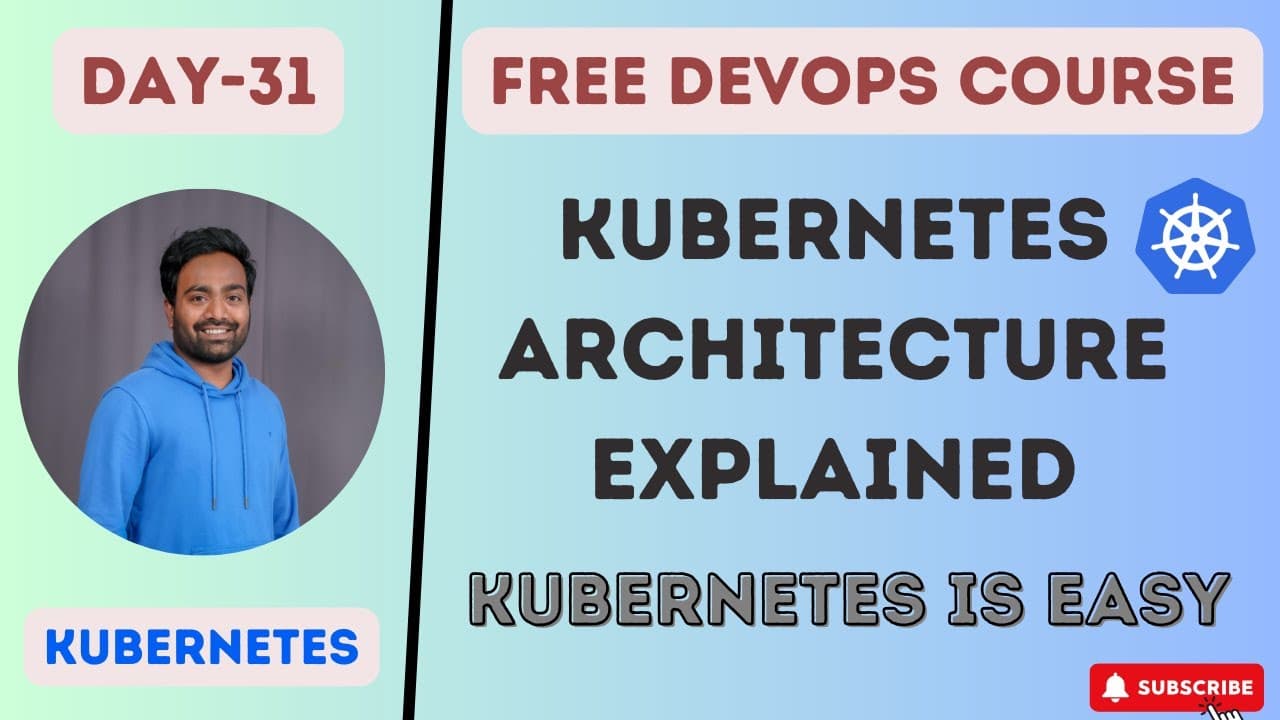
Day 31: How Does Kubernetes Architecture Work? | Kubernetes Is Easy
TL;DR
Kubernetes architecture works by dividing a cluster into a control plane and a data plane, with a master and worker nodes coordinating pod creation and execution. The control plane includes the API server, etcd, scheduler, controller manager, and cloud controller manager, while the data plane includes kubelet, kube-proxy, and a container runtime. Read on to understand why each component is required and how Kubernetes improves on Docker.
Transcript
hello everyone my name is Abhishek and welcome back to my channel so today we are at day 31 of our free devops course and in this video I'll be talking about the kubernetes architecture so before we jump on to the topic for today let me start with a very lighter note question why kubernetes is called as k8s so everybody knows that kubernetes in sho... Read More
Key Insights
- Kubernetes architecture is divided into a control plane and a data plane.
- The control plane includes components like the API server, scheduler, etcd, controller manager, and cloud controller manager.
- The data plane consists of components such as kubelet, kube-proxy, and container runtime.
- Kubernetes offers features like auto-healing, auto-scaling, and advanced networking.
- The API server acts as the core component, handling all external requests to the Kubernetes cluster.
- Scheduler is responsible for assigning pods to nodes based on resource availability.
- etcd serves as a key-value store for all cluster data, ensuring backup and recovery.
- Kubelet ensures that pods are running and communicates with the control plane if issues arise.
Install to Summarize YouTube Videos and Get Transcripts
Explore YouTube Video Summarizer or Get YouTube Transcript Extractor
Questions & Answers
Q: How does Kubernetes architecture work?
Kubernetes divides its architecture into a control plane and a data plane. The control plane manages the cluster through components such as the API server, etcd, scheduler, controller manager, and cloud controller manager, while the data plane runs applications through kubelet, kube-proxy, and a container runtime.
Q: What are the main components of Kubernetes architecture?
The control plane contains the API server, etcd, scheduler, controller manager, and cloud controller manager, also called CCM. The data plane contains kubelet, kube-proxy, and the container runtime.
Q: What is the difference between the Kubernetes control plane and data plane?
The control plane handles API requests, scheduling, cluster state, and overall management. The data plane focuses on executing applications and managing networking on worker nodes.
Q: What happens when a pod is created in Kubernetes?
A pod is Kubernetes' simplest unit, comparable to a container in Docker. Its creation involves the control plane coordinating placement and the data plane using a container runtime to execute it on a worker node.
Q: Why does Kubernetes require a container runtime?
A container cannot run without a container runtime, just as a Java application cannot run on a platform without a Java runtime. Kubernetes therefore uses a container runtime in its data plane to execute the containers within pods.
Q: How is Kubernetes architecture different from Docker?
Docker's simplest unit is a container, while Kubernetes' simplest unit is a pod. Kubernetes also has cluster behavior, auto-healing, auto-scaling, advanced load balancing, security features, and advanced networking, so its architecture requires more components than Docker.
Q: What is the role of the Kubernetes scheduler?
The scheduler assigns pods to nodes based on resource availability and constraints. It uses cluster-state information supplied through the API server to decide where pods should run.
Q: What roles do etcd and kubelet play in Kubernetes?
Etcd is the key-value store for Kubernetes cluster data and helps preserve the cluster's state. Kubelet operates on a node, ensures pods are running, and communicates their status to the control plane.
Summary & Key Takeaways
-
Kubernetes architecture is composed of a control plane and a data plane, each with specific roles. The control plane manages API requests, scheduling, and state through components like the API server and etcd. The data plane, with kubelet and kube-proxy, focuses on executing applications and managing networking.
-
Understanding Kubernetes' architecture is essential for utilizing its advanced features such as auto-scaling and self-healing. The control plane's API server handles incoming requests, while the scheduler allocates resources. The data plane ensures that applications run smoothly across nodes.
-
Kubernetes offers significant advantages over Docker, including built-in clustering, auto-healing, and enterprise-level support. The architecture's division into control and data planes allows for efficient management of containerized applications, making Kubernetes a powerful tool for modern DevOps practices.
Read in Other Languages (beta)
Share This Summary 📚
Summarize YouTube Videos and Get Video Transcripts with 1-Click
Try YouTube Summary with ChatGPT & Claude or YouTube Transcript Generator
Explore More Summaries from Abhishek.Veeramalla 📚




Summarize YouTube Videos and Get Video Transcripts with 1-Click
Try YouTube Summary with ChatGPT & Claude or YouTube Transcript Generator