What Are Philosophical Razors and How to Think Clearly?
TL;DR
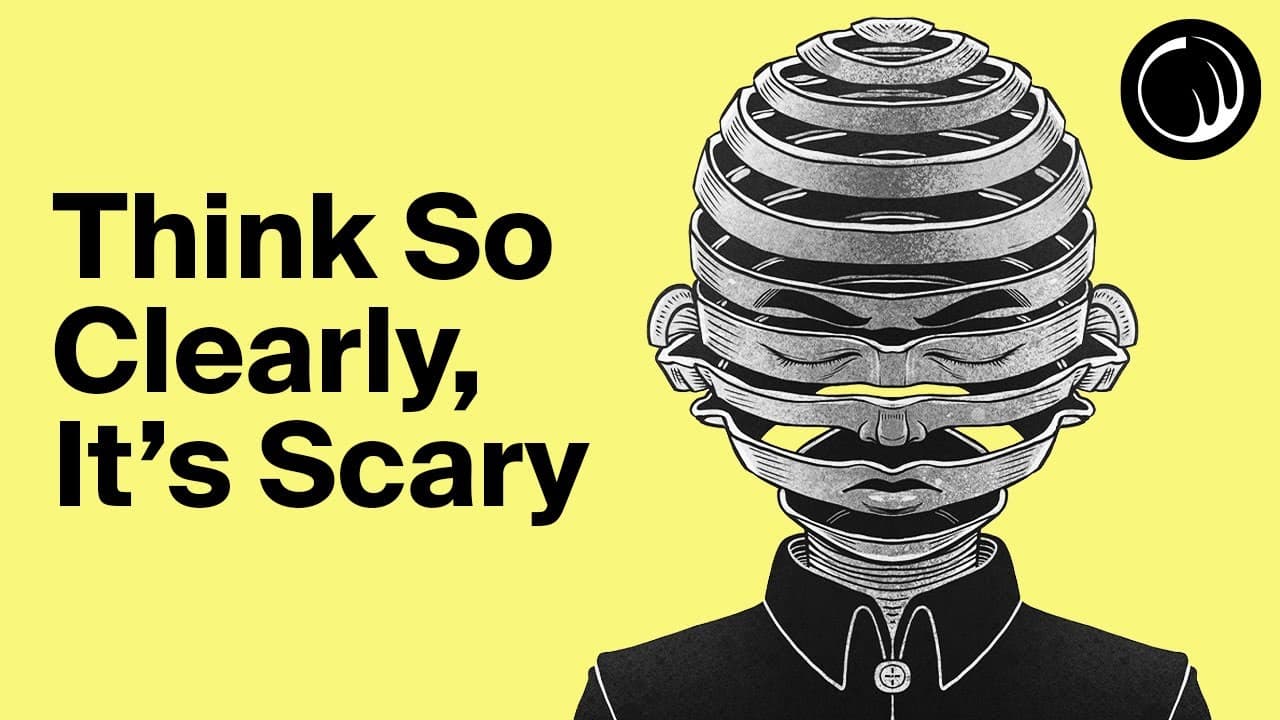
Philosophical razors improve critical thinking by cutting away less likely explanations and clarifying what evidence a claim requires. Occam’s razor favors explanations with fewer assumptions, while the Sagan standard, Hitchens’s razor, and Alder’s razor test extraordinary, unsupported, or untestable claims. Sean and Marie’s disagreement also shows why beliefs can feel inseparable from identity, and why thoughtful debate should seek understanding, giving you a reason to read on.
Transcript
This video is sponsored by boot.dev. Learn software development through immersive gamified experiences. Go to boot.dev and use code wonder to get 25% off your first annual plan. Sean’s grandfather had passed away just two days earlier. Though they weren’t especially close, it was still very affecting for Sean. His grandfather, who was a m... Read More
Key Insights
- A philosophical razor is a rule or principle for determining explanations by cutting away all the less likely ones, helping people navigate between perception, meaning, and evidence when deciding what is true.
- Occam's razor suggests the simplest explanation, requiring the fewest assumptions, is most likely correct. The more assumptions an argument needs, the more complex the required alignment of factors, and the less likely it is true.
- The Sagan standard, popularized by astronomer Carl Sagan, states that extraordinary claims require extraordinary evidence. It sets a proportional burden of proof rather than dismissing extraordinary possibilities outright.
- Hitchens's razor, named after Christopher Hitchens, holds that what can be asserted without evidence can also be dismissed without evidence, placing the burden of proof on whoever makes the claim.
- Alder's razor, popularized by mathematician Mike Alder, says what cannot be settled by experiment or observation is not worth debating. Alder admitted it cuts out crap but also nearly everything else.
- An argument arises when two or more parties hold and express conflicting beliefs about a phenomenon, which is natural since humans see reality through a narrow, skewed view shaped by time, place, culture, and psychology.
- Being wrong feels like an existential threat because identity is built on our experiences and beliefs, so challenges to them feel like challenges against us, especially when tied to our worldview or source of meaning.
- Arguing chiefly to win, and holding tightly to belief anchors, perpetuates ignorance and susceptibility to being wrong. Paraphrasing debater Bo Seo: intelligence is knowing how to win, wisdom is knowing whether an argument is worth engaging.
Install to Summarize YouTube Videos and Get Transcripts
Explore YouTube Video Summarizer or Get YouTube Transcript Extractor
Questions & Answers
Q: What is a philosophical razor?
A philosophical razor is a rule or principle for evaluating explanations by cutting away the less likely ones. It helps people navigate perception, meaning, and evidence when deciding what they believe is true.
Q: What is Occam’s razor, and how does it improve critical thinking?
Occam’s razor says the simplest explanation requiring the fewest assumptions is most likely to be correct. The simplest explanation is not always true, but explanations become less likely as they require more assumptions and a more complex alignment of factors.
Q: How does Occam’s razor apply to Sean’s fallen shaker bottle?
Marie suggests that the bottle may have gradually moved toward the edge of the fridge as its door opened and closed, eventually falling because of slight movement or a draft. That explanation requires fewer assumptions than Sean’s belief that his recently deceased grandfather caused the bottle to fall as a message about health and discipline.
Q: What is the Sagan standard?
The Sagan standard, popularized by astronomer Carl Sagan, states that extraordinary claims require extraordinary evidence. It does not automatically reject extraordinary possibilities; it requires the supporting evidence to be proportional to the implications of the claim.
Q: What is Hitchens’s razor?
Hitchens’s razor, named after Christopher Hitchens, holds that what can be asserted without evidence can also be dismissed without evidence. It places the burden of proof on the person making the claim.
Q: What is Alder’s razor?
Alder’s razor, popularized by mathematician Mike Alder, says that what cannot be settled through experiment or observation is not worth debating. It sharply narrows discussion to testable matters, but Alder acknowledged that it cuts out both “crap” and nearly everything else.
Q: Why can being wrong feel like an existential threat?
People build their identities from experiences and beliefs, so a challenge to those beliefs can feel like a challenge to the self. The feeling becomes especially intense when the disputed belief supports a person’s worldview, life, or source of meaning.
Q: How should philosophical razors be used in an argument?
They should help people examine explanations, assumptions, evidence, and whether a disagreement can be settled, not merely help someone win. Sean and Marie ultimately treat the supernatural question as worth discussing for wonder and openness to possibility, even if they cannot use the discussion to settle the truth.
Summary & Key Takeaways
-
The story follows Sean, whose shaker bottle fell off his fridge two days after his grandfather died, leading him to believe it was a supernatural message urging him toward discipline and health, which he had always emphasized in life.
-
Sean's girlfriend Marie, a materialist, responds with a series of philosophical razors: Occam's razor (the simplest explanation is most likely), the Sagan standard (extraordinary claims require extraordinary evidence), and Hitchens's razor (unproven assertions can be dismissed without evidence).
-
As the debate narrows, Marie invokes Alder's razor: what cannot be settled by experiment or observation is not worth debating. They ultimately agree the topic is worth discussing for wonder and openness to possibility, if not for settling truth.
Read in Other Languages (beta)
Share This Summary 📚
Summarize YouTube Videos and Get Video Transcripts with 1-Click
Try YouTube Summary with ChatGPT & Claude or YouTube Transcript Generator
Explore More Summaries from Pursuit of Wonder 📚

Summarize YouTube Videos and Get Video Transcripts with 1-Click
Try YouTube Summary with ChatGPT & Claude or YouTube Transcript Generator