How Does the Brain Filter Our Experience of Reality?
TL;DR
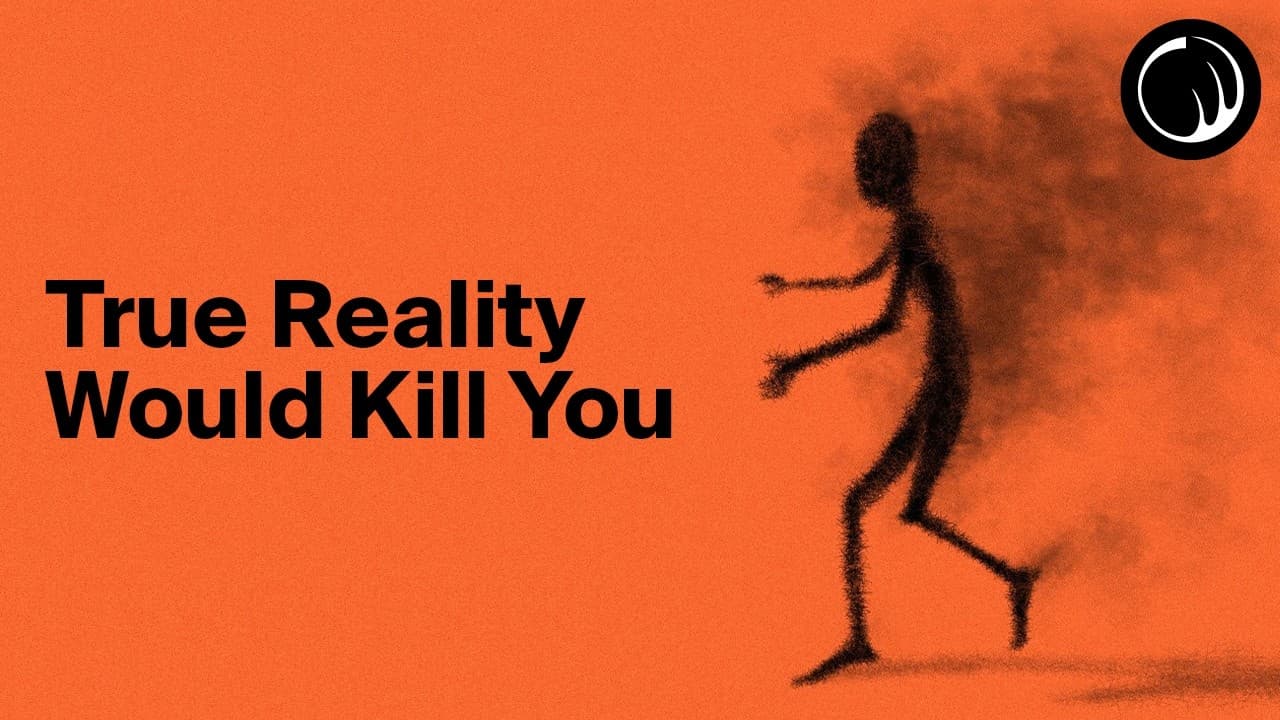
The brain may function primarily as a filter that reduces an immense field of possible awareness into the narrow stream needed for biological survival. Aldous Huxley argued that meditation, prayer, aesthetic observation, mystical engagement, and psychedelic experiences can loosen this filter, although whether such states reveal a divine reality or merely reflect shared human biology remains unresolved.
Transcript
This video is sponsored by Storyblocks. Get unlimited stock media downloads at one set price using my link in the description. We tend to view the mind as something that produces things. Thoughts, concepts, perceptions. In a relative sense, this may be true. But perhaps in a deeper, more accurate sense, it is actually the opposite that is true. Rat... Read More
Key Insights
- Huxley's reducing-valve theory presents the brain and nervous system as eliminative filters that restrict awareness. Their practical role is to prevent overwhelming confusion by selecting the perceptions, memories, symbols, and concepts most useful for biological survival.
- Ordinary consciousness is described as a narrow, survival-oriented stream rather than the complete field of possible awareness. Under this interpretation, consciousness does not grant full access to reality, because its normal organization actively excludes most information from experience.
- Perennialism is a school of thought centered on timeless wisdom that appears across different philosophical, religious, and mystical traditions. It examines recurring metaphors, moral principles, and ontological insights that emerged across periods and places, sometimes without known contact.
- Philosophia perennis refers to enduring truths or themes believed to persist throughout philosophical history. The transcript emphasizes that scholars do not agree on its precise meaning, and that the parallels identified by perennialists are often interpretive rather than literal equivalences.
- Recurring mystical ideas can support more than one explanation. Huxley interpreted them as evidence of a unified divine reality, while another possibility is that similar human brains interacting with similar features of the world independently generate comparable concepts and metaphors.
- Huxley's mescaline experience in 1953 intensified his interest in consciousness and perception. Under psychiatric supervision, he felt that ordinary mental boundaries and filtering functions had loosened, allowing him to perceive naked existence rather than merely a conventional arrangement of objects.
- Contemplative and altered states may loosen the mind's ordinary filters, according to Huxley. Meditation, prayer, aesthetic observation, mystical engagement, philosophical practice, religious experience, and psychedelic experience are presented as possible ways to encounter what he called reality's suchness.
- The truth of Huxley's metaphysical interpretation remains unresolved in the transcript. Even if perennial patterns arise from shared physiology rather than divine reality, their persistence across cultures may still identify unusually robust intersubjective insights about consciousness, existence, and human experience.
- Related book: The Terrible Paradox of Self-Awareness
- Export your Kindle highlights to Glasp: How to Download Highlights and Notes from Kindle
Install to Summarize YouTube Videos and Get Transcripts
Explore YouTube Video Summarizer or Get YouTube Transcript Extractor
Questions & Answers
Q: How does the brain filter our experience of reality?
According to the reducing-valve theory discussed in the transcript, the brain, nervous system, and sense organs eliminate most potential perceptions and memories. They leave a small selection that is practically useful for survival and effective action. Ordinary experience is therefore shaped through symbols, concepts, and restricted attention, rather than providing direct access to the full scope of reality or possible awareness.
Q: What is Aldous Huxley's reducing-valve theory of consciousness?
Huxley's theory proposes that the mind has access to a vast potential field of awareness, but the brain and nervous system reduce that field to a manageable stream. The filter protects people from being overwhelmed by information that is largely irrelevant to survival. Consciousness, in this account, is less a producer of mental phenomena than a mechanism that limits what reaches ordinary experience.
Q: What is perennialism in Aldous Huxley's philosophy?
Perennialism is the view that a timeless wisdom appears across philosophical, religious, and mystical traditions throughout history and around the world. Huxley compared Eastern and Western mystics and sought shared ontological and moral principles beneath their different language. He believed these overlaps pointed toward a single eternal divine reality that underlies things, living beings, minds, and the soul.
Q: What does philosophia perennis mean?
Philosophia perennis describes a philosophy or body of truth believed to endure across historical periods and generations. It suggests that continuous themes can be recognized even as temporary philosophical fashions disappear. The transcript also stresses that there is no agreed precise definition, and that proposed similarities between traditions are frequently interpretive, metaphorical, or partial rather than simple literal matches.
Q: Why do mystical traditions share similar ideas?
The transcript presents two possible explanations for recurring mystical and philosophical ideas. Perennialists such as Huxley regard them as signs of an underlying, unchanging metaphysical reality. A competing explanation is that humans possess broadly similar brains and bodies and encounter common features of the world, so separate cultures may independently create comparable concepts, metaphors, practices, and insights without sharing a divine source.
Q: How did mescaline influence Aldous Huxley's ideas?
Huxley took mescaline, a psychedelic compound found in certain cacti, under a psychiatrist's supervision in 1953. He interpreted the experience as a loosening of the brain's normal filtering functions and a disclosure of fuller, less mediated reality. His observations strengthened the theory he later presented in The Doors of Perception and Heaven and Hell, published in 1954 and 1956 respectively.
Q: What practices can open the mind's reducing valve?
Huxley proposed several ways that ordinary mental filtering might be loosened, including meditation, prayer, contemplation, aesthetic observation, mystical engagement, and experiences of a spiritual, religious, philosophical, or psychedelic nature. He believed these states could move awareness beyond its usual dependence on words, concepts, symbols, separate objects, and linear time, allowing a more direct encounter with what he called the suchness of reality.
Q: Does altered consciousness reveal reality as it truly is?
The transcript does not settle whether altered consciousness reveals objective reality. Huxley believed that psychedelic and contemplative states could disclose a unified divine ground normally hidden by the brain's survival-oriented filters. However, the same experiences and cross-cultural similarities might instead reflect stable features of human physiology and cognition. Their philosophical importance can remain substantial even if Huxley's metaphysical explanation is ultimately incorrect.
Summary & Key Takeaways
-
Aldous Huxley proposed that the brain and nervous system do not simply produce consciousness. Instead, they may eliminate most possible perceptions and memories, preserving only a small, practically useful selection. Ordinary consciousness would therefore represent a survival-oriented reduction of reality rather than complete access to everything that can potentially be experienced.
-
Huxley's perennialism holds that recurring insights across religions, philosophies, and mystical traditions may reveal an enduring metaphysical reality shared by humanity. An alternative explanation is that similar ideas arise because human brains and environments share common features, just as separate cultures independently developed comparable tools suited to similar physical needs.
-
After taking mescaline under psychiatric supervision in 1953, Huxley believed he experienced reality in a fuller and less mediated form. He later described ways of loosening consciousness's filters, including contemplation, meditation, prayer, aesthetic observation, mystical practice, and psychedelic experience, while the video's conclusion leaves the truth of his interpretation open to debate.
Read in Other Languages (beta)
Share This Summary 📚
Summarize YouTube Videos and Get Video Transcripts with 1-Click
Try YouTube Summary with ChatGPT & Claude or YouTube Transcript Generator
Explore More Summaries from Pursuit of Wonder 📚

Summarize YouTube Videos and Get Video Transcripts with 1-Click
Try YouTube Summary with ChatGPT & Claude or YouTube Transcript Generator