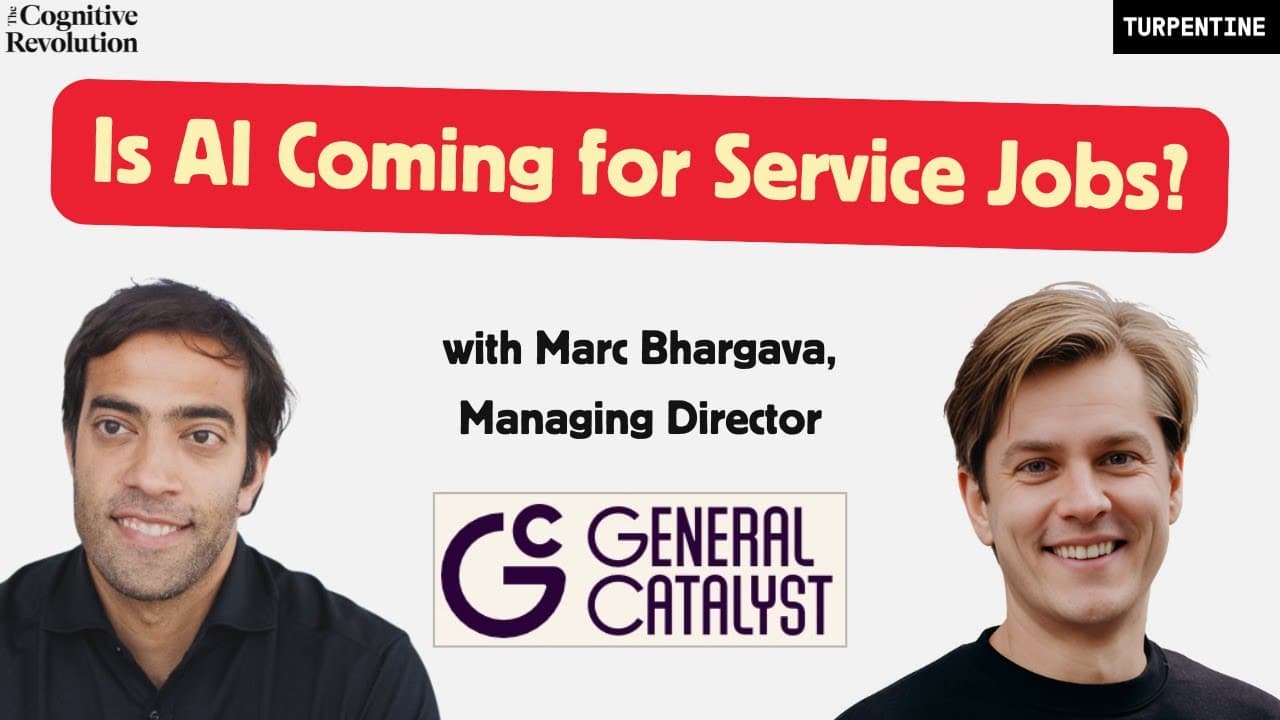
How AI Transforms Service Industries with Marc Bhargava
TL;DR
General Catalyst's AI rollup strategy aims to transform low-margin service businesses into high-margin software-like companies by automating 30-70% of tasks. This involves acquiring traditional service businesses and integrating AI to enhance efficiency and output, focusing on industries like accounting, legal, and call centers. The approach emphasizes growth through AI enablement rather than cost-cutting, aiming for significant revenue increases with minimal cost growth.
Transcript
Hello and welcome back to the cognitive revolution. Today I'm excited to be speaking with Mark Bargava, managing director at general catalyst about their creation strategy and a fascinating new category of AI company. They're building AI enabled rollups. These are companies that begin as vertical software startups, but having achieved initial produ... Read More
Key Insights
- General Catalyst's strategy involves acquiring traditional service businesses and transforming them through AI automation to achieve software-like margins.
- The focus is on industries where 30-70% of tasks are automatable today, such as accounting, legal services, and call centers.
- AI rollups start as vertical software startups and grow by acquiring service businesses, integrating AI to enhance efficiency and output.
- The goal is to enable each person to handle more work, addressing labor shortages in many service industries.
- The strategy emphasizes growth through AI enablement rather than cost-cutting, aiming for significant revenue increases with minimal cost growth.
- AI transformation is implemented pragmatically, layering AI into existing processes rather than redesigning workflows.
- Service businesses traditionally run at low profit margins, but AI integration aims to achieve 30-40% margins.
- The approach involves recruiting teams that combine AI technical talent with industry veterans who understand service operations and M&A.
Install to Summarize YouTube Videos and Get Transcripts
Explore YouTube Video Summarizer or Get YouTube Transcript Extractor
Questions & Answers
Q: How does General Catalyst's AI rollup strategy work?
General Catalyst's AI rollup strategy involves acquiring traditional service businesses and transforming them through AI automation to achieve software-like margins. The focus is on industries where 30-70% of tasks are automatable today, such as accounting, legal services, and call centers. The approach emphasizes growth through AI enablement rather than cost-cutting, aiming for significant revenue increases with minimal cost growth.
Q: What industries are targeted for AI transformation?
The strategy targets industries where a significant portion of tasks are automatable, including accounting, legal services, and call centers. These sectors are chosen because they traditionally operate at low profit margins, but with AI integration, they have the potential to achieve software-like margins of 30-40%. The focus is on transforming these industries by layering AI into existing processes to enhance efficiency and output.
Q: How does AI integration impact service businesses?
AI integration in service businesses aims to enhance efficiency and output by automating routine tasks, allowing employees to handle more work and address labor shortages. This transformation focuses on growth through AI enablement rather than cost-cutting, aiming for significant revenue increases with minimal cost growth. The goal is to achieve higher profit margins and improve service delivery without eliminating jobs.
Q: What is the role of teams in the AI rollup strategy?
Teams play a crucial role in the AI rollup strategy by combining AI technical talent with industry veterans who understand service operations and M&A. These teams are responsible for integrating AI into acquired service businesses, working closely with initial customers to pilot AI tools and automation workflows. The approach involves recruiting and assembling founding teams that can effectively implement AI transformation and drive growth.
Q: How are AI rollups implemented in service industries?
AI rollups are implemented by acquiring traditional service businesses and integrating AI into existing processes to enhance efficiency and output. This involves identifying automatable tasks, layering AI into workflows, and working closely with initial customers to pilot AI tools. The approach focuses on pragmatic AI transformation, enabling each person to handle more work and addressing labor shortages in service industries.
Q: What are the potential challenges of AI transformation?
Potential challenges of AI transformation include the risk of disruption to employment and the need for careful implementation to ensure smooth integration into existing processes. While AI has the potential to significantly enhance efficiency and output, it is important to address concerns about job elimination and ensure that AI transformation focuses on enabling growth and improving service delivery rather than cutting costs.
Q: What is the expected impact on profit margins?
The expected impact on profit margins is significant, with AI integration aiming to transform traditionally low-margin service businesses into companies with software-like margins of 30-40%. By automating routine tasks and enhancing efficiency and output, AI rollups have the potential to achieve higher profit margins and improve service delivery, ultimately driving growth and increasing revenue with minimal cost growth.
Q: How does the strategy address labor shortages?
The strategy addresses labor shortages by enabling each person to handle more work through AI enablement. By automating routine tasks and enhancing efficiency, AI integration allows service businesses to take on more clients and increase revenue without expanding their workforce. The focus is on transforming service industries to operate more efficiently and effectively, addressing labor shortages and improving service delivery.
Summary & Key Takeaways
-
General Catalyst's AI rollup strategy focuses on transforming low-margin service businesses into software-like companies by automating 30-70% of tasks. This involves acquiring traditional service businesses and integrating AI to enhance efficiency and output, particularly in industries like accounting, legal, and call centers. The approach emphasizes growth through AI enablement rather than cost-cutting, aiming for significant revenue increases with minimal cost growth.
-
Marc Bhargava discusses how AI rollups begin as vertical software startups and grow by acquiring service businesses. The strategy involves layering AI into existing processes, enabling each person to handle more work and addressing labor shortages in many service industries. The goal is to achieve software-like profit margins of 30-40% in traditionally low-margin service sectors.
-
The conversation highlights the importance of recruiting teams that combine AI technical talent with industry veterans who understand service operations and M&A. While there is potential for AI transformation to be disruptive to employment, the strategy focuses on enabling growth and efficiency rather than job elimination, aiming to bring AI transformation to Main Street businesses.
Read in Other Languages (beta)
Share This Summary 📚
Summarize YouTube Videos and Get Video Transcripts with 1-Click
Try YouTube Summary with ChatGPT & Claude or YouTube Transcript Generator
Explore More Summaries from Cognitive Revolution "How AI Changes Everything" 📚






Summarize YouTube Videos and Get Video Transcripts with 1-Click
Try YouTube Summary with ChatGPT & Claude or YouTube Transcript Generator