How Do Java Records Reduce Boilerplate Code? Full Java Records Tutorial
TL;DR
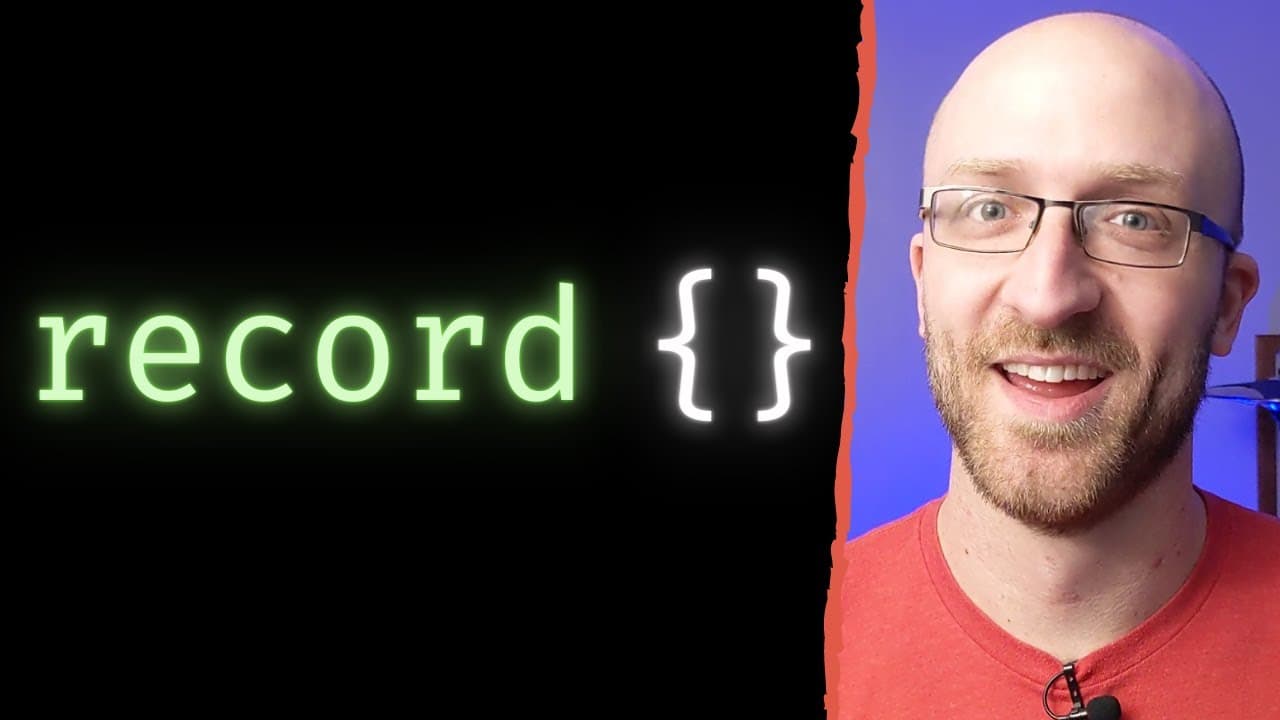
Java records reduce boilerplate by generating the core code needed for simple data-holding classes from a concise declaration. In the employee example, a traditional class takes almost 50 lines to hold two values, while a one-line record declaration provides private final fields, public accessors, a canonical constructor, and implementations of toString, hashCode, and equals. Read on to see how records are declared and what Java generates automatically.
Transcript
records are a relatively new addition to Java that you can use to avoid a ton of boilerplate code in certain types of classes in this video we'll talk about exactly what records are how they can simplify your code and when and how you can Implement them into your Java programs my name is John and I'm a lead Java software engineer I also have a full... Read More
Key Insights
- Java records are a new feature that simplify class creation by reducing boilerplate code.
- Records automatically generate private fields, getters, and a canonical constructor.
- Records are immutable, meaning their fields cannot change after object creation.
- Records cannot extend other classes but can implement interfaces.
- A compact constructor can be used in records to simplify initialization logic.
- Records automatically generate toString, equals, and hashCode methods.
- Records cannot have non-static instance fields outside their component list.
- Records are implicitly final, meaning they cannot be subclassed.
Install to Summarize YouTube Videos and Get Transcripts
Explore YouTube Video Summarizer or Get YouTube Transcript Extractor
Questions & Answers
Q: What are Java records, and how do they reduce boilerplate code?
A record is a special type of Java class designed to hold data. From a short declaration, Java generates private final fields, public accessor methods, a canonical constructor, and implementations of toString, hashCode, and equals.
Q: How do you create a record in Java?
Use public record instead of public class, followed by the record name and its components in parentheses. The example declares an employee record with a String name and an int employee number, then uses curly brackets to complete the declaration.
Q: How much code can a Java record replace?
The tutorial's traditional employee class requires almost 50 lines to hold two pieces of data. An equivalent employee record is declared in a single line of code.
Q: What fields does Java generate for a record?
Java generates a private field for every component listed in the record declaration. Those fields are final by default, so they cannot be changed after the record object is created.
Q: How do getter methods work in Java records?
Java generates a public accessor for each record component. Unlike a traditional getter such as getName(), the generated record accessor uses only the component name, such as name().
Q: What is a canonical constructor in a Java record?
A record automatically receives a constructor whose parameters match all components in its declaration. This canonical constructor sets the record's fields from those parameter values, allowing an object to be created without writing the constructor explicitly.
Q: Do Java records generate equals, hashCode, and toString methods?
Yes. Java automatically supplies implementations of equals, hashCode, and toString for a record, replacing methods that would otherwise need to be written or generated for a traditional data-holding class.
Q: How is an EmployeeRecord object created in the tutorial?
The tutorial creates an EmployeeRecord by calling its generated constructor with a name and employee number. Its example passes the name Kramer and employee number 54321.
Summary & Key Takeaways
-
Java records help eliminate boilerplate code by generating constructors, getters, and other methods automatically. They are particularly useful for classes designed to hold data. Records are immutable and cannot extend other classes, but they can implement interfaces, offering flexibility in Java programming.
-
Using records, Java developers can create data-holding classes with minimal code. Records automatically handle common methods like toString, equals, and hashCode, reducing manual coding errors. They also introduce compact constructors for efficient initialization, making them a powerful tool for Java programmers.
-
Records in Java streamline the creation of simple data classes by automatically generating necessary methods and ensuring immutability. While they cannot be extended, they can implement interfaces, providing a balance of simplicity and functionality. This feature is ideal for developers seeking to enhance code efficiency and maintainability.
Read in Other Languages (beta)
Share This Summary 📚
Summarize YouTube Videos and Get Video Transcripts with 1-Click
Try YouTube Summary with ChatGPT & Claude or YouTube Transcript Generator
Explore More Summaries from Coding with John 📚


Summarize YouTube Videos and Get Video Transcripts with 1-Click
Try YouTube Summary with ChatGPT & Claude or YouTube Transcript Generator