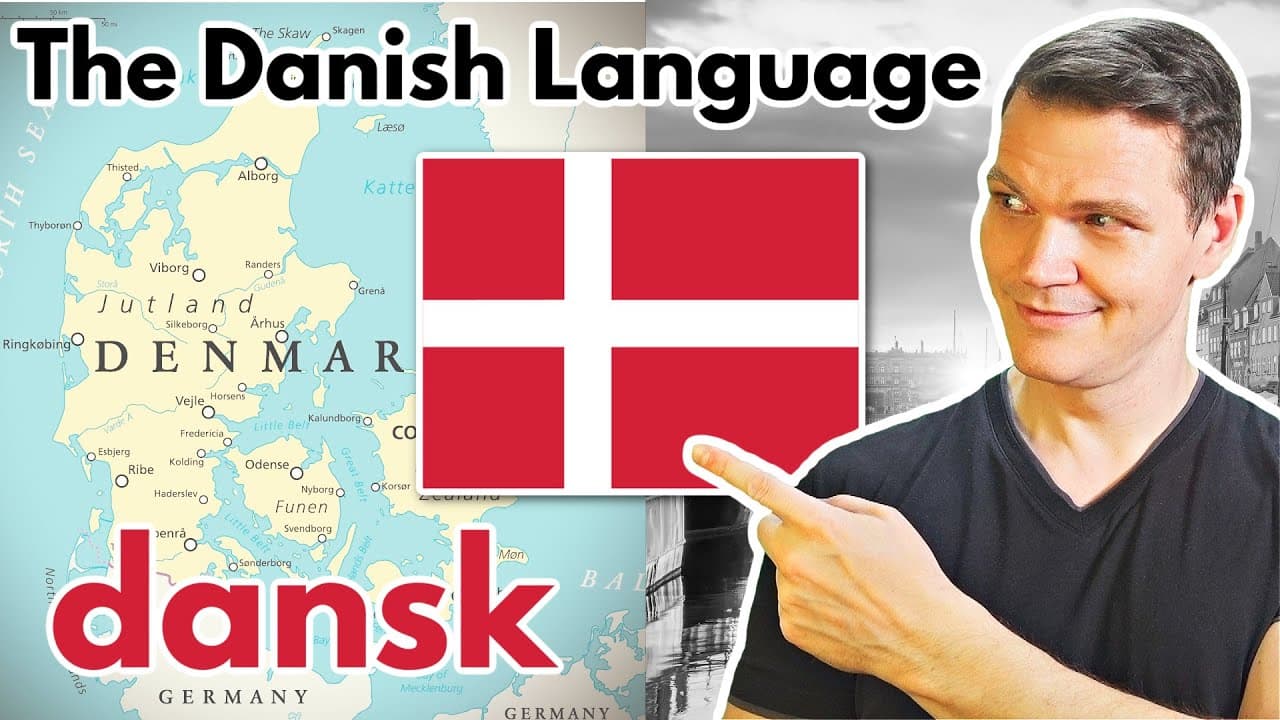
The Danish Language (IS THIS REAL?)
TL;DR
The video explores the Danish language's history, pronunciation, and grammar.
Transcript
this video is brought to you by danish class 101 pod 101 and class 101 courses are one of my favorite ways to start learning a new language online click the link in the description or visit langfocus.com danish class to give it a try finally today we're going to talk about the danish language so i can explore my danish roots no no i am danish no wa... Read More
Key Insights
- Danish is a North Germanic language with around 6 million native speakers, mainly in Denmark and parts of Germany.
- Danish phonology is complex, with many sounds being slurred or disappearing, making it hard for Swedish and Norwegian speakers to understand.
- The Danish language evolved from Old Norse and has been influenced by Latin and Low German over centuries.
- Danish pronunciation includes unique features like the soft 'd' sound and the 'stød', a creaky voice sound that distinguishes words.
- Danish grammar includes features like definite articles as suffixes and a V2 word order, where the verb comes second in the sentence.
- Danish numbers from 50 to 100 are based on multiples of 20, unlike other North Germanic languages.
- Danish verbs are not conjugated for person or number, similar to Swedish and Norwegian.
- The video suggests using DanishClass101 for learning Danish through audio and video lessons, vocabulary flashcards, and quizzes.
Install to Summarize YouTube Videos and Get Transcripts
Explore YouTube Video Summarizer or Get YouTube Transcript Extractor
Questions & Answers
Q: What makes Danish pronunciation difficult for Swedish and Norwegian speakers?
Danish pronunciation is challenging due to its complex phonology, where many sounds are slurred or disappear. This makes it hard for Swedish and Norwegian speakers to understand. Unique features like the soft 'd' sound and 'stød', a creaky voice sound, further differentiate Danish from its linguistic relatives.
Q: How did Danish evolve as a language?
Danish evolved from Old Norse, a language that developed from Proto-Germanic by the 8th century. Over time, Old Norse diverged into Old West Norse and Old East Norse, with Old Danish emerging by the 13th century. Influences from Latin and Low German also shaped Danish, especially during the Hanseatic expansion and the Protestant Reformation.
Q: What are some unique grammatical features of Danish?
Danish grammar includes the use of definite articles as suffixes attached to nouns, unlike English where they precede nouns. It also follows a V2 word order, meaning the verb comes second in the sentence. Additionally, Danish verbs are not conjugated for person or number, similar to Swedish and Norwegian.
Q: How are Danish numbers from 50 to 100 unique?
Danish numbers from 50 to 100 are based on multiples of 20, rather than 10. For example, 'fifty' is 'halvtreds', meaning 'half three times twenty'. This system is not found in other North Germanic languages, making Danish numerals particularly unique and complex.
Q: What is the 'stød' feature in Danish pronunciation?
The 'stød' is a unique phonological feature in Danish, similar to a glottal stop but without full closure of the vocal cords. It results in a creaky voice sound and is phonemic, meaning it can distinguish words that otherwise sound identical. It appears in syllables with long vowels or short vowels followed by voiced consonants.
Q: How does DanishClass101 help in learning Danish?
DanishClass101 offers a comprehensive language learning experience with audio and video lessons, downloadable materials, and vocabulary tools. It provides pronunciation guides, quizzes, and spaced repetition flashcards to help learners memorize and practice Danish effectively. The platform is suitable for learners at any level and focuses on building listening comprehension and pronunciation skills.
Q: What is the significance of the Danish language's historical influences?
The historical influences on Danish, such as Latin and Low German, have significantly shaped its vocabulary and development as a literary language. The Protestant Reformation played a crucial role in standardizing Danish, especially with the publication of the first Danish Bible in 1550, which helped establish it as a literary language.
Q: How does Danish grammar handle gender and articles?
Danish grammar features two genders: common and neuter. Definite articles are suffixes attached to nouns, unlike English where articles precede nouns. Adjectives in definite contexts require a standalone definite article before the noun. Danish also has a unique system for plural noun endings, which varies based on noun class rather than gender.
Summary & Key Takeaways
-
The video delves into the Danish language, emphasizing its complex phonology and historical development from Old Norse. Danish is primarily spoken in Denmark and parts of Germany. Its pronunciation is challenging, with features like the soft 'd' and 'stød'.
-
Danish grammar is explored, highlighting its unique use of definite articles as suffixes and the V2 word order. The video also covers Danish numbers, which are based on multiples of 20, and the non-conjugation of verbs for person or number.
-
The video recommends DanishClass101 for learning Danish, offering a range of audio and video lessons, vocabulary tools, and quizzes. It encourages learners to focus on pronunciation and utilize available resources for comprehensive language acquisition.
Read in Other Languages (beta)
Share This Summary 📚
Summarize YouTube Videos and Get Video Transcripts with 1-Click
Try YouTube Summary with ChatGPT & Claude or YouTube Transcript Generator
Explore More Summaries from Langfocus 📚


Summarize YouTube Videos and Get Video Transcripts with 1-Click
Try YouTube Summary with ChatGPT & Claude or YouTube Transcript Generator