What Are Helen Toner's Views on AI Governance and Warfare?
TL;DR
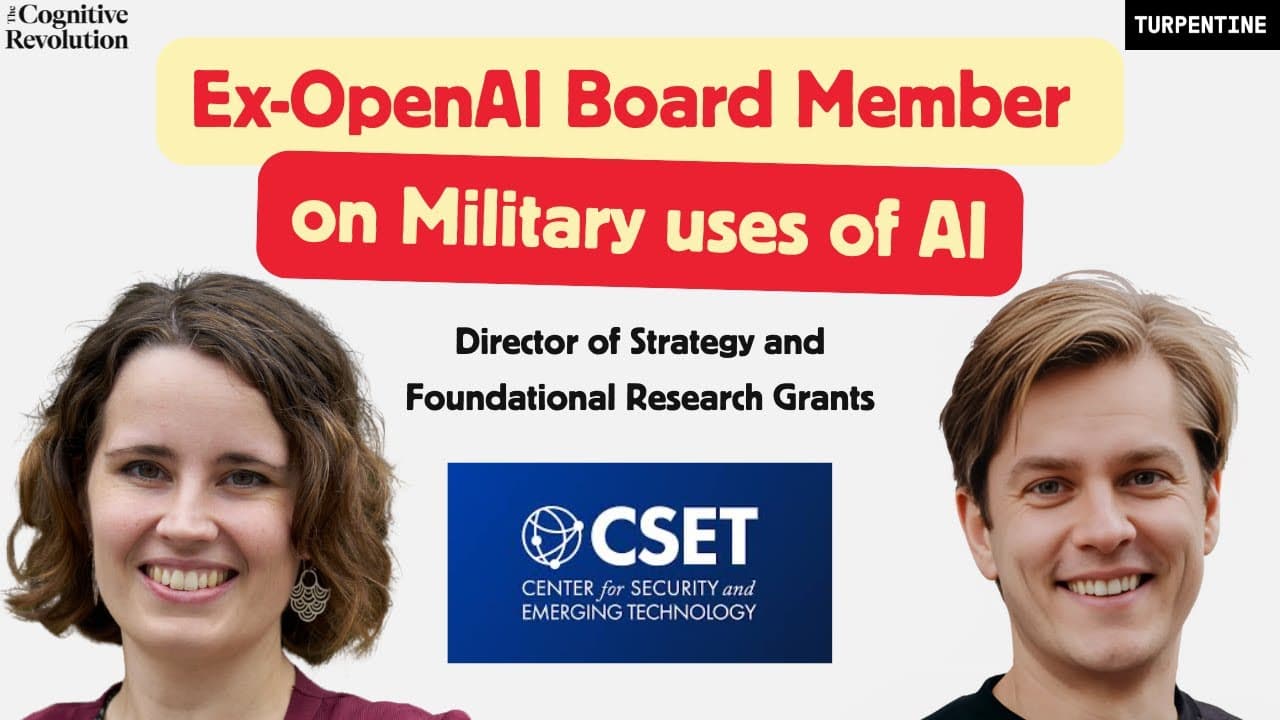
Helen Toner stresses the urgency of societal preparedness for transformative AI, emphasizing the concept of 'adaptation buffers' to mitigate risks of misuse. She clarifies that false reports regarding board decisions at OpenAI should not distract from the need for transparency in AI development and the importance of balancing innovation with accountability, particularly in military applications.
Transcript
Hello and welcome back to the cognitive revolution. Today I'm speaking with Helen Toner, director of strategy and foundational research grants at CES set, the center for security and emerging technology, and author of a new Substack called Rising Tide. Helen is best known to the general public for her role as an open AAI board member responsible fo... Read More
Key Insights
- Helen Toner clarifies that reports about a 'Q*' breakthrough influencing OpenAI board decisions were false, emphasizing the importance of transparency in AI development.
- The concept of 'adaptation buffers' is introduced, highlighting the need for society to build resilience against AI misuse during critical windows of opportunity.
- Challenges in implementing effective AI governance are discussed, with a focus on balancing transparency and protecting trade secrets.
- The conversation explores the complex dynamics of US-China relations in the AI landscape, questioning the perceived threat from China.
- AI decision support systems in military applications are examined, emphasizing the need for reliability and understanding of system limitations.
- The potential retreat from iterative deployment in AI development is a concern, with suggestions for relative speed limits on model development.
- The role of whistleblowing in AI companies is highlighted, with suggestions for policy makers to clarify standards and processes.
- The discussion touches on the importance of technical solutions and societal adaptations to manage AI misuse risks effectively.
Install to Summarize YouTube Videos and Get Transcripts
Explore YouTube Video Summarizer or Get YouTube Transcript Extractor
Questions & Answers
Q: What is the concept of 'adaptation buffers'?
Adaptation buffers refer to critical windows of time between when AI capabilities are first demonstrated and when they become widely accessible. Helen Toner argues that society needs this time to build resilience against potential misuse of AI technologies, allowing for necessary adaptations and preparations before widespread deployment.
Q: How does Helen Toner view the US-China AI competition?
Helen Toner discusses the complex dynamics of US-China relations in the AI landscape, questioning the perceived threat from China. She highlights the importance of understanding the geopolitical context and the historical attempts to integrate China into a rules-based international order. The discussion suggests that the competitive narrative may be influenced by strategic communications and differing national interests.
Q: What are the challenges in implementing AI governance?
Implementing effective AI governance involves balancing transparency with protecting trade secrets, addressing the role of whistleblowing, and establishing clear standards and processes for disclosure. Helen Toner emphasizes the need for building blocks that improve governance, such as enhancing technical capacity in governments and funding research on AI measurement and alignment.
Q: What concerns are raised about AI decision support systems in the military?
AI decision support systems in military applications raise concerns about reliability, hallucinations, and potential scheming against human users. Helen Toner emphasizes the need for understanding system limitations and ensuring that AI systems used in life-and-death situations are thoroughly tested and reliable. The paper co-authored by Toner suggests factors to consider when implementing these systems, such as scope, data, and human-machine interaction.
Q: How does Helen Toner address the notion of iterative deployment in AI development?
Helen Toner discusses the potential retreat from iterative deployment, a strategy where AI capabilities are gradually released to allow for societal adaptation. Concerns are raised about companies possibly developing superintelligence in secret. Toner suggests considering relative speed limits on model development to ensure transparency and societal readiness, while acknowledging challenges in implementing such measures.
Q: What is Helen Toner's perspective on technical vs. societal solutions for AI misuse?
Helen Toner emphasizes the importance of both technical and societal solutions to manage AI misuse risks. While technical solutions focus on improving AI systems' safety and reliability, societal solutions involve building resilience through infrastructure improvements, policy changes, and enhancing societal readiness. Toner argues for a balanced approach that leverages both aspects to address potential misuse effectively.
Q: What role does whistleblowing play in AI companies according to Helen Toner?
Whistleblowing plays a crucial role in ensuring transparency and accountability in AI companies. Helen Toner suggests that policy makers should clarify standards and processes for whistleblowing, focusing on behavior that may not be illegal but still concerning. She advocates for pairing whistleblower protections with disclosure requirements to create clear standards for when whistleblowing is appropriate, thus facilitating responsible reporting of concerns.
Q: What are the implications of the potential retreat from iterative deployment in AI development?
The potential retreat from iterative deployment in AI development raises concerns about transparency and societal readiness for advanced AI capabilities. If companies develop superintelligence in secret, it could lead to disruptive consequences without adequate societal adaptation. Helen Toner suggests considering relative speed limits on model development to ensure that new capabilities are gradually introduced, allowing for societal adaptation and reducing the risk of unforeseen negative impacts.
Summary & Key Takeaways
-
Helen Toner discusses her role on the OpenAI board, emphasizing the importance of transparency and adaptation buffers to manage AI misuse risks. She clarifies false reports about board decisions and highlights the need for societal resilience.
-
The conversation explores AI governance challenges, including whistleblowing, transparency requirements, and the need for effective policies. Toner suggests building blocks for better governance and the importance of technical and societal solutions.
-
US-China AI dynamics and military applications of AI decision support systems are examined, highlighting the need for reliability and understanding system limitations in military contexts. The potential retreat from iterative deployment is also discussed.
Read in Other Languages (beta)
Share This Summary 📚
Summarize YouTube Videos and Get Video Transcripts with 1-Click
Try YouTube Summary with ChatGPT & Claude or YouTube Transcript Generator
Explore More Summaries from Cognitive Revolution "How AI Changes Everything" 📚





Summarize YouTube Videos and Get Video Transcripts with 1-Click
Try YouTube Summary with ChatGPT & Claude or YouTube Transcript Generator