The ARMENIAN Language
TL;DR
Armenian is a unique Indo-European language with diverse influences.
Transcript
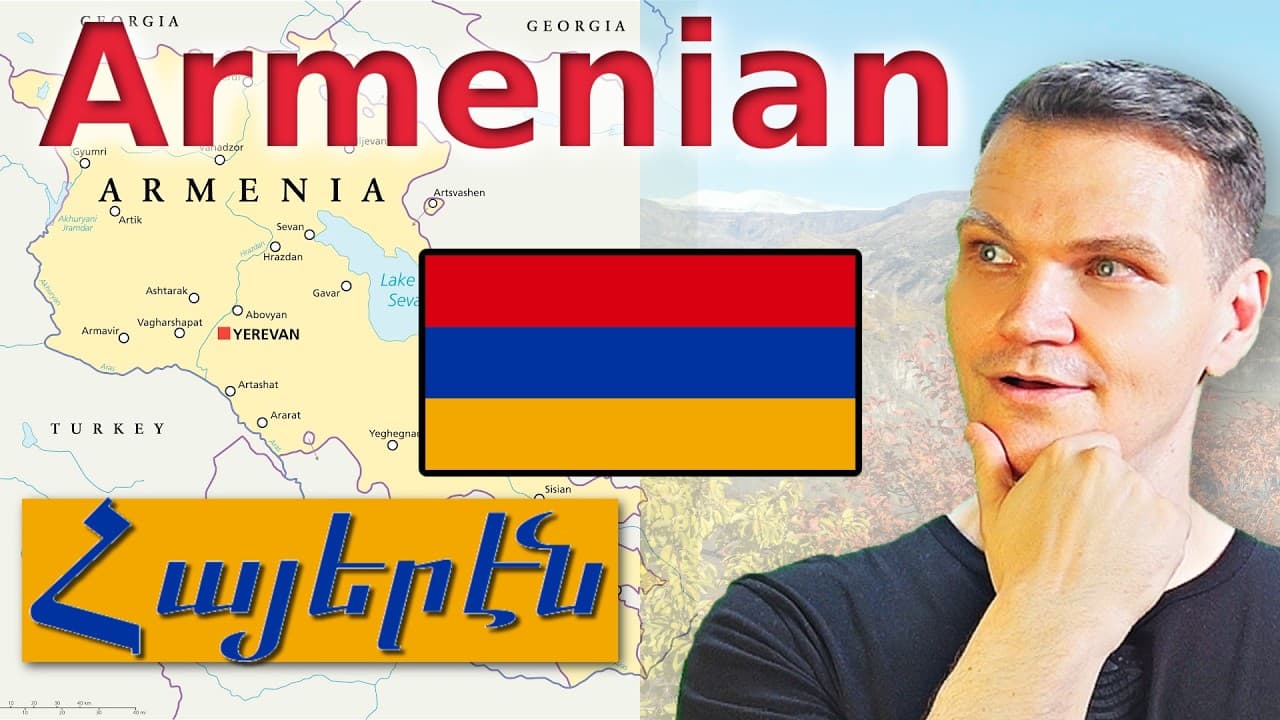
today we're going to talk about the Armenian language the official language of Armenia a country located up in the mountains of the Armenian Highlands it's spoken by between six and seven million people around 3 million of them in Armenia others live in nearby areas where Armenians have historically lived or in the Armenian diaspora throughout the ... Read More
Key Insights
- Armenian is an Indo-European language, forming its own independent branch, and is spoken by millions worldwide.
- The Armenian alphabet was created in the 5th century by Mesrop Mashtots, with the earliest texts being religious translations.
- Armenian has been influenced by various languages, including Parthian, Middle Persian, and several extinct Anatolian and Semitic languages.
- The language has two standard varieties: Eastern Armenian and Western Armenian, with distinct dialects and historical influences.
- Armenian's noun structure includes multiple suffixes, with a complex case system that has evolved over time.
- The language is pro-drop, meaning subject pronouns can be omitted, and it uses a subject-object-verb order.
- Armenian verbs are conjugated with auxiliary verbs, with various participles forming different tenses.
- Despite its challenges, such as a steep learning curve and complex script, Armenian is a vital part of cultural identity.
Install to Summarize YouTube Videos and Get Transcripts
Explore YouTube Video Summarizer or Get YouTube Transcript Extractor
Questions & Answers
Q: What language family does Armenian belong to?
Armenian belongs to the Indo-European language family. It forms its own independent branch within this family, distinguishing it from other Indo-European languages. Although related to languages like English, Spanish, and Russian, Armenian stands alone in its branch, highlighting its unique linguistic characteristics.
Q: How was the Armenian alphabet created?
The Armenian alphabet was created in the early 5th century by a Christian monk named Mesrop Mashtots. It was developed to facilitate the translation of religious texts, such as the Bible, into Armenian. This creation marked a significant milestone in the cultural and linguistic development of the Armenian people.
Q: What are some influences on the Armenian language?
Armenian has been influenced by several languages throughout its history. Notable influences include Parthian and Middle Persian, as well as extinct Anatolian languages like Hittite and Luwian. Additionally, Armenian has borrowed from Semitic languages such as Arabic and Syriac, reflecting its historical interactions with neighboring cultures.
Q: What distinguishes Eastern and Western Armenian?
Eastern and Western Armenian are the two main standard varieties of the language, each influenced by different historical empires. Eastern Armenian, based on the Yerevan dialect, is official in Armenia and used in regions like Russia and Iran. Western Armenian, based on the Constantinople dialect, is used in the Armenian diaspora, particularly in Turkey and the Middle East.
Q: How does Armenian handle noun and verb structures?
Armenian nouns take several suffixes, including plural, case, and possessive suffixes. The language has a complex case system with five cases. Armenian verbs are conjugated using auxiliary verbs, forming various tenses with participles. This structure presents a learning challenge but reflects the language's rich linguistic history.
Q: What is the typical word order in Armenian sentences?
The typical word order in Armenian sentences is subject-object-verb (SOV). However, Armenian is a pro-drop language, meaning subject pronouns can be omitted if they are clear from the context. The language's flexible word order allows for emphasis on different parts of a sentence, depending on the desired focus.
Q: How does Armenian differ from other Indo-European languages?
Armenian differs from other Indo-European languages by forming its own independent branch within the family. It has a unique alphabet, complex noun and verb structures, and has been influenced by a variety of languages throughout its history. These factors contribute to its distinctiveness and cultural significance among its speakers.
Q: Why is Armenian considered important despite its complexity?
Armenian is considered important because it is a crucial part of the cultural identity of Armenian people worldwide. Despite its complexity, including a challenging script and diverse dialects, the language's rich history and adaptability showcase its resilience and significance in preserving Armenian heritage and identity across generations.
Summary & Key Takeaways
-
Armenian is a unique branch of the Indo-European language family with a rich history and diverse influences. Its alphabet was created in the 5th century, and the language has been shaped by contact with numerous other languages throughout history.
-
The language is characterized by two main standard varieties, Eastern and Western Armenian, each influenced by different historical empires. Armenian's complex noun and verb structures present challenges to learners, but also reflect its rich linguistic heritage.
-
Despite its complexity, Armenian remains a crucial part of the cultural identity for its speakers worldwide. The language's evolution showcases its adaptability and the historical interactions between Armenia and neighboring regions.
Read in Other Languages (beta)
Share This Summary 📚
Summarize YouTube Videos and Get Video Transcripts with 1-Click
Try YouTube Summary with ChatGPT & Claude or YouTube Transcript Generator
Explore More Summaries from Langfocus 📚




Summarize YouTube Videos and Get Video Transcripts with 1-Click
Try YouTube Summary with ChatGPT & Claude or YouTube Transcript Generator