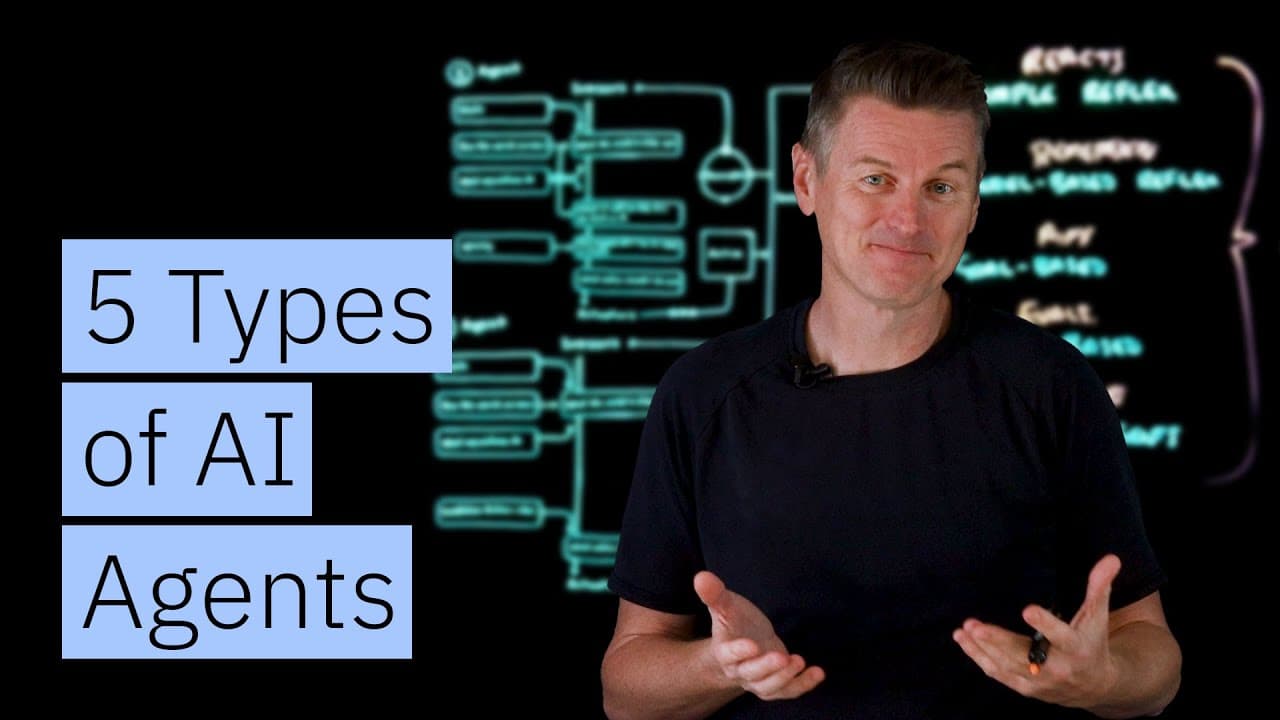
What Are the Five Main Types of AI Agents?
TL;DR
AI agents range from simple systems that follow fixed condition-action rules to learning systems that improve through environmental feedback. Their capabilities progress from reacting, remembering, and pursuing goals to ranking outcomes by utility and adapting through experience, while multi-agent systems combine several agents and human involvement remains valuable for complex use cases.
Transcript
In the world of AI, it seems that 2025 is the year of the AI Agent. New agentic workflows and models are released all the time, often accompanied by breathless declarations on social media that a task that previously required human expertise has now been entirely automated by the latest agentic breakthrough. But can you distinguish a simple reflex ... Read More
Key Insights
- Simple reflex agents are rule-driven systems that select actions from current perceptions without storing past information. They perform effectively in structured, predictable environments with well-defined rules, but dynamic conditions can expose their limitations and cause the same mistakes to recur.
- A thermostat is an example of a simple reflex agent because it turns heating on when temperature falls below a predefined threshold and turns it off when the set temperature is reached. Its behavior follows a direct condition-action structure.
- Model-based reflex agents are reactive systems with an internal state that records relevant information about the world. They update that state by observing environmental changes and tracking the consequences of their own actions, enabling decisions beyond immediately visible inputs.
- Goal-based agents are systems that simulate the future outcomes of possible actions and select actions that support a desired result. Unlike reflex agents, they ask whether a predicted future state helps achieve the stated goal under current conditions.
- Utility-based agents are systems that rank goal-compatible outcomes according to desirability. A utility score can represent preferences involving factors such as delivery speed, safety, battery level, weather, and energy use, allowing the agent to choose among several successful options.
- Learning agents are adaptive systems that improve their mapping from states to actions through environmental feedback. A critic evaluates outcomes, a learning element updates knowledge, a problem generator proposes unexplored actions, and a performance element selects actions using the learned strategy.
- The progression among the five agent types is from reacting to remembering, aiming, evaluating, and improving. Greater capability introduces additional requirements, including an accurate utility function for utility-based decisions and substantial time and data for learning from experience.
- Multi-agent systems are arrangements in which several agents operate within a shared environment and cooperate toward a common goal. These systems can combine agent capabilities for complex use cases, while human involvement remains valuable because AI agents generally work best with a human in the loop.
Install to Summarize YouTube Videos and Get Transcripts
Explore YouTube Video Summarizer or Get YouTube Transcript Extractor
Questions & Answers
Q: What are the five main types of AI agents?
The five main types are simple reflex agents, model-based reflex agents, goal-based agents, utility-based agents, and learning agents. Simple reflex agents react through fixed rules, while model-based agents remember state. Goal-based agents predict actions that advance an objective, utility-based agents rank desirable outcomes, and learning agents improve their behavior through experience and feedback.
Q: How does a simple reflex AI agent work?
A simple reflex agent receives perceptions from its environment through sensors and uses those inputs to represent the world as it currently appears. It applies predefined condition-action rules, such as turning on heat when temperature reaches a specified level. Actuators execute the chosen action, which changes the environment and produces the next set of perceptions.
Q: Why do simple reflex agents struggle in dynamic environments?
Simple reflex agents struggle in dynamic environments because they depend on predefined rules and do not store information about previous states or actions. When a new situation is not adequately covered by those rules, the agent lacks historical context for adapting its response. As a result, it can repeatedly make the same mistake when conditions change unexpectedly.
Q: What is the difference between simple and model-based reflex agents?
A simple reflex agent selects actions from current perceptions using condition-action rules, without remembering the past. A model-based reflex agent also uses rules, but maintains an internal state that reflects how the environment evolves and how its actions affect it. This memory lets the model-based agent infer information about parts of the environment it cannot currently observe.
Q: How does a goal-based AI agent choose an action?
A goal-based agent combines its current state, an internal model of the world, and a defined objective. It simulates the likely future outcomes of possible actions and asks which outcome will help it achieve the goal. For example, a self-driving car can predict whether turning toward a highway will move it closer to its intended destination.
Q: What makes a utility-based agent different from a goal-based agent?
A goal-based agent seeks an action that reaches its objective, and any successful route can be acceptable. A utility-based agent also evaluates how desirable each successful outcome is. It assigns preference values to future states and ranks alternatives, allowing it to select a route that better balances factors such as speed, safety, weather, battery level, and energy usage.
Q: How does a learning AI agent improve through experience?
A learning agent uses a critic to compare action outcomes with a performance standard and produce numerical feedback, often called a reward in reinforcement learning. A learning element updates the agent's knowledge from that feedback. A problem generator suggests actions not yet explored, while the performance element selects actions based on strategies currently considered optimal.
Q: When should multiple AI agents and humans work together?
Multiple agents can work together when a shared environment and common goal benefit from cooperative behavior. This arrangement is called a multi-agent system. As learning agents and generative AI support increasingly complex use cases, combining agents can expand what the system handles. Human involvement still remains valuable because AI agents typically perform best with a human in the loop.
Summary & Key Takeaways
-
Simple reflex agents respond to current perceptions with predefined condition-action rules. Sensors collect information from the environment, internal logic selects a matching rule, and actuators perform the resulting action. These agents execute quickly in predictable settings, but their lack of memory makes them vulnerable to unfamiliar situations and repeated mistakes.
-
Model-based reflex agents maintain an internal state representing how the environment evolves and how their actions affect it. Goal-based agents extend this model by predicting which actions lead toward a desired outcome. They can adapt their choices to current conditions instead of relying entirely on direct condition-action matches.
-
Utility-based agents rank possible outcomes using preference values, allowing them to balance factors such as speed, safety, and energy use. Learning agents improve from feedback through critic, learning, problem-generation, and performance components. Multiple agents can also cooperate in shared environments, though human oversight remains useful for complex applications.
Read in Other Languages (beta)
Share This Summary 📚
Summarize YouTube Videos and Get Video Transcripts with 1-Click
Try YouTube Summary with ChatGPT & Claude or YouTube Transcript Generator
Explore More Summaries from IBM Technology 📚
Summarize YouTube Videos and Get Video Transcripts with 1-Click
Try YouTube Summary with ChatGPT & Claude or YouTube Transcript Generator