How Do Zero-Knowledge Proofs Protect Secrets?
TL;DR
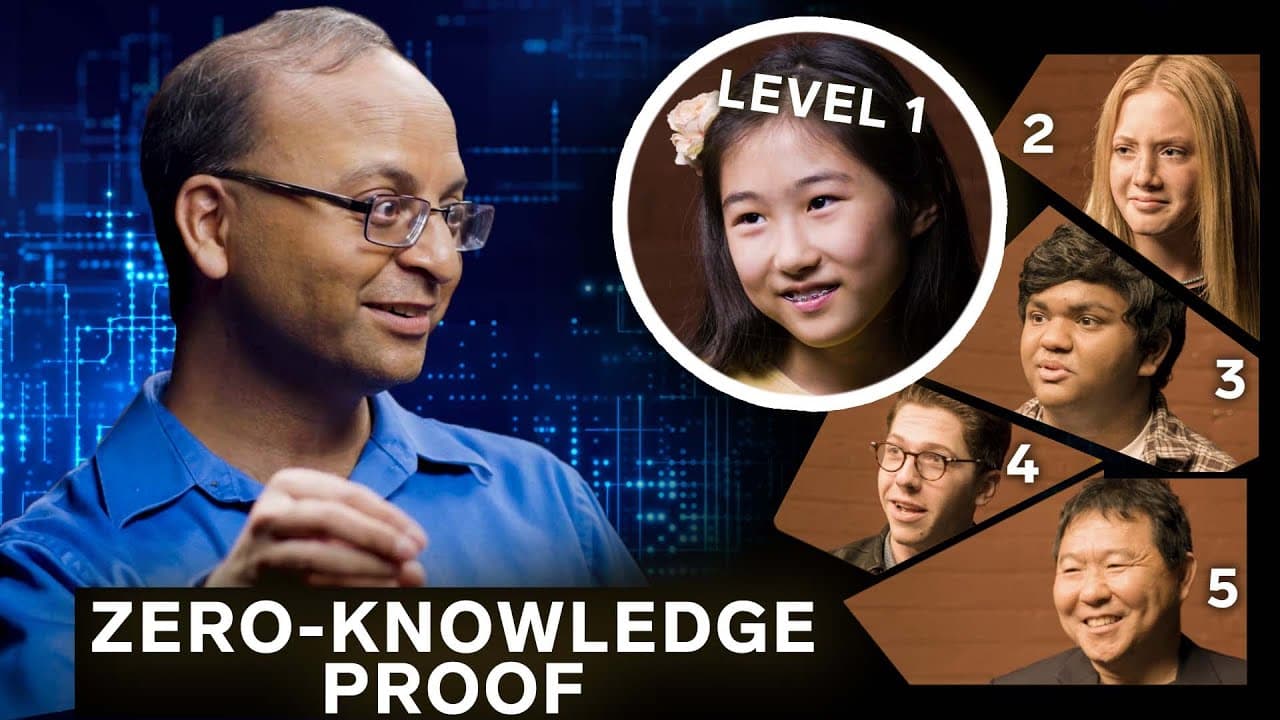
A zero-knowledge proof lets a prover convince a verifier that a statement is true without revealing why it is true or disclosing the underlying secret. The method can use repeated, randomized checks to build confidence while preventing the verifier from combining revealed information, with potential applications in authentication, encrypted communication, blockchains, and cryptocurrency ownership claims.
Transcript
- Hi, my name is Amit Sahai, and I'm a Professor of computer science at the UCLA Samueli School of Engineering. Today, I've been asked to explain zero-knowledge proofs in five levels of increasing complexity. A zero-knowledge proof is a way for a prover to convince a verifier that some statement is true, and yet reveal no additional information bey... Read More
Key Insights
- A zero-knowledge proof is an interaction in which a prover convinces a verifier that a statement is true without revealing additional information about why it is true. Its unusual value comes from separating confidence in a claim from access to the secret supporting that claim.
- The hidden-puffin demonstration is a simple zero-knowledge example because the prover reveals the puffin through a hole while concealing the photograph's position. The verifier confirms that the prover knows the puffin's location but cannot determine that location within the original photograph.
- The locked-box demonstration proves knowledge of a combination without disclosing the combination. The verifier places an unpredictable written message inside, and the prover opens the box and reads it, establishing access while providing no visible information about the actual numbers used to unlock it.
- Zero-knowledge authentication could let a person prove an identity without giving a computer the underlying password. Under the scenario described, compromising that computer would reveal nothing about the password because the computer itself would not receive or retain the secret.
- NP-complete problems are described as difficult problems whose solutions can be used to solve any problem in the class NP. Map three-coloring provides a way to convert many different statements into a common form that can then support a zero-knowledge proof.
- A valid three-colored map assigns colors so that neighboring countries sharing a border never have the same color. A verifier can test a hidden coloring by selecting two neighboring countries and checking that the concealed colors inside their envelopes are different.
- Repeated randomized checks build confidence without exposing the entire witness. The prover changes the color assignments between rounds, so observations from separate checks cannot be combined into a complete coloring, while consistently valid answers across a thousand rounds would be highly convincing.
- Practical zero-knowledge implementations use encryption and mathematics instead of envelopes, posters, or physical lockboxes. The goal is not merely greater efficiency, but the ability to verify claims while preserving secrets in situations involving distrust, encrypted messages, blockchains, and cryptocurrencies.
Install to Summarize YouTube Videos and Get Transcripts
Explore YouTube Video Summarizer or Get YouTube Transcript Extractor
Questions & Answers
Q: What is a zero-knowledge proof in cryptography?
A zero-knowledge proof is a method by which one participant, called the prover, convinces another participant, called the verifier, that a statement is true. The verifier learns no additional information about why the statement is true or about the secret supporting it. The central idea is therefore to establish confidence in a claim without transferring the underlying evidence or secret itself.
Q: How does the hidden-puffin example explain zero knowledge?
The prover knows where a puffin is hidden among many penguins but does not want to reveal its location. The photograph is placed behind a larger poster so that only the puffin appears through a small hole. The verifier sees the puffin and confirms the prover's knowledge, yet cannot determine how the photograph was positioned or where the puffin appears in the original image.
Q: How can someone prove they know a lock combination without revealing it?
The verifier writes an unpredictable secret message, folds it, and places it inside the locked box. The prover uses the undisclosed combination to open the box and report the message. Because the prover could not have known the message beforehand, successfully reading it demonstrates access to the box. The verifier gains confidence that the prover knows the combination without seeing or learning the combination itself.
Q: How could zero-knowledge proofs improve password authentication?
Zero-knowledge authentication could allow a user to prove an identity without directly entering or transmitting a reusable password to the computer. In the scenario described, a person would prove a claim such as being Chelsea while revealing nothing else. If a hacker later compromised the computer, the password would not be available there because even the computer had never learned the underlying secret.
Q: Why is map three-coloring used in a zero-knowledge proof?
Map three-coloring is presented as an NP-complete problem, meaning it is difficult to solve and can represent a broad variety of problems in the class NP. A different statement, such as possessing at least a specified amount of Bitcoin, can be converted into a map that is three-colorable only when that statement is true. The map then provides a common structure for proving the claim.
Q: How does the map three-coloring protocol preserve secrecy?
The prover hides one color inside an envelope for every country. The verifier randomly chooses two neighboring countries and opens only those envelopes to confirm that their colors differ. Before another round, the prover changes the color assignments while preserving a valid coloring. Consequently, information revealed in separate rounds cannot be assembled into the complete secret coloring, although each successful check increases confidence.
Q: Why must a zero-knowledge map proof repeat its checks?
A single check of two neighboring countries offers only limited confidence because it covers a small part of the map. Repeating the test with randomly selected neighboring countries makes continued deception increasingly difficult within the protocol described. If the prover displays different colors correctly through a thousand rounds, the verifier becomes strongly convinced that a valid coloring exists, without opening every envelope or learning the complete arrangement.
Q: Where can zero-knowledge proofs be applied?
The transcript identifies blockchains and cryptocurrencies as active areas for zero-knowledge proofs. It also describes password-free disclosure during authentication, mathematical exchanges of encrypted messages, and proofs of knowledge of an encryption key. Another example is proving ownership of at least a specified Bitcoin amount without revealing the account address, allowing verification of the claim while keeping associated secret information concealed.
Summary & Key Takeaways
-
Zero-knowledge proofs separate verification from disclosure. A prover demonstrates that a statement is true, while a verifier learns nothing beyond that truth. Physical demonstrations involving a hidden puffin and a locked box show how someone can establish knowledge of a location or combination without directly exposing the secret itself.
-
The map three-coloring example introduces a probabilistic protocol. Colors are hidden in envelopes, and the verifier repeatedly chooses neighboring countries to check that their colors differ. The prover changes the color assignments between rounds, preventing the verifier from assembling the complete coloring while steadily increasing confidence that a valid solution exists.
-
The concept has practical relevance to computers, blockchains, cryptocurrencies, and authentication. Mathematical encryption replaces physical locks and envelopes in implementations. A person could prove knowledge of a key, establish identity without submitting a reusable password, or demonstrate possession of a specified Bitcoin amount without revealing the corresponding account address.
-
Key Insights specifically written standalone: no extra item.
-
The remaining output contains exactly eight detailed search-oriented questions and answers.
Read in Other Languages (beta)
Share This Summary 📚
Summarize YouTube Videos and Get Video Transcripts with 1-Click
Try YouTube Summary with ChatGPT & Claude or YouTube Transcript Generator
Explore More Summaries from WIRED 📚

Summarize YouTube Videos and Get Video Transcripts with 1-Click
Try YouTube Summary with ChatGPT & Claude or YouTube Transcript Generator