How to Create and Use Lists in Python
TL;DR
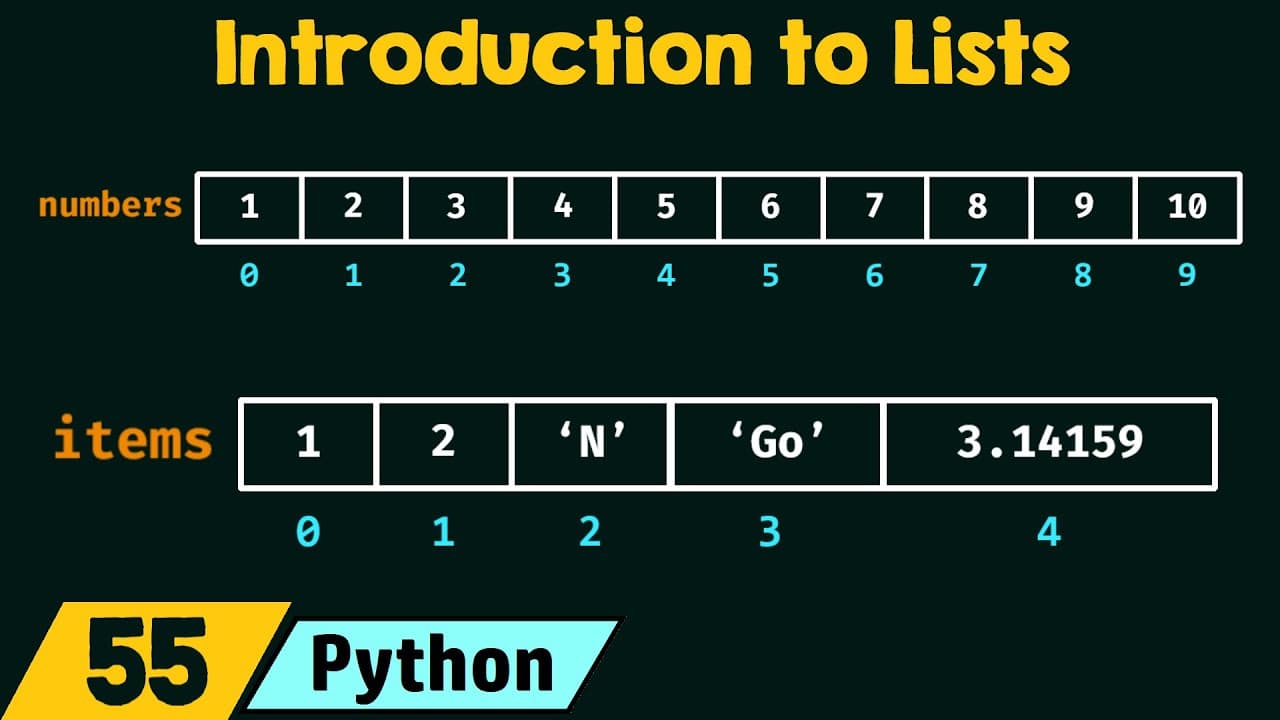
Lists in Python are versatile collections that can store similar or different data types, and they allow duplicate items. You can create a list by placing items in square brackets separated by commas. Key features include mutability, enabling changes to items, and the ability to hold various data types.
Transcript
foreign onwards we will understand lists in Greater details in this presentation I will introduce you to the concepts of lists so without any further delay let's get started the first topic of this presentation is Introduction to lists the second topic is creating a list and the third topic is features of a list let's start with the first topic tha... Read More
Key Insights
- 👂 A list in Python is a collection of similar or different types of data items.
- 👂 Lists can be created by placing items inside square brackets, separated by commas.
- 👂 Lists in Python can store duplicate items.
- 👂 Items in a list are mutable, meaning they can be changed.
Install to Summarize YouTube Videos and Get Transcripts
Explore YouTube Video Summarizer or Get YouTube Transcript Extractor
Questions & Answers
Q: What is a list in Python?
A list in Python is a collection of similar or different types of data items, allowing the storage of duplicate items and varied data types.
Q: How do you create a list in Python?
A list in Python can be created by placing items inside square brackets, separated by commas. For example, [1, 2, 3] would create a list of three integers.
Q: Can a list in Python store duplicate items?
Yes, a list in Python can store duplicate items. This means that the same value can appear multiple times within a list.
Q: Are items in a list mutable in Python?
Yes, items in a list in Python are mutable, meaning they can be changed. This allows for modifications to the values stored in a list.
Q: Can a list in Python store different types of data items?
Yes, a list in Python can store different types of data items. This means that a single list can contain integers, strings, floats, or any other data type.
Key Insights:
- A list in Python is a collection of similar or different types of data items.
- Lists can be created by placing items inside square brackets, separated by commas.
- Lists in Python can store duplicate items.
- Items in a list are mutable, meaning they can be changed.
- Lists can store items of various types, allowing for mixed data types in a single list.
Summary & Key Takeaways
-
Lists in Python are collections of similar or different types of data items, capable of storing duplicate items and varied data types.
-
Lists can be created by placing items inside square brackets, separated by commas.
-
Features of lists include the ability to store duplicate items, mutable items that can be changed, and the capability to store different types of data.
Read in Other Languages (beta)
Share This Summary 📚
Summarize YouTube Videos and Get Video Transcripts with 1-Click
Try YouTube Summary with ChatGPT & Claude or YouTube Transcript Generator
Explore More Summaries from Neso Academy 📚
Summarize YouTube Videos and Get Video Transcripts with 1-Click
Try YouTube Summary with ChatGPT & Claude or YouTube Transcript Generator