How to Structure Meta Ads for Andromeda
TL;DR
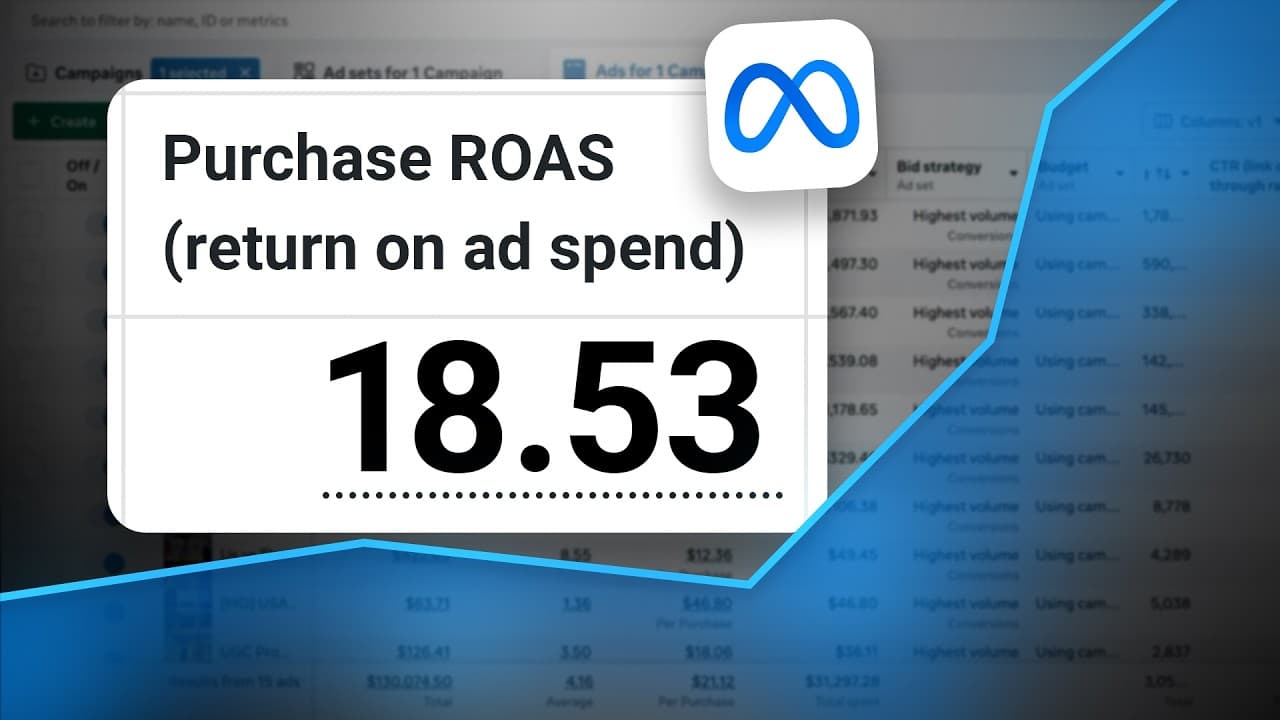
Meta’s Andromeda algorithm rewards ads that combine efficient conversion results with the ability to scale. Use campaign-level budgets with separate ad sets for new creative packs, apply minimums or maximums where needed, multiply proven creative concepts with AI, and avoid unnecessary account changes once performance is strong. Keep feeding the system better creatives, offers, landing pages, and products.
Transcript
If it feels like Facebook's current algorithm is currently working against your account, it's because most advertisers are unknowingly doing things that deprioritize them in this algorithm. I've managed over $500 million in Facebook ads, over $100 million in the Andromeda era of Facebook ads, and the pattern I keep seeing is the same. The brands th... Read More
Key Insights
- Meta’s Andromeda algorithm evaluates both conversion efficiency and scalability. It considers whether an ad can outperform alternatives on the account’s chosen conversion metric and whether that performance can continue as spending increases, rather than rewarding return on ad spend alone.
- A high return on ad spend does not guarantee that an ad will receive substantial budget. Some ads perform efficiently with only a few dollars of spend, but their results deteriorate when advertisers force additional spending because those ads have not demonstrated scalable performance.
- Ad set budget optimization gives advertisers direct control over each ad set’s spending, but it removes substantial budget-allocation responsibility from the algorithm. This can overfund inefficient ad sets while limiting ad sets and ads that have demonstrated stronger performance and an ability to scale.
- Campaign budget optimization is more compatible with algorithmic allocation because the budget is controlled at the campaign level. However, placing every ad inside one campaign and one ad set leaves advertisers with few practical actions beyond launching ads, pausing ads, and changing the total budget.
- A tiered structure creates control without abandoning algorithmic budget distribution. Launching each new creative pack in a separate ad set prevents it from disrupting older launches except through budget allocation and enables differentiated value rules, goals, minimums, and maximums.
- A seven-day minimum budget can ensure that each newly launched ad set receives a small testing allocation. This prevents newly produced creatives from receiving no spend while still allowing the broader campaign budget system to direct most resources according to performance.
- Creative quality at scale is more valuable than creative volume by itself. The agency’s workflow uses leading high-spending image ads as starting points, studies competitor ads for inspiration, and applies AI to produce variations while incorporating established brand colors and other brand-kit elements.
- Stable performance requires restraint after the structure and creative engine are working. Adding bid caps, cost caps, campaigns, structures, or strategies without a performance-driven reason can interfere with progress, while continued investment in creatives, offers, landing pages, and product quality strengthens the inputs.
Install to Summarize YouTube Videos and Get Transcripts
Explore YouTube Video Summarizer or Get YouTube Transcript Extractor
Questions & Answers
Q: How does Meta’s Andromeda algorithm evaluate ads?
Meta’s Andromeda algorithm evaluates whether an ad can achieve the account’s efficiency objective better than competing ads and whether it can scale. The efficiency objective may be return on ad spend, cost per acquisition, or another result tied to the selected conversion event. This dual evaluation explains why an efficient ad may receive limited spending when it has not demonstrated scalable performance.
Q: Why does a high-ROAS Meta ad sometimes receive little spend?
A high-return ad may receive little spend because Meta also assesses whether its results can hold as the budget grows. An ad can perform exceptionally with only a small amount of spending yet deteriorate when more budget is forced toward it. The algorithm may therefore favor another ad that combines acceptable efficiency with a stronger demonstrated capacity to absorb and convert additional spending.
Q: Why can Meta ad performance decline when budgets increase?
Performance can decline during a budget increase when the ads that worked at the lower level cannot maintain their efficiency at a larger scale. The transcript describes accounts performing sustainably at one daily budget and then hitting a wall after an increase. At that point, return on ad spend falls and the advertiser may earn less than at the previous, lower spending level.
Q: Should Meta advertisers use ad set or campaign budgets?
Campaign-level budgeting is presented as more algorithm-friendly because Meta can distribute money across ad sets according to performance and scalability. Setting every budget at the ad set level gives the advertiser more direct control, but it can create inefficiencies by overfunding weaker ad sets and restricting stronger ones. The recommended approach combines campaign budgeting with differentiated ad sets and carefully chosen controls.
Q: Why is a single campaign and single ad set limiting?
A single campaign with one ad set mainly lets the advertiser launch ads, pause ads, and raise or lower the overall budget. It removes useful differentiation between creative groups or audiences. Without separate ad sets, advertisers cannot apply distinct value rules, return goals, target costs, or spending minimums and maximums to particular groups in the way the recommended tiered structure allows.
Q: How should new Meta ad creatives be launched?
Each new round of creatives should be launched as a separate ad set within a campaign budget optimization structure. This pack-based approach keeps older launches intact while allowing the algorithm to distribute the campaign budget. It also creates specific control points for each creative group, including the ability to apply value rules, spending limits, performance goals, or protections against fatigue.
Q: What is the purpose of a seven-day minimum budget?
A seven-day minimum budget forces a newly launched ad set to receive a small portion of testing spend. Its purpose is to prevent newly produced creatives from receiving zero delivery before the system has a meaningful opportunity to evaluate them. The minimum functions as a testing safeguard while the campaign-level budget continues allocating the remaining money based on observed account performance.
Q: How should advertisers scale creative production with AI?
Advertisers should use AI to multiply creative concepts that have already demonstrated quality rather than pursuing volume without direction. The described workflow starts with the five highest-spending image ads, requests iterations, studies competitor advertising for inspiration, and produces slight variations. Brand information, including colors, can guide the outputs so increased volume remains connected to proven performance and the established identity.
Summary & Key Takeaways
-
Meta evaluates an ad based on both efficiency and scalability. An ad can generate a high return on ad spend while receiving little budget if the system does not consider it scalable. Forcing more spend onto such an ad can reduce performance, which explains why advertisers often encounter a wall while increasing budgets.
-
Neither fully manual ad set budgeting nor a single campaign with one ad set provides the desired balance of automation and control. A tiered campaign budget optimization structure separates creative launches into ad sets, preserves existing activity, and supports tools such as value rules, return goals, target costs, and spending limits.
-
Creative quality at scale matters more than producing volume without direction. The recommended workflow starts with proven, high-spending ads, creates variations inspired by successful concepts and competitors, and uses AI to multiply output. Once the account is performing and scaling, advertisers should avoid excessive adjustments and continue improving their core inputs.
Read in Other Languages (beta)
Share This Summary 📚
Summarize YouTube Videos and Get Video Transcripts with 1-Click
Try YouTube Summary with ChatGPT & Claude or YouTube Transcript Generator
Explore More Summaries from Sam Piliero 📚





Summarize YouTube Videos and Get Video Transcripts with 1-Click
Try YouTube Summary with ChatGPT & Claude or YouTube Transcript Generator