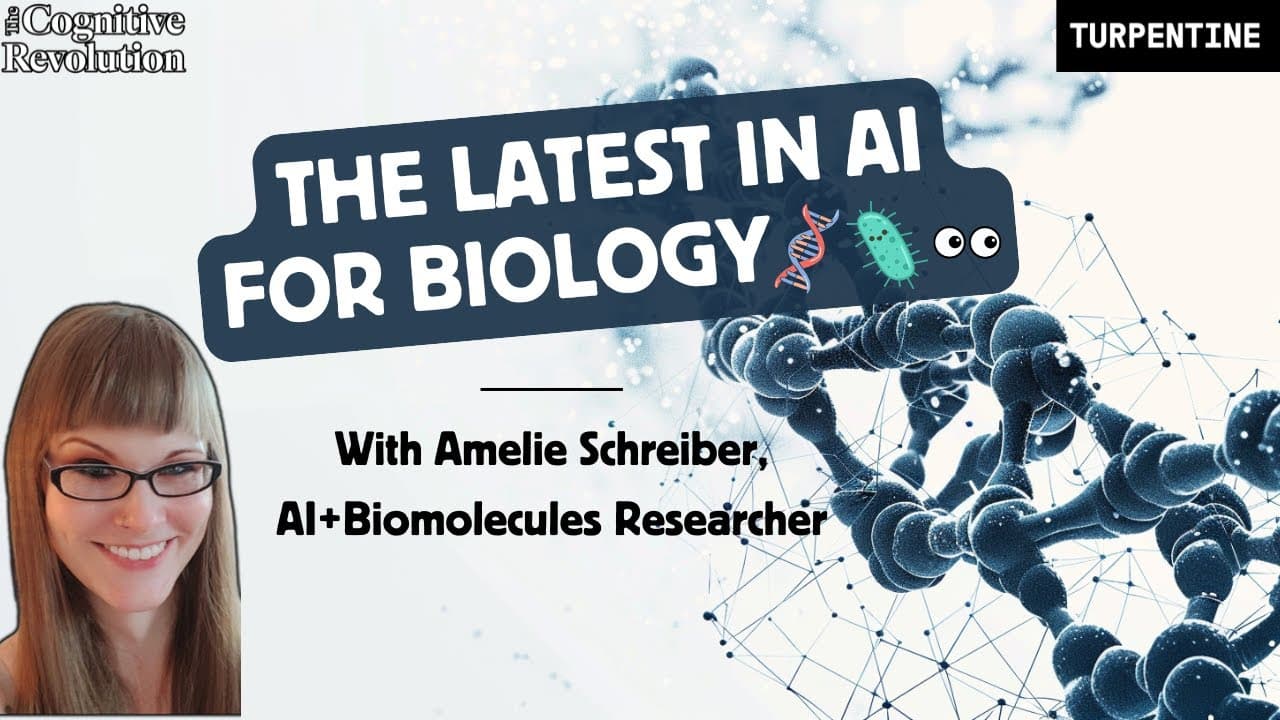
What Are the Frontiers in AI for Biology? Dynamics, Diffusion, and Design with Amelie Schreiber
TL;DR
AI is advancing biology through tools that model molecular structures, dynamics, and design workflows. Amelie Schreiber discusses AlphaFold 3, multimodal ESM3, MDGen, peptide-focused diffusion models, and the prospect of chaining specialized tools into AI-driven protein engineering and drug discovery workflows. Read on to see what each model contributes and why molecular dynamics is becoming a central frontier.
Transcript
I saw people designing mechanical degraders that pulled apart like the needle complex of bacteria so that the bacteria couldn't infect the cell and they were actually able to like pull apart the needle complex of the proteins that they designed and prevent infection if you can scale that process and have an agent drive a big complicated workflow an... Read More
Key Insights
- AlphaFold 3 now predicts complexes of proteins, RNA, DNA, small molecules, and ions, significantly expanding its capabilities.
- ESM3 combines sequence, structure, and function prediction, representing a multimodal approach to understanding proteins.
- Flow matching models offer advantages over diffusion models, including faster inference speeds and better training stability.
- Peptide models like PepFlow and GeoAB are crucial for designing disordered peptides and antibody loops, which are traditionally challenging.
- Molecular dynamics simulations are essential for understanding protein function, as they reveal the dynamic nature of molecular interactions.
- New enzyme design workflows integrate AI models to optimize catalytic site arrangements and dynamic interactions for improved functionality.
- The field is rapidly evolving, with AI-driven workflows and agents poised to automate and scale complex biological design tasks.
- Open-source platforms and collaborative efforts are crucial for advancing AI applications in biology, though much work remains to integrate existing models.
Install to Summarize YouTube Videos and Get Transcripts
Explore YouTube Video Summarizer or Get YouTube Transcript Extractor
Questions & Answers
Q: What are the key frontiers in AI for biology discussed by Amelie Schreiber?
The discussion focuses on molecular dynamics, diffusion-based design, and workflows that connect specialized AI models. Examples include AlphaFold 3, ESM3, MDGen, and models for shorter amino-acid sequences called peptides.
Q: How does AlphaFold 3 expand structure prediction?
AlphaFold 3 extends structure prediction to RNA, DNA, small molecules, metallic ions, and ensembles containing these components. This broadens the paradigm beyond predicting proteins alone.
Q: What does ESM3 combine in a single model?
ESM3 is described as a multimodal model combining protein sequence, structure, and function. It is one example of the rapidly growing set of AI tools for understanding biology at the molecular level.
Q: Why is modeling molecular dynamics important in AI for biology?
Biological molecules are dynamic, so static structures do not capture everything relevant to their behavior. The conversation identifies modeling dynamics, not only structures, as a new frontier and highlights MDGen as a model that accelerates work traditionally performed through computational methods.
Q: Why are peptides difficult to model?
Peptides are shorter sequences of amino acids and are often less structured than larger proteins. That lower degree of structure generally makes them harder to model, motivating diffusion models specialized for peptides.
Q: How could specialized AI models support protein engineering?
Researchers are exploring how to chain specialized models together across an entire protein-design workflow. Such orchestration could make protein engineering more efficient, creative, and responsive to biological details.
Q: What could AI-driven workflows change in drug discovery and enzyme design?
AI-assisted and AI-driven workflows could automate increasingly complicated protein-engineering and drug-discovery tasks. The episode highlights the possibility of designing enzymes that catalyze entirely new reactions and making such work more accessible and affordable over the next few years.
Q: What example shows the potential of AI-designed biological molecules?
The transcript describes designed mechanical degraders that pulled apart a bacterium’s needle complex and prevented infection. It suggests that scaling this process through an agent-directed workflow capable of producing molecules could substantially change biological design.
Summary & Key Takeaways
-
Advancements in AI, such as AlphaFold 3 and ESM3, are revolutionizing biology by enhancing our understanding of molecular interactions and dynamics. These models enable more efficient protein engineering and drug discovery, promising to transform medicine and industrial processes. The integration of AI-driven workflows and agents is expected to automate complex tasks, making them more accessible and scalable.
-
Flow matching models offer significant improvements over traditional diffusion models, providing faster inference speeds and better training stability. New peptide models like PepFlow and GeoAB address challenges in designing disordered peptides and antibody loops, which are critical for various applications. These innovations highlight the potential of AI to solve complex biological problems.
-
The field of AI in biology is rapidly evolving, with open-source platforms and collaborative efforts playing a crucial role in advancing applications. While much work remains to integrate existing models into cohesive workflows, the progress made in recent months indicates a promising future for AI-driven biological research and development.
Read in Other Languages (beta)
Share This Summary 📚
Summarize YouTube Videos and Get Video Transcripts with 1-Click
Try YouTube Summary with ChatGPT & Claude or YouTube Transcript Generator
Explore More Summaries from Cognitive Revolution "How AI Changes Everything" 📚

Summarize YouTube Videos and Get Video Transcripts with 1-Click
Try YouTube Summary with ChatGPT & Claude or YouTube Transcript Generator