How AI Transforms Material Science with Orbital Materials
TL;DR
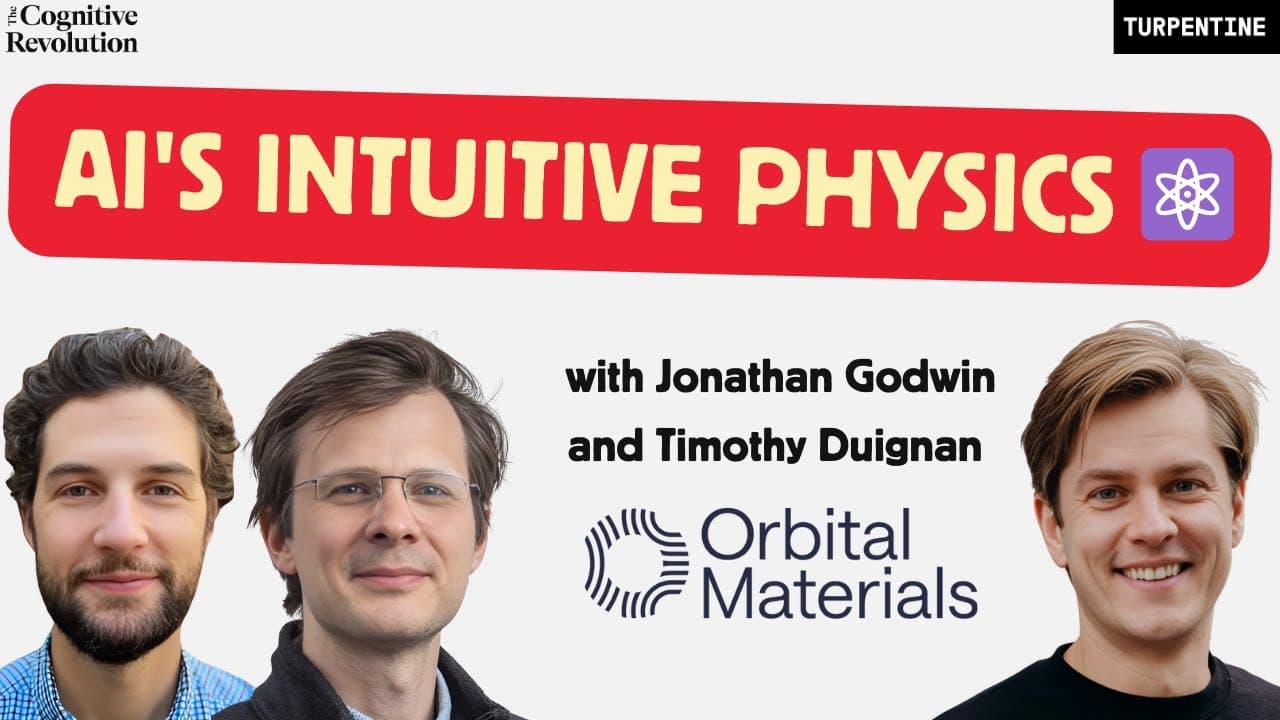
AI is revolutionizing material science by accelerating the discovery and creation of new materials. Orbital Materials is pioneering this transformation, focusing on applications for data centers and carbon capture. Their AI models can simulate complex systems, such as potassium ion channels, enabling faster and more efficient material development. This innovation promises significant advancements in technology and sustainability.
Transcript
finding efficient ways of keeping track of the important information and losing the unimportant information is just a central problem in a lot of physical modeling and I think AI machine learning algorithms are just very good at doing that the thing that completely blew my mind was you know training on small inorganic crystals like 20 atom systems ... Read More
Key Insights
- AI models are dramatically accelerating the discovery of new materials by simulating complex systems efficiently.
- Orbital Materials focuses on creating materials for data centers and carbon capture to enhance sustainability.
- Their AI models use message passing neural networks to predict atomic interactions faster than traditional methods.
- The potassium ion channel simulation revealed new insights, showing AI's potential in biological research.
- AI's ability to generalize from small crystal structures to complex systems like proteins is groundbreaking.
- The integration of AI in material science could lead to significant technological and environmental advancements.
- AI-driven material discovery may change the role of scientists, focusing more on validation than hypothesis generation.
- Future developments could see AI models simulating entire cells, further revolutionizing scientific research.
Install to Summarize YouTube Videos and Get Transcripts
Explore YouTube Video Summarizer or Get YouTube Transcript Extractor
Questions & Answers
Q: How does AI accelerate material discovery?
AI accelerates material discovery by simulating complex systems efficiently, allowing researchers to predict material properties and interactions faster than traditional methods. Orbital Materials uses AI models to generalize from small crystal structures to complex systems, enabling the rapid development of new materials with specific properties for various applications.
Q: What are Orbital Materials' focus areas?
Orbital Materials focuses on developing materials for data centers and carbon capture. Their goal is to enhance sustainability and technological advancement by creating materials that improve data center efficiency and capture carbon emissions. This approach aims to address critical environmental challenges while supporting the growth of AI technologies.
Q: How do AI models simulate complex systems?
AI models simulate complex systems using message passing neural networks, which predict atomic interactions faster than traditional methods. These models can generalize from small crystal structures to larger, more complex systems, such as proteins, enabling researchers to gain insights into material and biological processes with unprecedented speed and accuracy.
Q: What new insights were gained from simulating the potassium ion channel?
Simulating the potassium ion channel with AI revealed new insights, such as the role of water molecules and a specific hydroxy group's involvement in ion transport. These findings help explain longstanding questions about ion channel function and demonstrate AI's potential to advance understanding in biological research and medical applications.
Q: Why is AI's generalization ability significant?
AI's ability to generalize from small crystal structures to complex systems is significant because it allows researchers to apply insights from simple models to larger, more intricate biological and material systems. This capability accelerates the discovery process, enabling the development of advanced materials and solutions to complex scientific challenges.
Q: What impact could AI have on scientific research?
AI could significantly impact scientific research by accelerating the discovery and development of new materials, enhancing understanding of biological processes, and addressing global challenges like climate change. As AI models become more sophisticated, they may enable breakthroughs in clean energy, electronics, medicine, and beyond, transforming various scientific fields.
Q: How might AI change the role of scientists?
AI might change the role of scientists by shifting their focus from hypothesis generation to validation and implementation. As AI models become more capable of generating creative solutions and insights, scientists may spend more time testing and applying these findings, potentially reducing job satisfaction but accelerating scientific progress.
Q: What are the future prospects of AI in material science?
The future prospects of AI in material science include the development of advanced materials for a wide range of applications, from data centers to clean energy. AI models may eventually simulate entire cells, providing deeper insights into biological processes and enabling new medical and technological innovations. This progress could revolutionize scientific research and address critical global challenges.
Summary & Key Takeaways
-
AI is transforming material science by enabling faster discovery and development of new materials. Orbital Materials uses AI to create materials for data centers and carbon capture, focusing on sustainability and technological advancement. Their models simulate complex systems efficiently, providing insights into biological processes such as potassium ion channels.
-
Orbital Materials' AI models, using message passing neural networks, predict atomic interactions faster than traditional computation, unlocking potential advancements in clean energy, electronics, and medicine. The ability to generalize from small crystal structures to complex systems is a significant breakthrough for scientific research.
-
The integration of AI in material science could lead to major technological and environmental advancements. While scientists may shift from hypothesis generation to validation, the potential to accelerate scientific progress and address global challenges makes this a worthy trade-off.
Read in Other Languages (beta)
Share This Summary 📚
Summarize YouTube Videos and Get Video Transcripts with 1-Click
Try YouTube Summary with ChatGPT & Claude or YouTube Transcript Generator
Explore More Summaries from Cognitive Revolution "How AI Changes Everything" 📚





Summarize YouTube Videos and Get Video Transcripts with 1-Click
Try YouTube Summary with ChatGPT & Claude or YouTube Transcript Generator