How Safe Are Self-Driving Cars Today?
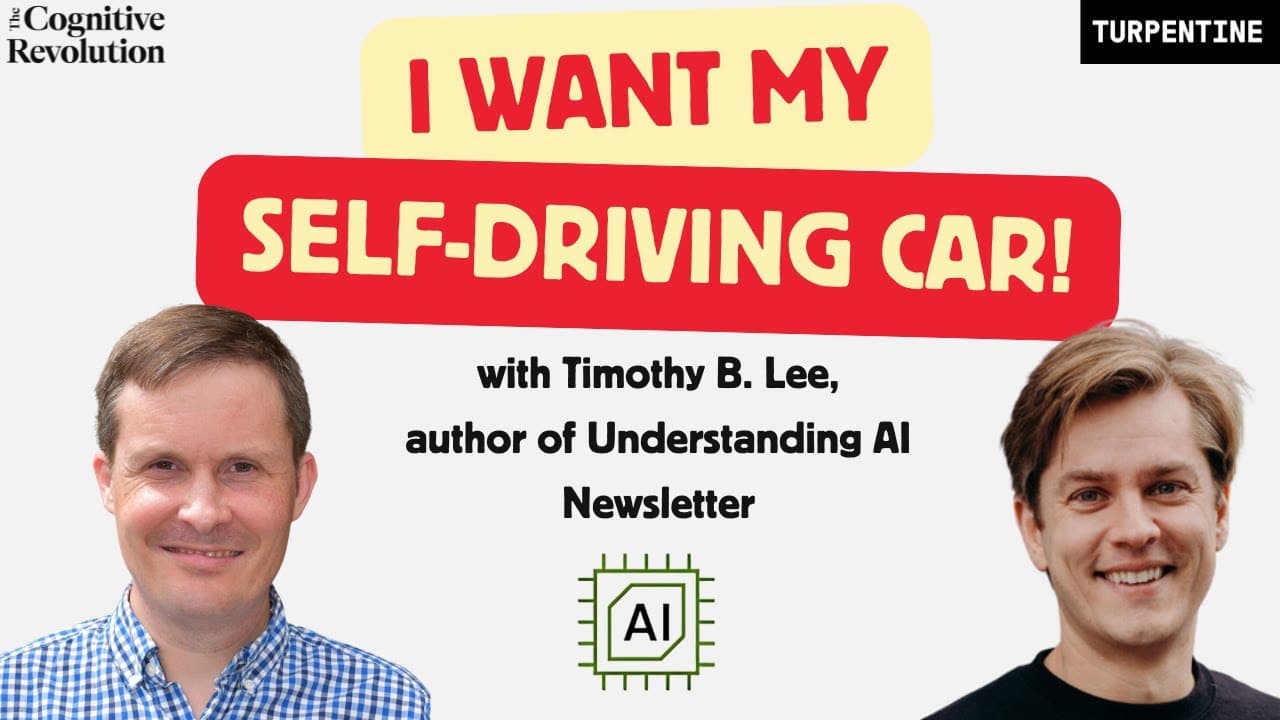
TL;DR
Self-driving cars, led by companies like Waymo and Tesla, are making significant strides in safety and technology. Waymo's approach, using lidar and a comprehensive sensor suite, shows promising safety statistics, while Tesla's camera-only strategy benefits from a vast data pool. However, challenges remain, especially in handling complex edge cases and freeway driving. Regulatory environments are not the primary barrier; instead, technological and cultural factors play a more significant role in adoption.
Transcript
hello and welcome to the cognitive Revolution where we interview Visionary researchers entrepreneurs and Builders working on the frontier of artificial intelligence each week we'll explore their revolutionary ideas and together we'll build a picture of how AI technology will transform work life and Society in the coming years I'm Nathan lens joined... Read More
Key Insights
- Waymo uses a combination of lidar, radar, and cameras to create a detailed 3D model of the surroundings, enhancing safety and precision.
- Tesla relies on a camera-only approach, leveraging its vast fleet for data collection to improve its self-driving capabilities.
- Waymo's cars have driven over 20 million miles without a fatal accident, with injury crashes occurring every 2.4 million miles.
- Self-driving cars face challenges in complex scenarios, such as emergency scenes, requiring advanced reasoning and prediction.
- The regulatory environment is more permissive than commonly perceived, with companies voluntarily halting operations when issues arise.
- Maps play a crucial role in navigation, with Waymo using high-definition maps and Tesla utilizing crowd-sourced data for its navigation system.
- The expansion of self-driving services is limited by technological readiness and the logistical challenges of scaling operations.
- Cultural acceptance and understanding of self-driving technology remain significant barriers to widespread adoption.
Install to Summarize YouTube Videos and Get Transcripts
Explore YouTube Video Summarizer or Get YouTube Transcript Extractor
Questions & Answers
Q: How does Waymo ensure the safety of its self-driving cars?
Waymo employs a comprehensive sensor suite, including lidar, radar, and cameras, to create a detailed 3D model of the surroundings. This approach allows for precise distance measurements and object recognition, enhancing safety. Waymo's cars have driven over 20 million miles without a fatal accident, and their injury crash rate is significantly lower than that of human drivers.
Q: What are the main challenges facing self-driving cars today?
Self-driving cars face several challenges, including handling complex scenarios like emergency scenes, ensuring safety on freeways, and achieving cultural acceptance. Technological readiness, particularly in reasoning and prediction, is crucial for overcoming these hurdles. While regulatory environments are relatively permissive, companies must focus on refining their technology to meet safety standards.
Q: How do Tesla's and Waymo's approaches to self-driving technology differ?
Tesla relies on a camera-only approach, leveraging its extensive fleet for data collection to improve its self-driving capabilities. In contrast, Waymo uses a combination of lidar, radar, and cameras to create a detailed 3D model of the surroundings, enhancing safety and precision. Both companies face unique challenges and advantages in their strategies.
Q: What role do maps play in self-driving car navigation?
Maps are crucial for self-driving car navigation. Waymo uses high-definition maps to ensure precise navigation and safety, while Tesla utilizes crowd-sourced data to create a navigation system. Both companies update their maps regularly, with Waymo's approach allowing for automated data collection and integration from its fleet.
Q: Are regulatory environments a barrier to self-driving car adoption?
Regulatory environments are not the primary barrier to self-driving car adoption. The industry operates under a self-certification model, with states regulating drivers and the federal government overseeing vehicle design. Companies like Waymo and Tesla have demonstrated that technological readiness and cultural acceptance are more significant factors in adoption.
Q: How safe are self-driving cars compared to human drivers?
Self-driving cars, particularly Waymo's, have demonstrated a strong safety record. Waymo's cars have fewer injury crashes than human drivers, with a rate of one injury crash every 2.4 million miles. However, due to the rarity of fatal crashes, it's challenging to statistically prove superiority over human drivers, though current data suggests they are safer.
Q: What is the cultural perception of self-driving cars?
Cultural perception of self-driving cars is mixed, with some viewing them as a futuristic marvel and others expressing skepticism about their safety and reliability. The limited geographical deployment and technological readiness contribute to this perception. Overcoming cultural barriers and increasing public understanding are crucial for broader adoption.
Q: What is the future of self-driving car services?
The future of self-driving car services depends on overcoming technological challenges, particularly in freeway driving and complex edge cases. Companies like Waymo and Tesla must continue refining their technology to meet safety and reliability standards. As these challenges are addressed, the expansion of services is expected, potentially transforming transportation.
Summary & Key Takeaways
-
Self-driving technology, led by Waymo and Tesla, is advancing rapidly, with Waymo showcasing impressive safety statistics. Their approach uses lidar, radar, and cameras to ensure precision and safety, while Tesla's camera-only method benefits from its extensive fleet data. Despite regulatory flexibility, technological and cultural challenges hinder rapid adoption.
-
Waymo's self-driving cars have demonstrated a strong safety record, with significantly fewer injury crashes compared to human drivers. However, the technology still struggles with complex scenarios like emergency scenes, highlighting the need for advanced reasoning capabilities. The regulatory landscape is not as restrictive, allowing companies to test and expand cautiously.
-
The future of self-driving cars depends on overcoming technological hurdles, particularly in freeway driving and complex edge cases. Cultural acceptance and understanding remain critical for broader adoption. While regulatory environments are accommodating, companies like Waymo and Tesla must continue refining their technology to meet safety and reliability standards.
Read in Other Languages (beta)
Share This Summary 📚
Summarize YouTube Videos and Get Video Transcripts with 1-Click
Try YouTube Summary with ChatGPT & Claude or YouTube Transcript Generator
Explore More Summaries from Cognitive Revolution "How AI Changes Everything" 📚






Summarize YouTube Videos and Get Video Transcripts with 1-Click
Try YouTube Summary with ChatGPT & Claude or YouTube Transcript Generator