How Can AI Revolutionize Gaming Strategies?
TL;DR
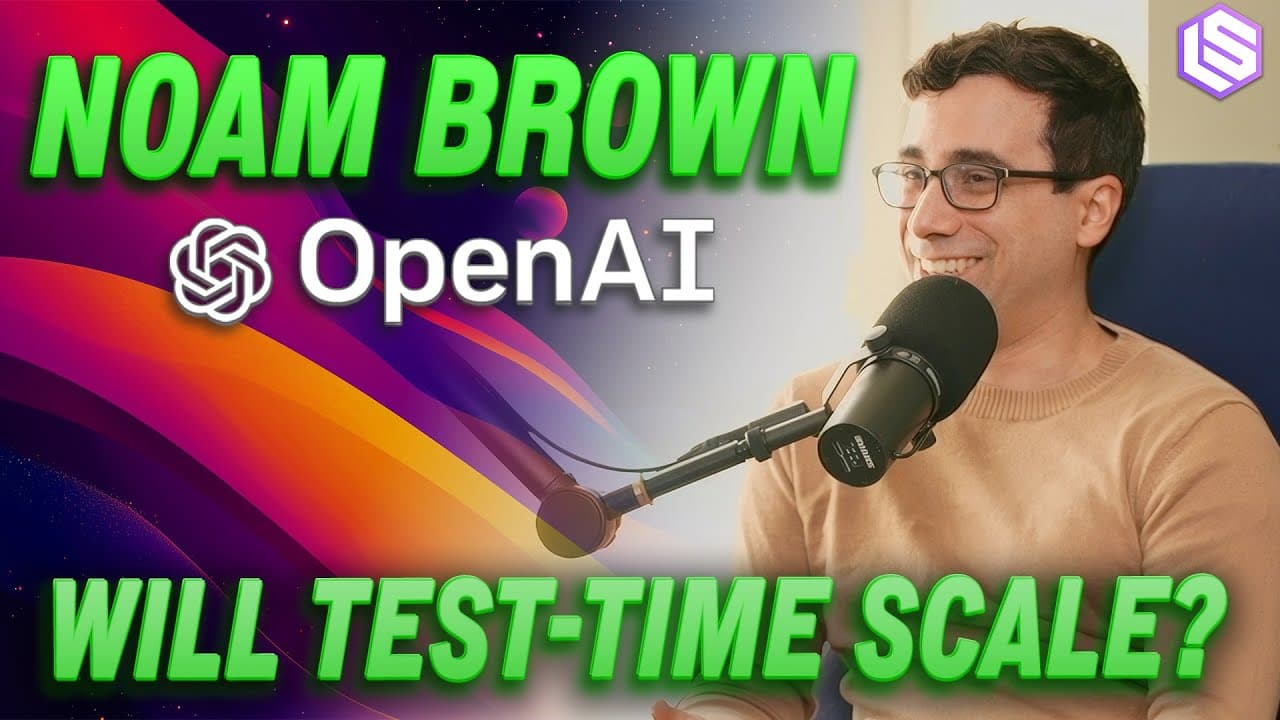
AI has the potential to transform gaming strategies by enhancing human decision-making and adapting complex reasoning methods. Noam Brown discusses the shift from quick, heuristic approaches to profound reasoning processes, emphasizing the importance of advanced models and reinforcement fine-tuning for creating adaptable systems. These developments might lead to an AI civilization that evolves through competition and cooperation, similar to human societies.
Transcript
hey everyone welcome to the L and Space podcast this is Allesio partner and CTO of Deible and I'm joined by my co-host Spooks founder of Small AI hello hello and we are here recording on a holiday Monday with Nan Brown from OpenAI welcome thank you so glad to have you finally join us uh a lot a lot of people have heard you you've been rather genero... Read More
Key Insights
- Noam Brown's work on AI for games like Diplomacy and Poker has enhanced both AI and human strategies, showcasing AI's potential to improve human strategic thinking.
- The limitations of early language models in passing the Turing Test highlight the importance of advanced reasoning models for more reliable AI interactions.
- Brown emphasizes the need for a paradigm shift from system 1 (fast thinking) to system 2 (slow reasoning) in AI to handle complex tasks effectively.
- AI's current reliance on scaffolds and routers is seen as a temporary measure, with future advancements expected to eliminate the need for such support structures.
- Reinforcement fine-tuning is a promising area for AI development, allowing for more adaptable and specialized models based on specific datasets.
- The concept of AI civilization suggests that AI systems could evolve through competition and cooperation, similar to human societal development.
- Challenges in scaling test-time compute include balancing cost and time, with the need for more efficient models that can think longer without significant resource increases.
- The development of implicit world models and theory of mind in AI is crucial for understanding and interacting with complex environments and other agents.
Install to Summarize YouTube Videos and Get Transcripts
Explore YouTube Video Summarizer or Get YouTube Transcript Extractor
Questions & Answers
Q: How has Noam Brown's experience with AI in games influenced his personal gameplay?
Noam Brown's experience with AI, particularly in games like Diplomacy, has significantly improved his understanding and gameplay. By observing AI strategies and behaviors, he has learned new tactics and approaches that have enhanced his personal play, leading to successes such as winning the world championship.
Q: What challenges did early language models face in passing the Turing Test?
Early language models struggled with the Turing Test due to limitations in language understanding and reasoning. These models often produced bizarre responses or failed to maintain coherent conversations, leading to failures in mimicking human-like interactions. Advancements in reasoning models have since improved these capabilities.
Q: What is the significance of the system 1 and system 2 paradigm in AI?
The system 1 and system 2 paradigm in AI refers to fast, heuristic-based thinking versus slower, deliberate reasoning. Brown highlights the need for AI to transition towards system 2 thinking to handle complex tasks that require deeper understanding and problem-solving abilities, moving beyond simple heuristic approaches.
Q: Why is the current reliance on scaffolds and routers in AI seen as temporary?
The reliance on scaffolds and routers is considered temporary because future advancements in AI are expected to eliminate the need for such support structures. As AI models become more capable and efficient, they will be able to perform tasks without the need for additional scaffolding, streamlining their operations.
Q: What role does reinforcement fine-tuning play in AI development?
Reinforcement fine-tuning plays a crucial role in AI development by allowing models to adapt and specialize based on specific datasets. This process enhances the model's ability to perform tasks more effectively and efficiently, making them more useful in various applications and environments.
Q: What is the concept of AI civilization?
AI civilization refers to the idea that AI systems could evolve through competition and cooperation, similar to human societal development. By interacting and learning from each other, AI could build upon collective knowledge and capabilities, leading to advancements in AI intelligence and problem-solving abilities.
Q: What are the challenges in scaling test-time compute for AI?
Scaling test-time compute for AI involves balancing the costs and time required for models to think longer and solve complex problems. As models become more capable, they need to be more efficient, allowing them to perform tasks without significant increases in resource consumption or processing time.
Q: Why are implicit world models important for AI development?
Implicit world models are important for AI development because they enable AI systems to understand and interact with complex environments and other agents. These models help AI develop theory of mind, allowing them to anticipate and respond to the actions and intentions of others, enhancing their overall capabilities.
Summary & Key Takeaways
-
Noam Brown discusses his work on AI in games like Diplomacy and Poker, highlighting AI's ability to improve human strategies and the challenges of creating superhuman AI players. He also explores the limitations of early language models and the importance of reasoning paradigms.
-
Brown emphasizes the need for AI to transition from fast, heuristic-based thinking to slower, more deliberate reasoning to handle complex tasks effectively. He discusses the reliance on scaffolds and routers in current AI systems and the potential for reinforcement fine-tuning to create more adaptable models.
-
The concept of AI civilization is introduced, suggesting that AI systems could evolve through competition and cooperation, similar to human societal development. Brown also discusses the challenges of scaling test-time compute and the importance of developing implicit world models for AI.
Read in Other Languages (beta)
Share This Summary 📚
Summarize YouTube Videos and Get Video Transcripts with 1-Click
Try YouTube Summary with ChatGPT & Claude or YouTube Transcript Generator
Explore More Summaries from Latent Space 📚

Summarize YouTube Videos and Get Video Transcripts with 1-Click
Try YouTube Summary with ChatGPT & Claude or YouTube Transcript Generator